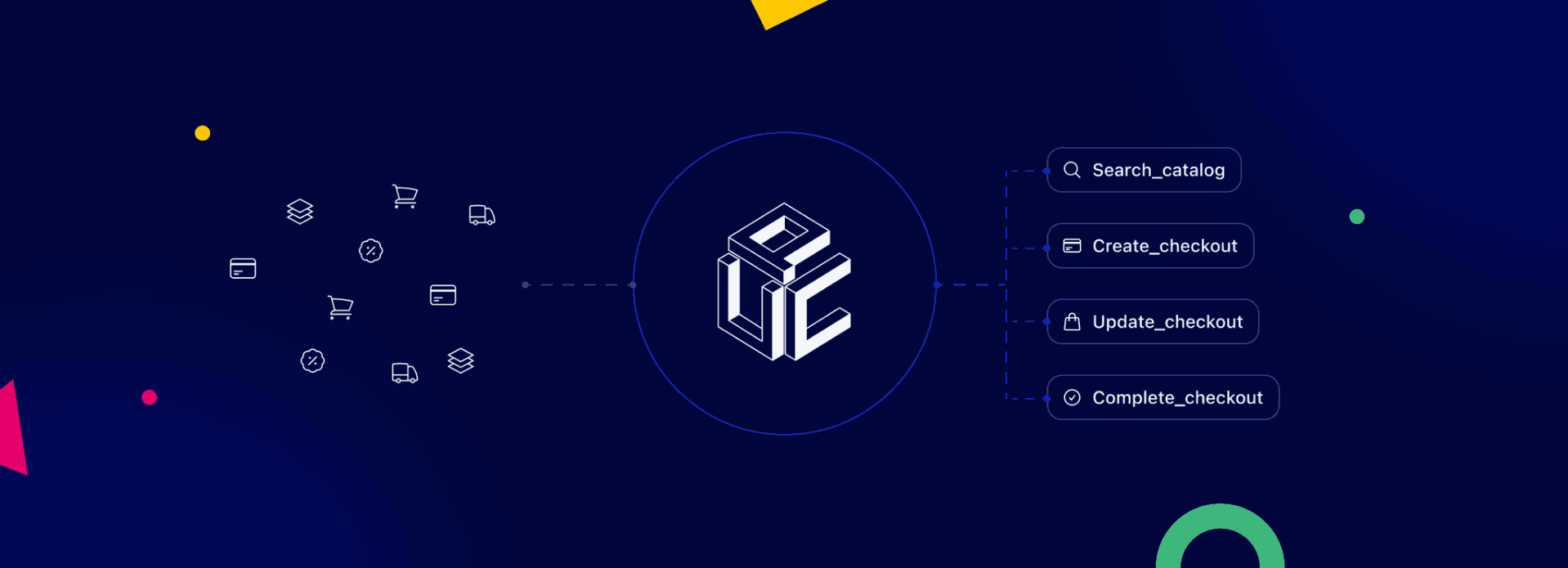
Despite the rise of AI in every aspect of our economy and everyday lives, the use of AI in the retail world has been limited because merchants’ product data lives in isolated systems, making it difficult for AI shopping agents to understand and compare items. Small and mid-sized merchants, in particular, have struggled to access advanced AI tools due to the complexity of integrating inconsistent and disconnected data sources.
To fix this, Google and Shopify have co‑developed the Universal Commerce Protocol (UCP), an open‑source standard that gives AI agents and merchants a common language. UCP is more than another API - it standardizes the entire transaction stack: discovery, authentication, payment and fulfillment.
What UCP does and who’s behind it
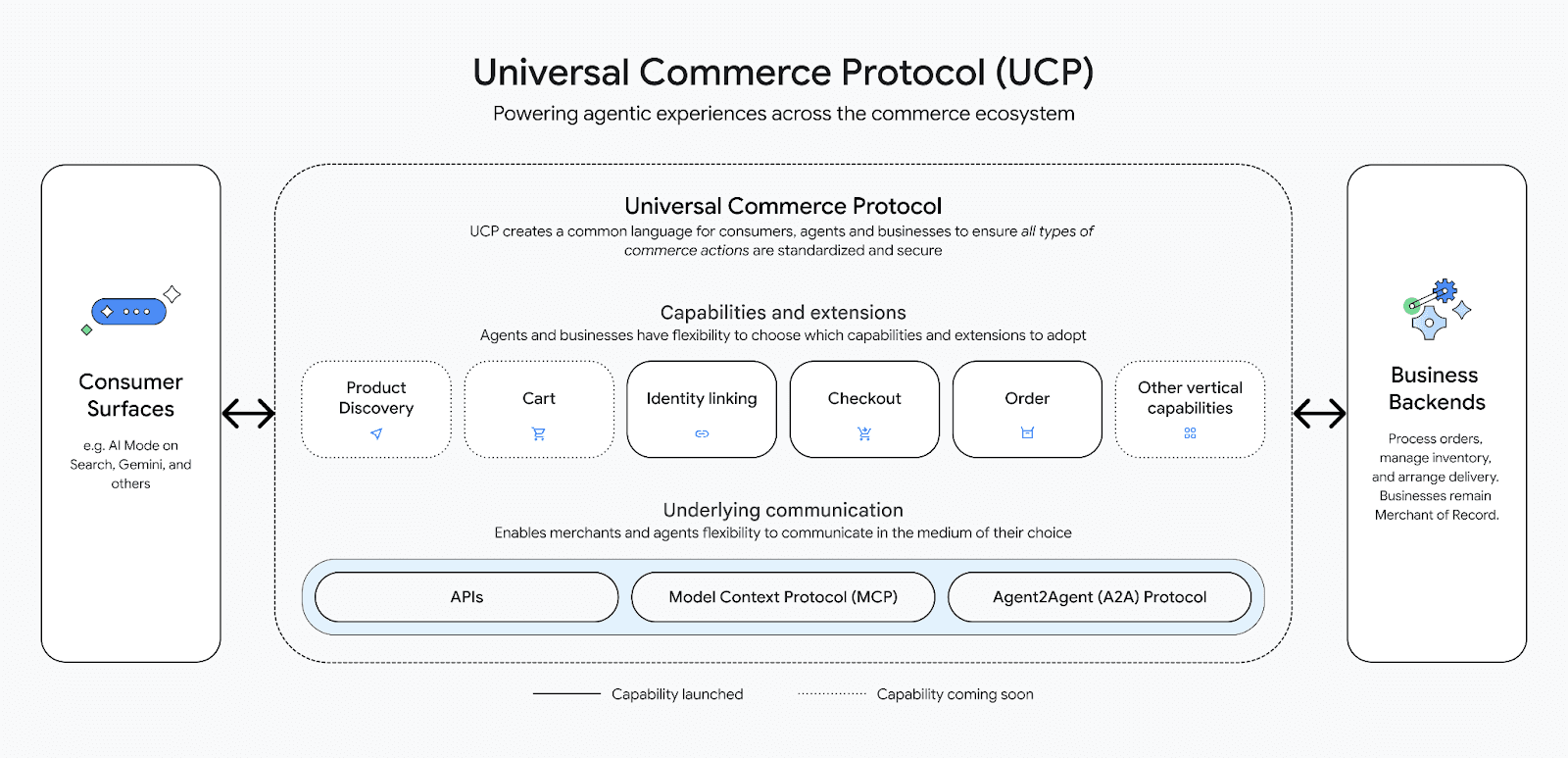
UCP establishes shared data formats and functional primitives that let AI agents, retailers and payment providers communicate seamlessly and it’s compatible with existing agent protocols.
Inside Google for Developers Blog
The standard is being built with broad industry support. Alongside Google and Shopify, UCP is co‑developed or endorsed by major retailers such as Etsy, Wayfair, Target and Walmart and payment networks including Visa, American Express and Stripe. Forbes notes that backing from such companies indicates that UCP is becoming an infrastructure layer rather than just another integration point.
Why this standard matters
Universal language for agentic commerce: Until now, AI-powered shopping agents often delivered unreliable results because retailers described products in wildly different ways. One store might sell a “navy blue cotton shirt,” while another lists the same item as “midnight blue apparel.” Without a shared structure, AI systems can’t reliably compare pricing, availability, or product attributes. UCP fixes this by standardizing product data, enabling agents to compare inventory, pricing and attributes across merchants.
Unified integration across platforms: Instead of building separate connections for each platform, merchants integrate once with UCP. The protocol collapses the N × N integration problem by providing a single abstraction layer, reducing technical overhead for small and mid‑sized businesses.
Extensible and secure by design: UCP separates core capabilities (checkout, orders and identity linking) from extensions like fulfillment and discounts, allowing merchants to implement only what they need. Security features include tokenized payments and OAuth‑based identity linking.
Businesses still own their data: Business ownership and trust remain central. Retailers retain full control of their checkout experience and remain the merchant of record. Customers benefit from frictionless shopping while merchants maintain their data and brand relationship.
Key benefits
Adopting the Universal Commerce Protocol delivers immediate, tangible benefits across the retail ecosystem:
Improved Product Discovery: When AI agents can clearly understand your inventory, your products are more likely to surface in highly specific, natural-language searches.
Lower Integration Complexity: Retailers no longer need costly, custom-built middleware to connect their Shopify stores with Google’s AI-powered search and discovery tools.
Faster checkout with loyalty features: UCP supports discount codes, loyalty credentials, subscription billing and pre‑order terms within chat interfaces. It also provides accurate real-time product inventory data that prevents annoying out-of-stock experiences.
Reduced cart abandonment: By minimizing context switching—letting shoppers go from discovery to purchase without leaving the conversation—UCP aims to lower abandonment rates.
Multi‑modal shopping: UCP supports voice, chat and embedded in‑app purchases, enabling merchants to reach customers across AI assistants, search, and social platforms.
UCP’s latest developments and implementations
Google’s January 2026 announcement previewed several UCP‑powered products:
UCP‑powered checkout in Google’s AI Mode and Gemini app – soon shoppers will buy directly from eligible U.S. retailers while researching on Google. Google Pay and PayPal will handle secure payments, with retailers maintaining control of the sale.
Business Agent on Google Search – brands can deploy a branded AI chat agent that answers product questions and completes purchases.
New Merchant Center attributes – dozens of new data fields (e.g., answers to common questions, compatible accessories) are being introduced to improve discovery in conversational commerce.
Direct Offers pilot – advertisers can present exclusive deals directly in AI Mode, helping close sales.
Shopify is integrating UCP across its ecosystem and is one of the key steps in Shopify's own AI toolset investment:
Agentic Storefronts & Agentic plan – Shopify’s plan lets merchants on any platform list products in the Shopify Catalog and sell across AI channels without owning a Shopify store.
Microsoft Copilot Checkout – UCP enables embedded checkout within Microsoft’s Copilot assistant.
Future verticals – Shopify emphasises that UCP is designed to handle not just retail but any commerce vertical, from subscriptions to services.
How UCP works
At its core, UCP defines three capabilities and a set of extensions:
Checkout – handles cart creation, dynamic pricing (taxes, discounts) and payment steps in one session.
Identity Linking – uses OAuth 2.0 to let customers link their account on an AI platform to the merchant, enabling loyalty points or order history retrieval without sharing passwords.
Order – provides webhook‑based updates for order status (shipped, delivered, returned).
Extensions add optional functionality such as discounts, buyer consent preferences and fulfilment options.
When an AI agent contacts a merchant, the agent and merchant exchange profiles declaring what capabilities they support. UCP automatically negotiates the overlap. If an agent can’t handle a particular step (like choosing a delivery window), UCP seamlessly hands the shopper over to the merchant’s embedded checkout and returns to the agent afterward.
Preparing your store: Tagging & documentation
To adopt UCP, merchants must structure product data and checkout flows according to the specification. Shopify and Google recommend:
Standardizing product attributes (color, material, size) and avoiding ambiguous descriptions.
Exposing your catalog via UCP’s
/.well-known/ucp profile, declaring supported capabilities and optional extensions.Using the checkout, identity linking and order APIs or their Shopify equivalents to power transactions.
The official UCP documentation provides step‑by‑step guides and reference implementations. Shopify’s engineering post also explains how merchants declare capabilities and how agents discover them. While the protocol is technical under the hood, the goal is to enable merchants to integrate once and speak the “agentic commerce” language everywhere.
Final thoughts for E‑commerce owners
The launch of the Universal Commerce Protocol marks a meaningful shift in how AI and e-commerce work together. By replacing fragmented product data with a shared, open standard, Google and Shopify are addressing one of the biggest obstacles that has held AI-powered retail back.
For merchants, this isn’t just a technical upgrade - it’s a strategic opportunity. Clearer product data means better visibility, smoother integrations, and more reliable shopping experiences for customers. For the broader ecosystem, it signals a move toward a more open, competitive, and accessible future where advanced AI tools are no longer reserved for the largest players.
As AI shopping agents become a more common entry point for consumers, standards like the Universal Commerce Protocol will play a critical role in determining who gets discovered, trusted, and chosen. Retailers that embrace this shift early will be better positioned to compete in an AI-first commerce landscape that’s already taking shape.

" height="200.00000219726564px" id="j9Mmwfnw8" transform="translate(143.5 0)" width="479.5329973144531px"/><path d="M 0 15.944 C 0 7.139 7.154 0 15.98 0 C 24.804 0 31.959 7.138 31.959 15.943 L 31.959 59.637 C 31.959 68.442 39.113 75.58 47.938 75.58 C 56.763 75.58 63.917 68.442 63.917 59.637 L 63.917 15.944 C 63.917 7.139 71.071 0.001 79.897 0.001 C 88.721 0.001 95.875 7.139 95.875 15.944 L 95.875 56.095 C 95.875 82.51 74.413 103.923 47.938 103.923 C 21.462 103.923 0 82.51 0 56.095 Z" fill="rgb(59, 63, 91)" height="103.923px" id="KJCDMITFE" transform="translate(0 53)" width="95.875px"/><path d="M 0 15.943 C 0 7.138 7.154 0 15.979 0 C 24.804 0 31.958 7.138 31.958 15.943 C 31.958 24.748 24.804 31.886 15.979 31.886 C 7.154 31.886 0 24.748 0 15.943 Z" fill="rgb(252, 200, 0)" height="31.885999999999996px" id="q2K9EYOvZ" transform="translate(0 53)" width="31.95799999999963px"/><path d="M 0 15.943 C 0 7.138 7.154 0 15.979 0 C 24.804 0 31.958 7.138 31.958 15.943 C 31.958 24.748 24.804 31.886 15.979 31.886 C 7.154 31.886 0 24.748 0 15.943 Z" fill="rgb(63, 184, 126)" height="31.885999999999996px" id="bBya7XCj7" transform="translate(64 53)" width="31.95799999999963px"/><path d="M 0 14.171 C 0 6.344 6.359 0 14.204 0 C 22.048 0 28.407 6.344 28.407 14.171 C 28.407 21.997 22.048 28.342 14.204 28.342 C 6.359 28.342 0 21.997 0 14.171 Z" fill="rgb(229, 0, 106)" height="28.341999999999985px" id="WNzwBFOi7" transform="translate(34.5 128.5)" width="28.407000000000153px"/></g></svg>)