A report shows your site is loading slowly on phones.
A session recording shows the page jumping around after your latest update.
A check finds parts of the site that respond slowly when users click or tap.
Sounds familiar?
In website optimization, spotting the issue is important, but it’s rarely the hardest and most time-consuming part. The real challenge is turning that insight into a fix that’s safe, measurable, and doesn’t quietly impact something else (tracking, revenue, UX) along the way.
That gap between “we detected a problem” and “the issue is fixed and verified” is where much of the time and effort in web optimization is spent.
This is where agentic AI is starting to make a difference. Agentic systems fit into existing optimization workflows, helping teams analyze issues, suggest next steps, and support testing and validation. The result is a much faster path from detecting a problem to confirming that the fix actually worked, with safer testing, measurable outcomes, and greater confidence that changes improve both user experience and business metrics.
To understand why, it helps to look more closely at what agentic AI actually is and how it works.
What is agentic AI
Agentic AI refers to AI systems that help complete tasks, instead of producing a single response and stopping there.
In practice, this means the AI works in a loop. An AI agent can break a task into steps, use available tools to gather information or perform actions, evaluate whether the result moved closer to the desired outcome, and then decide what to do next. This process continues until the objective is reached, a stopping condition is met, or a guardrail triggers human review.
How does agentic AI differ from generative AI
Agentic AI isn’t just a chatbot with a better vocabulary and manners. Unlike generative AI, which typically produces a single output such as text, code, or a summary, agentic AI focuses on helping move work forward.
To better illustrate this distinction, let’s apply it to a practical workflow.
Generative AI systems are designed to respond to prompts. You ask a question, and the system generates an answer, a piece of code, or a suggested solution. Once the AI responds to that question, the interaction usually stops unless a human asks the next question or decides what to do with the output.
Agentic systems work differently. Instead of simply responding to a prompt, they are designed to pursue a goal. They gather context, decide what to do next, take action through available tools, and check whether that goal was achieved. If not, it continues the process until the objective is reached or a human review step intervenes.
In simple terms, generative AI is good at producing answers. Agentic AI is designed to help turn those answers into progress toward a specific outcome.
How agentic AI works: the role of AI agents
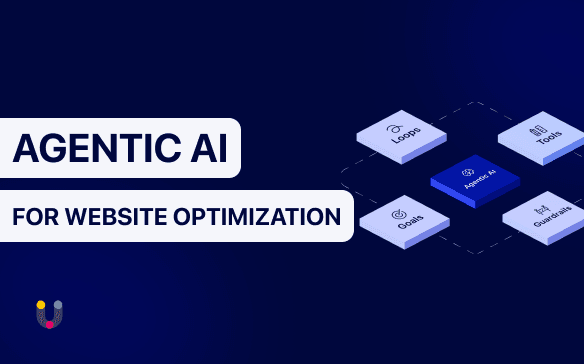
Agentic AI relies on AI agents - specialized machine learning models designed to solve specific tasks by working within set boundaries and following a clear process, consisting of four pillars: a goal, a loop, tools, and guardrails.
The goal
The primary shift in agentic AI is moving from generating outputs (like a block of text) to achieving outcomes (like a faster webpage). You provide the agent with a high-level objective, for example to reduce cumulative layout shift (CLS) on mobile article pages to under 0.1, and the agent then treats this goal as its north star, guiding every subsequent decision it makes.
The loop
Instead of a straight line from question to answer, agents operate in a continuous motion:
Agents observe by collecting context. In web optimization, that could mean pulling Core Web Vitals (CWV) data, crawling templates, reviewing recent releases, or running a performance audit.
They plan by deciding what to do next (for example: “confirm whether interaction delays correlate with a new third-party script”).
They act by using a tool to assist the workflow (querying a dataset, running a test, or drafting a patch for review).
They verify by checking whether the result moved towards the goal, then deciding whether to continue.
This continuous loop ensures the system follows predictable optimization steps rather than acting randomly.
The tools
Agents need access to clearly defined tools such as APIs, performance audits, datasets, or scripts. Without tools, an AI system can only suggest ideas; with tools, it can actually help execute optimization steps.
The guardrails
When agents can suggest or implement changes to a website, safety checks are essential. Human-in-the-loop reviews, permission controls, and staging environments ensure that any proposed fix is validated before reaching production.
To visualize this in action, think of an AI agent as a highly capable employee assigned to a specific task. They don't just hand you a list of problems; they use their available tools to investigate, draft solutions, and determine the next steps independently. However, because you remain responsible for the final outcome, the agent is programmed to check in for approval whenever a decision impacts your live site.
In a web optimization workflow, this means the AI moves beyond simple reporting. For example, if layout shifts worsen on an article page, the agent can automatically pinpoint the cause, test a potential fix in a staging environment, and verify the performance improvement before ever asking you to hit "publish".
In other words, “agentic” is not about giving AI a personality or a trait. It’s about giving AI agents an operating model, so they can help teams turn optimization intent into verified improvement.
With this framework in mind, the next step is understanding that not all AI agents work the same way. Different types of agents are suited to different optimization tasks.
Single-purpose vs General-purpose agents
Single-purpose agents, as the name suggests, focus on one specific task, making them predictable, easier to test, and simpler to maintain. By contrast, general-purpose agents can handle broader, multi-step workflows across different systems, but they require more tools, orchestration, and stricter guardrails.
Let’s put things in a real-world context.
A single-purpose agent on a publisher’s site might focus on improving page speed. For example, tools like Uxify’s Navigation AI focus specifically on improving page load time. By analyzing real user behaviour, the system predicts which page a visitor is likely to open next and preloads it in advance, so the page appears almost instantly when the user clicks. This kind of narrowly focused optimization loop improves performance without requiring website redesigns, while human teams continue to monitor results and decide on broader changes.
A general-purpose agent on an eCommerce site might coordinate a full promotion rollout. It could update the product page layout in the content management system (CMS), clear cache, and run a test transaction to confirm that checkout still works. The agent verifies performance and sales metrics at each step, while marketing and operations teams review and approve actions along the way.
In summary, single-purpose agents are best when you need a safe, narrow fix, while general-purpose agents suit complex end-to-end processes. Choose single-purpose for simplicity and predictability; use general-purpose only when broad flexibility is worth the extra complexity.
Website optimization is a good example of where single-purpose agents work best. The work itself is made up of many small, repeatable tasks, making them the perfect ground for single-purpose AI agents to show their power.
How to use AI agents to optimize your site
Website optimization is the process of continuously improving how fast, stable, and responsive your site feels for real users. It involves monitoring performance metrics, identifying issues that affect user experience, testing fixes safely, and confirming that those changes actually improve your website.
Much of this work revolves around CWV, Google’s set of metrics for measuring real-world user experience. These include loading performance (LCP), page responsiveness (INP), and visual stability (CLS). By defining clear benchmarks for what counts as “good” UX, CWV give optimization teams measurable targets to work toward.
This is where AI agents become particularly useful. Instead of simply reporting that something is wrong, they help move the optimization process forward. An agent can analyze performance data, identify which metric has regressed, investigate likely causes, such as a new script, layout change, or resource slowdown, and suggest or test a fix in a controlled environment. And because websites don't stay fast on their own, the ability to run an optimization loop repeatedly becomes a competitive advantage.

AI becomes a tool, not a toy, when it's focused on your specific business needs and solves your customers' real problems. Instead of making big, vague promises, here are practical ways AI agents can actually boost your revenue, depending on your niche.
AI Agents use cases
Publishers: protect revenue without sacrificing experience
Publishers face a constant tension: ads and tracking scripts are necessary for revenue, but they often break the user experience. Because CWV explicitly measure visual stability and responsiveness, pages that “feel” jumpy or laggy tend to show it in CWV data, especially when third-party scripts are involved.
An AI agent can monitor your site for layout shifts, pin down the exact script causing the trouble, and suggest a fix for the team to review or directly implement. It doesn't stop until the performance metrics hit a 'good' rating, giving you a clear, data-backed result.
Publishers also benefit from agentic “change hygiene”: every time you add a new tracking tag, the AI compares the data before and after to see if it slowed things down. It doesn’t just guess; it tests every change against the metrics you care about and suggests the best way to keep the site аt the optimal speed.
Agencies: scale best practices across many sites and stacks
Agencies often already know what “good” looks like - fast, stable, accessible, conversion-friendly pages. The bottleneck is implementing that consistently across clients with different CMSs, codebases, release cycles, and stakeholder constraints. This is exactly where AI thrives: handling complex, unpredictable tasks by checking the facts at every step to make sure it’s still on track.
A smart way for agencies to work is fast-tracking the fix - moving straight from finding a problem to solving it with AI. The agent helps prioritize issues, drafts a potential code fix, and prepares a summary for the client. It does all the heavy lifting, but a human still stays in control to review and approve every change before it goes live.
eCommerce merchants: reduce friction where it affects conversion
eCommerce teams live in a world where milliseconds, mis-taps, and rage clicking show up as abandoned baskets. While every business differs, the broader lesson is consistent with user behaviour: better experience tends to improve funnel progression.
Smart eCommerce optimization is targeted and strategic. You can employ an AI agent to track your most important pages, find bottlenecks like slow-loading videos or laggy buttons, and recommend a precise fix. After you confirm the fix the agent will test the improvement to make sure they didn't break your shop's features. All of this happens continuously, ensuring an ongoing monitoring and site optimization for better conversions.
Any monetized website: subscriptions, lead-gen, affiliates, B2B SaaS
Many monetized sites are not “publishers” or “shops.” Their revenue comes from lead forms, demos, trials, upsells, memberships, or affiliate journeys. These sites still benefit from agentic workflows because the pattern is the same: spot friction, fix it, prove it, prevent regressions.
In these businesses, agentic systems can be particularly valuable as continuous optimization assistants: monitoring experience signals, flagging high-impact regressions, and helping teams ship small, frequent improvements rather than waiting for quarterly audits.
If you’ve gotten this far, we want this one through-line to stick with you: the real power of agentic AI isn't in finding performance problems - it’s in driving their resolution. Unlike generative AI, which might simply tell you why a page is slow, an agentic system moves the work forward by drafting the fix, testing it in a staging environment, and verifying the result.
This transforms website optimization from a grueling manual task into an automated, daily routine. Consistent revenue depends on a site that is fast every single day, and by letting agents handle the repetitive cycle of diagnosis and validation, your team can focus on approving improvements rather than chasing bugs.
At Uxify we approach website optimization the same way: as a continuous loop of monitoring performance and iterating based on real user data. It’s exactly the kind of workflow where agentic systems can deliver the most impact.
Final thoughts
The shift toward agentic AI represents a move from tools that simply generate text, write your email or plan your trip, to systems that drive real business outcomes. By using a disciplined loop of observing data, planning fixes, and verifying results, AI agents turn the overwhelming task of website optimization into a manageable, continuous routine. Whether you are a publisher protecting ad revenue, an agency scaling best practices, or an eCommerce merchant reducing checkout friction, the goal remains the same: replacing guesswork with measurable, data-backed evidence.
Something important to mention as a final thought: moving toward AI-driven optimization doesn't mean giving up control. It’s about making AI your high-speed assistant rather than your replacement. The key is a “human-in-the-loop” approach, where AI agents identify and suggest fixes while a human expert remains the final judge. This setup allows you to set clear rules and boundaries, ensuring that every change is safe, measurable, and aligned with your brand.
By combining automated speed with human oversight, you build a reliable system that protects your revenue and maintains long-term trust with your audience. Ultimately, shifting from one-off projects to a continuous, agent-supported routine ensures your site stays fast and effective every single day. This is also the philosophy behind platforms like Uxify: turning performance optimization from a periodic project into a continuous, measurable process supported by data, tooling, and increasingly - intelligent automation.

Frequently Asked Questions
What is Agentic AI in simple terms?
Agentic AI describes AI systems that can pursue a goal by planning steps, using tools to take actions, checking results, and iterating until the outcome is achieved or a guardrail stops the process.
How is Agentic AI different from generative AI?
Generative AI is designed to produce outputs like text, code, or summaries, whereas agentic AI extends this by adding loops, tools, and decision-making, enabling systems to complete multi-step tasks and achieve a specific goal.
What makes something an AI agent?
In classic AI, an agent perceives an environment and acts on it; modern AI agents often perceive via data and tools and act via tool calls and system actions, optimizing against a performance measure.
How do AI agents work in practice?
AI agents work in loops: they gather data, decide what to do next, take action using tools, and evaluate results. This cycle continues until the goal is achieved or a human review step is required.
Why does Agentic AI matter for website optimization?
Because website optimization is a continuous loop—detect issues, implement fixes, and validate impact. Agentic workflows are designed for multi-step work with measurement-driven verification.
Can Agentic AI improve Core Web Vitals like LCP, INP, and CLS?
It can help by identifying regressions, prioritizing high-impact templates, proposing or implementing fixes, and validating against Core Web Vitals thresholds such as LCP ≤ 2.5s, INP ≤ 200ms, and CLS ≤ 0.1.

" height="200.00000219726564px" id="j9Mmwfnw8" transform="translate(143.5 0)" width="479.5329973144531px"/><path d="M 0 15.944 C 0 7.139 7.154 0 15.98 0 C 24.804 0 31.959 7.138 31.959 15.943 L 31.959 59.637 C 31.959 68.442 39.113 75.58 47.938 75.58 C 56.763 75.58 63.917 68.442 63.917 59.637 L 63.917 15.944 C 63.917 7.139 71.071 0.001 79.897 0.001 C 88.721 0.001 95.875 7.139 95.875 15.944 L 95.875 56.095 C 95.875 82.51 74.413 103.923 47.938 103.923 C 21.462 103.923 0 82.51 0 56.095 Z" fill="rgb(59, 63, 91)" height="103.923px" id="KJCDMITFE" transform="translate(0 53)" width="95.875px"/><path d="M 0 15.943 C 0 7.138 7.154 0 15.979 0 C 24.804 0 31.958 7.138 31.958 15.943 C 31.958 24.748 24.804 31.886 15.979 31.886 C 7.154 31.886 0 24.748 0 15.943 Z" fill="rgb(252, 200, 0)" height="31.885999999999996px" id="q2K9EYOvZ" transform="translate(0 53)" width="31.95799999999963px"/><path d="M 0 15.943 C 0 7.138 7.154 0 15.979 0 C 24.804 0 31.958 7.138 31.958 15.943 C 31.958 24.748 24.804 31.886 15.979 31.886 C 7.154 31.886 0 24.748 0 15.943 Z" fill="rgb(63, 184, 126)" height="31.885999999999996px" id="bBya7XCj7" transform="translate(64 53)" width="31.95799999999963px"/><path d="M 0 14.171 C 0 6.344 6.359 0 14.204 0 C 22.048 0 28.407 6.344 28.407 14.171 C 28.407 21.997 22.048 28.342 14.204 28.342 C 6.359 28.342 0 21.997 0 14.171 Z" fill="rgb(229, 0, 106)" height="28.341999999999985px" id="WNzwBFOi7" transform="translate(34.5 128.5)" width="28.407000000000153px"/></g></svg>)