What is AI A/B testing?
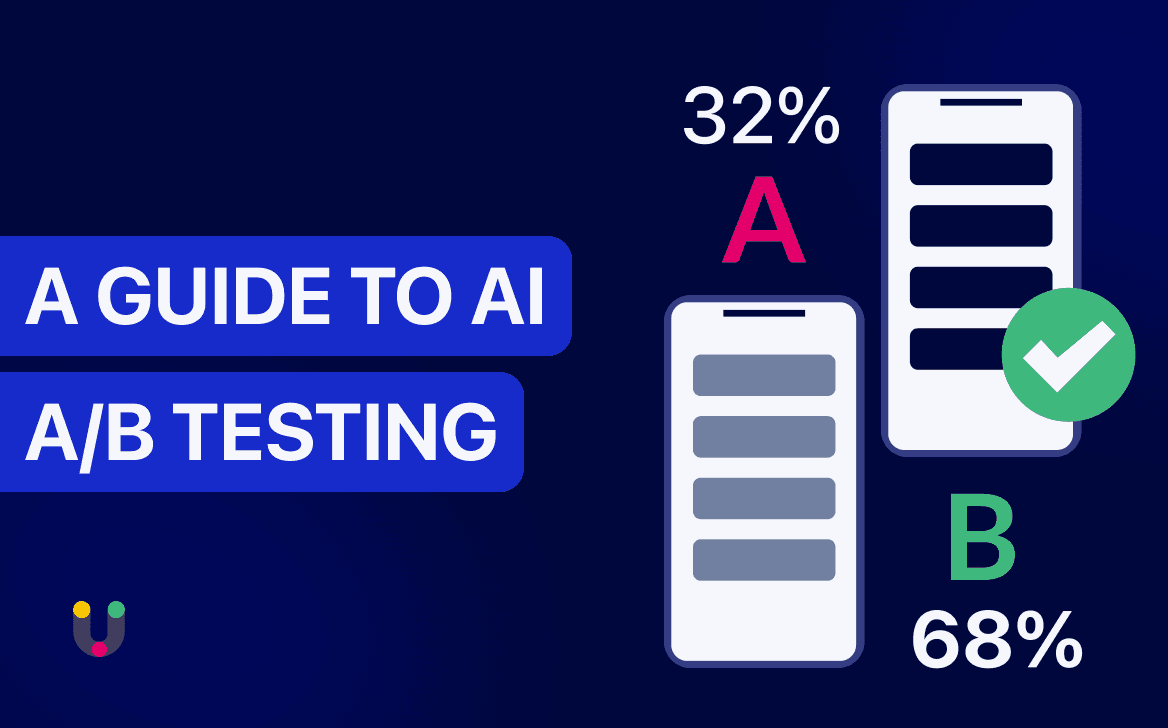
At its core, A/B testing is a split test that compares two versions of a webpage, email, app element, or other feature to determine which version performs better. The test divides your traffic between version A and version B, and measures the results.
It’s a reliable method, but it requires a rigid structure and often demands significant data, time, and effort to get right. Properly structuring A/B tests, however, is vital, as the changes will directly impact business performance.
AI takes the concept and enhances it with machine learning. Instead of guessing what might work, AI A/B testing now provides intelligent systems that learn from user behavior in real-time. It promises a fundamental shift in how you approach site optimization.
There are two possible usages for AI: pre-test and mid-test.
Pre-test: AI Attention Analysis predicts which designs grab attention before you launch the test itself.
Mid-test: Adaptive algorithms predict the likely winner early to save traffic on losing variants.
Pre-testing works by using machine learning models that have been trained on eye-tracking datasets. They can predict human behavior patterns when viewing design elements and web pages. Some common patterns include: contrast draws the eye, faces attract attention, and text hierarchy guides scanning order.
So, when a design is uploaded, the software (EyeQuant, Attention Insight, Neurons, etc.) will provide insights on gaze concentration points, attention scores for elements, etc., all derived from the previously acquired patterns.
Attention Analysis is great if you have numerous design variations, but can’t test them all due to budget or time constraints. Such a pre-test will likely remove the worst-performing variations and allow you to move on to the designs that are more closely tied in performance.
AI-driven mid-tests, on the other hand, mainly bring major performance improvements to known testing processes. While traditional A/B testing waits for a final result, AI often uses “Bandit algorithms” (e.g., Thompson Sampling) or dynamic traffic allocation. It means the system detects the winner early and gradually shifts traffic toward it, maximizing revenue while the test is still running.
There are some caveats, however. Bandit algorithms shift towards a variant that appears to be winning in an early stage of the test. But early on, data can be noisy, so the proposed winner may not be the real winner.
These two forms of A/B testing have different goals. Traditional A/B testing gives you certainty on who the actual winner is. AI A/B testing minimizes regret (i.e., sending traffic to the wrong variant and losing revenue).
It’s possible to use AI for post-test analysis; however, many tools provide enough detailed insights to develop a precise action plan. AI can also be used to generate new ideas or identify further improvements.
Benefits of AI in A/B testing
Faster test cycles and real-time insights
One of the biggest drags in traditional testing is waiting for statistical significance to ensure your data is valid. AI algorithms use different statistical methods to make a decision sooner, which allows you to make a reliable choice and maximize profit faster, reducing the wait time associated with traditional significance calculations.
Smarter audience segmentation and targeting
Standard tests often treat all traffic as one big substance, but there’s one major flaw with that: not all your users are the same people. Machine learning models can segment audiences automatically, identifying high-value groups you didn’t even know existed. It allows you to serve specific test variations to the users most likely to convert.
Auto-optimization and winner selection
Instead of just reporting the test results, which is the standard in most A/B testing tools, AI immediately acts on them itself. As soon as the system identifies a winning variation, it can automatically route more traffic to it.
You no longer have to manually monitor the dashboard every hour to improve your conversion rates.
Handling multivariate testing (MVT) at scale
When you want to test headlines, images, and buttons all at once, traditional methods break down under the complexity. AI excels here, managing MVT effortlessly by analyzing how multiple variables interact with each other.
Keep in mind that while AI helps prune the thousands of possible multivariate testing combinations down to the most likely winners, you still need high traffic volume to validate the results.
How AI enhances the A/B testing process
Automating hypothesis generation
Staring at a blank page and trying to guess what to test next is exhausting. AI can analyze your existing content and user behavior to suggest new hypotheses for you. It can even draft copy variations to save your creative team hours of brainstorming.
Dynamic traffic allocation
Instead of a fixed 50/50 split, machine learning algorithms adjust traffic distribution in real-time. If one variation is underperforming, the AI reduces its exposure to protect your conversion rates. The approach ensures you don’t lose money on bad variations while you’re still running experiments.
Using machine learning for predictive analysis
Machine learning has the capacity to predict what will happen, instead of just looking at what happened before. By analyzing historical test data, the system can forecast the potential impact of a change before you launch it full scale.
Limitations
While everything may sound just perfect, AI isn’t a magic wand that provides an instant fix to all your problems. You still need a sufficient sample size for the algorithms to learn effectively.
To work well, AI needs to collect data that’s clean and accurate. Garbage in, garbage out applies heavily here. If your tracking is broken, your test results will be useless. Also, if your site has low traffic, even the best machine learning models will struggle to make accurate predictions.
Additionally, AI models tend to lean towards short-term optimization – pure conversions that happen during the test instead of lifetime value, for example. If you have metric misalignment (clicks instead of conversions), AI will also confidently optimize for the wrong thing.
While AI-driven testing offers undeniable efficiency, it is important to remember that it is not always a requirement for success. In many scenarios, particularly for small businesses or those with limited traffic, a clean, manual comparison is more than sufficient to achieve your optimization goals. Ultimately, the goal is to choose the right approach for the job. While AI excels at continuous optimization and handling complex variables, traditional testing remains a foundational, reliable, and powerful practice for many business environments.
Common use cases for AI A/B testing
There are numerous use cases where A/B testing can be applied, and listing them all out is nearly impossible – as long as you have a service or product, have a website, and enough traffic, you can make use of A/B testing.
Ecommerce product page testing
Online stores use prebuilt AI tools to run tests on visual elements like checkout button placement, image positioning, and layout variations. The system automatically rotates these design components to see which specific combination drives the highest revenue.
Email subject line optimization
More sophisticated email marketing platforms now utilize automated split testing to compare subject lines, send times, and more using engagement data. The software deploys these variations to small sample subsets and monitors open rates to identify the best-performing version. Then, the majority of your subscriber list receives the version that drove the highest engagement.
UX/UI multivariate testing
Designers can run complex UX tests without slowing down the experience when supported by AI-driven website performance optimization. You must consider, however, that introducing heavy design variations often impacts technical performance and overall load times, which can be detrimental to the website’s UX.
Proper website speed optimization ensures that while you test UX, you aren’t hurting performance.
Ad creative and CTA performance
Marketers use AI tools to rotate through hundreds of ad creatives, letting the system pick winners based on business outcomes. It applies to on-page CTAs as well, where AI can tweak button text to maximize engagement.
Best AI A/B testing tools for 2026
Uxify. Novel tool that’s used for multivariate A/B tests, specializing in behavioral and site performance data. Uxify creates simulations, allowing you to see projected improvements in advance and evaluate the potential impact to your bottom line and site experience.
VWO. A strong platform that uses machine learning to analyze user behavior and suggest optimizations.
Optimizely. A leader in the space that offers powerful MVT capabilities and sophisticated targeting.
Adobe Target. Ideal for enterprise setups, and uses machine learning to deliver personalized experiences at scale.
Kameleoon. A strong contender focusing on AI-driven personalization and testing for compliant environments.
Articos. Runs A/B tests on synthetic personas instead of live users, so you can pressure-test messaging and concepts pre-launch and ship the winner with evidence behind it.
We advise you to check several tools and try them if possible before committing to one.
AI vs traditional A/B testing
Traditional testing relies on fixed timeframes and a pre-calculated sample size. AI testing is continuous and adapts as it gathers test data.
AI handles multiple variables and speeds up results, but requires more traffic and sophisticated tools. Traditional testing is simpler and easier to explain, but it is slower and more rigid regarding statistical significance.
In short, if you have high traffic and want to optimize continuously, AI-powered testing is superior. If you are a small local business with limited visitors, traditional methods might still be your best bet.
How to get started with AI A/B testing
There are four main components that will help you get started with A/B testing: ideation, creation, setup, and analysis.
Ideation. Machine learning models excel at processing vast amounts of unstructured data to identify user friction points. You can feed customer support logs or product reviews into an LLM to uncover specific pain points that require testing, which generates data-driven hypotheses for your experiments. It provides a clear roadmap on what needs to change to improve conversion.
Creation. You can use generative AI tools to accelerate the production of necessary creative assets for your different test variations. You can instantly produce multiple headline variations or distinct hero images to satisfy the requirements of a multivariate test.
Setup. Modern testing platforms utilize multi-armed bandit algorithms to manage how traffic reaches your new variations. The system dynamically allocates more visitors to the better-performing versions while the test is still running. It minimizes the opportunity cost of sending traffic to the losing variations during the experiment.
Analysis. AI-driven analytics tools dive deeper than simple conversion rates to reveal why a specific variation succeeded. These systems correlate the winning design with specific user segments and behavioral patterns to provide actionable insights. You receive a comprehensive breakdown of the factors that drove the success of the test.

Frequently Asked Questions
Can A/B testing be automated?
Yes, modern AI tools can automate most of the lifecycle, except for evaluation and deployment decisions, as these usually need human oversight. It reduces the manual burden of decision-making significantly.
How to use AI with A/B testing tools?
Start by integrating AI features within your existing platform, or choose a tool where machine learning is native. You can use generative AI to create copy and images for your variants.
Where can AI A/B testing be applied?
You can use it on landing pages, product descriptions, email campaigns, and even pricing models. Generative AI is particularly useful for content-heavy areas.
What metrics can you A/B test?
Common metrics include conversion rates, click-through rates, bounce rates, and revenue per visitor.
How to determine the sample size for an A/B test?
In traditional testing, you calculate the sample size before starting to ensure statistical significance. With AI-powered testing, the algorithms often manage sample size dynamically, stopping low-performing tests early.
How to tell if the A/B test is successful?
A test is successful if it reaches statistical significance and positively impacts your business outcomes. Do not just look at clicks; ensure the split test drives revenue or leads.

" height="200.00000219726564px" id="j9Mmwfnw8" transform="translate(143.5 0)" width="479.5329973144531px"/><path d="M 0 15.944 C 0 7.139 7.154 0 15.98 0 C 24.804 0 31.959 7.138 31.959 15.943 L 31.959 59.637 C 31.959 68.442 39.113 75.58 47.938 75.58 C 56.763 75.58 63.917 68.442 63.917 59.637 L 63.917 15.944 C 63.917 7.139 71.071 0.001 79.897 0.001 C 88.721 0.001 95.875 7.139 95.875 15.944 L 95.875 56.095 C 95.875 82.51 74.413 103.923 47.938 103.923 C 21.462 103.923 0 82.51 0 56.095 Z" fill="rgb(59, 63, 91)" height="103.923px" id="KJCDMITFE" transform="translate(0 53)" width="95.875px"/><path d="M 0 15.943 C 0 7.138 7.154 0 15.979 0 C 24.804 0 31.958 7.138 31.958 15.943 C 31.958 24.748 24.804 31.886 15.979 31.886 C 7.154 31.886 0 24.748 0 15.943 Z" fill="rgb(252, 200, 0)" height="31.885999999999996px" id="q2K9EYOvZ" transform="translate(0 53)" width="31.95799999999963px"/><path d="M 0 15.943 C 0 7.138 7.154 0 15.979 0 C 24.804 0 31.958 7.138 31.958 15.943 C 31.958 24.748 24.804 31.886 15.979 31.886 C 7.154 31.886 0 24.748 0 15.943 Z" fill="rgb(63, 184, 126)" height="31.885999999999996px" id="bBya7XCj7" transform="translate(64 53)" width="31.95799999999963px"/><path d="M 0 14.171 C 0 6.344 6.359 0 14.204 0 C 22.048 0 28.407 6.344 28.407 14.171 C 28.407 21.997 22.048 28.342 14.204 28.342 C 6.359 28.342 0 21.997 0 14.171 Z" fill="rgb(229, 0, 106)" height="28.341999999999985px" id="WNzwBFOi7" transform="translate(34.5 128.5)" width="28.407000000000153px"/></g></svg>)