
In 2026, speed isn’t just a “nice-to-have”—it’s a non-negotiable. Users expect instant experiences, and search engines, like Google, are paying attention. A slow-loading site frustrates visitors, increases bounce rates, and drags down your SEO performance. That’s where Core Web Vitals come in. This article details some of our favorite WordPress plugins for speeding up your site and improving its user experience.
Why does speed matter more than ever?
Core Web Vitals (CWV) are a set of performance metrics used by Google to evaluate user experience on your site. These include:
Largest Contentful Paint (LCP) – measures loading performance
Interaction to Next Paint (INP) – measures responsiveness
Cumulative Layout Shift (CLS) – measures visual stability
Sites that nail their Core Web Vitals don’t just rank higher on Google—they also keep users engaged, reduce bounce rates, and drive more conversions. Faster pages create smoother experiences, which means more satisfied visitors and increased revenue. The best part? If you're using WordPress, you don’t need to start from scratch. There’s a wide range of performance plugins designed to supercharge your site speed with just a few clicks.
Can WordPress plugins speed up your site?
Absolutely—when you pick the right ones. The magic of performance-focused plugins lies in their ability to optimize every aspect of your website. They can:
Optimization Technique | Description |
|---|---|
Minify and compress assets | Reduces file sizes, speeding up load times by removing unnecessary characters. |
Compress Images | Compresses images without losing quality, ensuring faster page loads. |
Enable Caching | Serves static pages to reduce server load and speed up repeat visits. |
Lazy-load Media | Loads images, videos, and iframes only when visible, improving initial load time. |
Optimize Database Queries | Speeds up backend by eliminating slow database requests. |
Integrate with CDNs | Delivers content faster by serving it from a closer server. |
Font Optimization | Reduces render-blocking resources for faster font loading. |
Advanced Optimization Techniques | Uses critical CSS, preloads resources, and reduces JavaScript delays to boost performance. |
But here's the thing: not all plugins are created equal. Some are focused just on caching, while others provide all-in-one optimization with extra features. Let’s dive into the best plugins for 2025 that’ll help you optimize your site from every angle.
Top 5 WordPress speed plugins for 2026
1️⃣FlyingPress

Description: A lightweight yet powerful plugin built for modern WordPress speed. It includes caching, lazy loading, font optimization, and more—all packaged with a user-friendly interface.
Price: Starts at $60/year
Free Trial: No
Trustpilot: 4.7⭐(Reviews 250+)
2️⃣NitroPack
Description: A cloud-based performance booster that handles caching, CDN, image compression, lazy loading, and more—automatically. Especially useful for users who want a “set it and forget it” solution.
Price: Free plan available; Paid plans from $17.50/month
Free Trial: Free plan acts as a trial
Trustpilot: 4.9⭐(Reviews 1,100+)
3️⃣WP Rocket

Description: A premium, all-in-one performance plugin that handles caching, file optimization, lazy loading, database cleanup, and CDN integration—all without complicated setup.
Price: Paid only – Starts at $59/year
Free Trial: No
Trustpilot: 4.7⭐(Reviews 2,500+)
4️⃣LiteSpeed Cache
Description: A powerful, free caching plugin made for sites running on LiteSpeed servers. It includes image optimization, database cleanup, and even a QUIC.cloud CDN integration.
Price: Free
Free Trial: N/A – It's 100% free
WordPress store: 4.8⭐(Reviews 2,600+)
5️⃣W3 Total Cache
Description: One of the oldest and most configurable performance plugins. Offers page and browser caching, object and database caching, minification, and CDN support.
Price: Free or Pro version at $99/year
Free Trial: No, but the free version offers robust features
WordPress store: 4.8⭐(Reviews 5,400+)
📊 Performance comparison: HTTP Archive Results
To give you a clearer picture of how these plugins perform in real-world conditions, let’s take a look at the results from the HTTP Archive, which tracks data on millions of websites. Here’s how each plugin stacks up in terms of speed improvement:
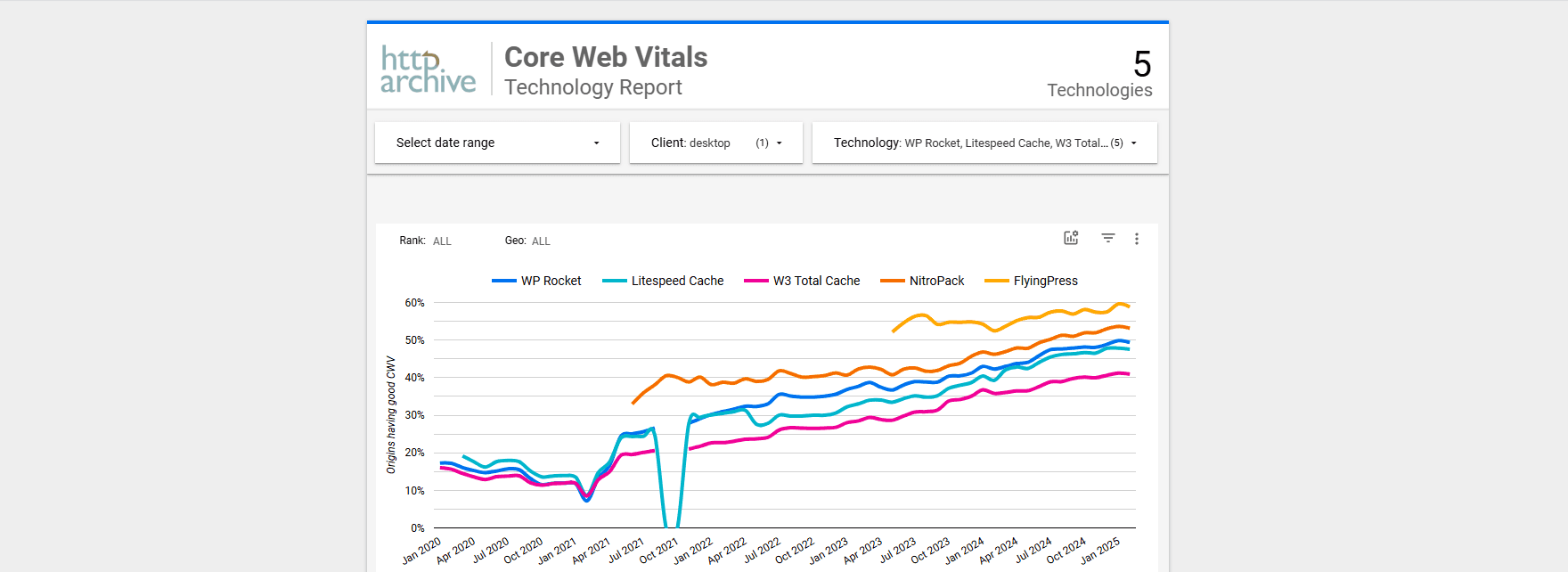
Source: httparchive.org
⚡Bonus: Taking WordPress optimization further with AI
The plugins above are excellent at solving known performance problems—compressing files, caching pages, deferring scripts. But they all share one limitation: they apply the same rules to every visitor, regardless of how that person actually browses your site.
That's the gap that WordPress optimization with AI is now beginning to close. Instead of static rules, AI-powered tools use machine learning to analyze real visitor behavior and adapt your site's performance to match it—predicting what users need next before they even click.
Meet Navigation AI by Uxify.
Navigation AI is exactly that kind of tool. It uses machine learning to predict where your visitors will click next—and prerenders that page before they get there. The result is instant page transitions that feel seamless and frictionless.
What sets it apart from speculative loading approaches that rely on fixed, manually configured rules is that Navigation AI continuously adapts. It learns from actual visitor behavior across your site, refining its predictions over time so the pages most likely to be visited next are always the ones being preloaded, not just the ones you guessed at during setup.
Best of all, it works on top of any existing speed plugin. Whether you're running WP Rocket, LiteSpeed, NitroPack, or another performance solution, Navigation AI layers on top to eliminate the one delay those plugins can't solve: the gap between a visitor's click and the next page appearing.

Final Thoughts
Speed is a competitive advantage. Whether you're blogging, running an ecommerce store, or offering services, your WordPress site's speed directly affects your bottom line.
Pick the right plugin, test your site regularly, and consider layering on advanced solutions like Uxify’s Navigation AI to stay ahead in 2026.

" height="200.00000219726564px" id="j9Mmwfnw8" transform="translate(143.5 0)" width="479.5329973144531px"/><path d="M 0 15.944 C 0 7.139 7.154 0 15.98 0 C 24.804 0 31.959 7.138 31.959 15.943 L 31.959 59.637 C 31.959 68.442 39.113 75.58 47.938 75.58 C 56.763 75.58 63.917 68.442 63.917 59.637 L 63.917 15.944 C 63.917 7.139 71.071 0.001 79.897 0.001 C 88.721 0.001 95.875 7.139 95.875 15.944 L 95.875 56.095 C 95.875 82.51 74.413 103.923 47.938 103.923 C 21.462 103.923 0 82.51 0 56.095 Z" fill="rgb(59, 63, 91)" height="103.923px" id="KJCDMITFE" transform="translate(0 53)" width="95.875px"/><path d="M 0 15.943 C 0 7.138 7.154 0 15.979 0 C 24.804 0 31.958 7.138 31.958 15.943 C 31.958 24.748 24.804 31.886 15.979 31.886 C 7.154 31.886 0 24.748 0 15.943 Z" fill="rgb(252, 200, 0)" height="31.885999999999996px" id="q2K9EYOvZ" transform="translate(0 53)" width="31.95799999999963px"/><path d="M 0 15.943 C 0 7.138 7.154 0 15.979 0 C 24.804 0 31.958 7.138 31.958 15.943 C 31.958 24.748 24.804 31.886 15.979 31.886 C 7.154 31.886 0 24.748 0 15.943 Z" fill="rgb(63, 184, 126)" height="31.885999999999996px" id="bBya7XCj7" transform="translate(64 53)" width="31.95799999999963px"/><path d="M 0 14.171 C 0 6.344 6.359 0 14.204 0 C 22.048 0 28.407 6.344 28.407 14.171 C 28.407 21.997 22.048 28.342 14.204 28.342 C 6.359 28.342 0 21.997 0 14.171 Z" fill="rgb(229, 0, 106)" height="28.341999999999985px" id="WNzwBFOi7" transform="translate(34.5 128.5)" width="28.407000000000153px"/></g></svg>)