Overview
Here's a thing about replenishment businesses: the second sale is worth way more than the first. The customer coming back for a refill didn't cost anything to find. They've already decided they trust you. And every time they show up again, they're basically saying, "yep, still worth it." Lose them once and you don't just lose a transaction - you lose every reorder they would have made for the next five years.
So when Shopify store Ecigone, one of the UK's biggest online vape retailers, brought Uxify in, that's the angle they were coming from. With 170+ brands, 4,000+ e-liquids, and a customer base that comes back every few weeks for pods, coils, and refills, the growth move wasn't to find more new people. It was to make sure the people they already have engaged come back more often, find what they need quicker, and leave a little happier than last time.
Six months later, the numbers are more than evident that they are on the right track. Customers on optimized sessions via Navigation AI browsed around twice as long, added to cart 50% more often, were significantly more engaged, and kept coming back for more. The more important part? None of that came from one big change. It came from making everything just a little smoother and letting the small improvements compound overtime.
About Ecigone
Ecigone have been around for over 12 years now and their product catalogue now spans over 70+ vape brands, plus the UK's largest e-liquid selection at 4,000+ flavours. With over 70,000 product reviews and a 4.9 Trustpilot rating, Ecigone has built the kind of customer base most ecommerce brands dream about: one that actually keeps coming back.
The challenge
We already painted the picture - big brand, leader in their category, tons of traffic coming in, good site engagement. Why did they even need to touch anything you might ask?
The real opportunity wasn't in fixing something broken - it was in tightening up the small moments where loyalty quietly slipped through the cracks.
Take returning customers. Around half of all non-optimized sessions were repeat visits, which sounds fine on paper. But there's a real gap between "comes back once" and "comes back every month for two years," and Ecigone was leaving points on the table in that gap.
Then there was session depth. The average non-optimized session lasted just over 6 minutes, and only about half of visitors looked at more than one page. That's not much time to wander a catalogue with 170+ brands and thousands of flavours. And certainly not enough to stumble onto the new arrival you'd have added to your next order if you'd just seen it.
Underneath all of that was site speed. Server response times were sitting around 0.4 seconds on non-optimized sessions. Half a second doesn't sound dramatic, but it's exactly enough hesitation to lose someone at the moments that actually count - when they were opening a product page, jumping to the cart, starting checkout. Each tiny delay was a little open door for shoppers to wander off somewhere else. And they did - in 1 in 5 sessions visitors didn’t engage with the site at all.
Nothing was on fire. But for a business that depends on customers coming back, all those small frictions add up to a really expensive problem over time.
The approach
Instead of treating speed, discovery, and customer return as three separate problems, Ecigone deployed Uxify to handle them as one. The thought-process was straightforward: a customer doesn't care which thing is making the site feel sluggish, all they know is that it's not as smooth as they want it to be. Fix the experience and all three numbers move.
Navigation AI does the heavy lifting on speed. It uses predictive preloading to figure out where a shopper is heading next, whether it’s the brand page they always check first, the flavour they reorder monthly, or the kit they've been eyeing, and quietly loads those pages in the background before the click even happens. By the time the customer taps anything, the page is just there.
The result wasn't really a faster website per se. It was a site that felt like it had been paying attention to how its customers actually shop - and it wasn’t going to make them wait for the next page.
A site that loads before you can click
First thing that changed: how the site actually felt.
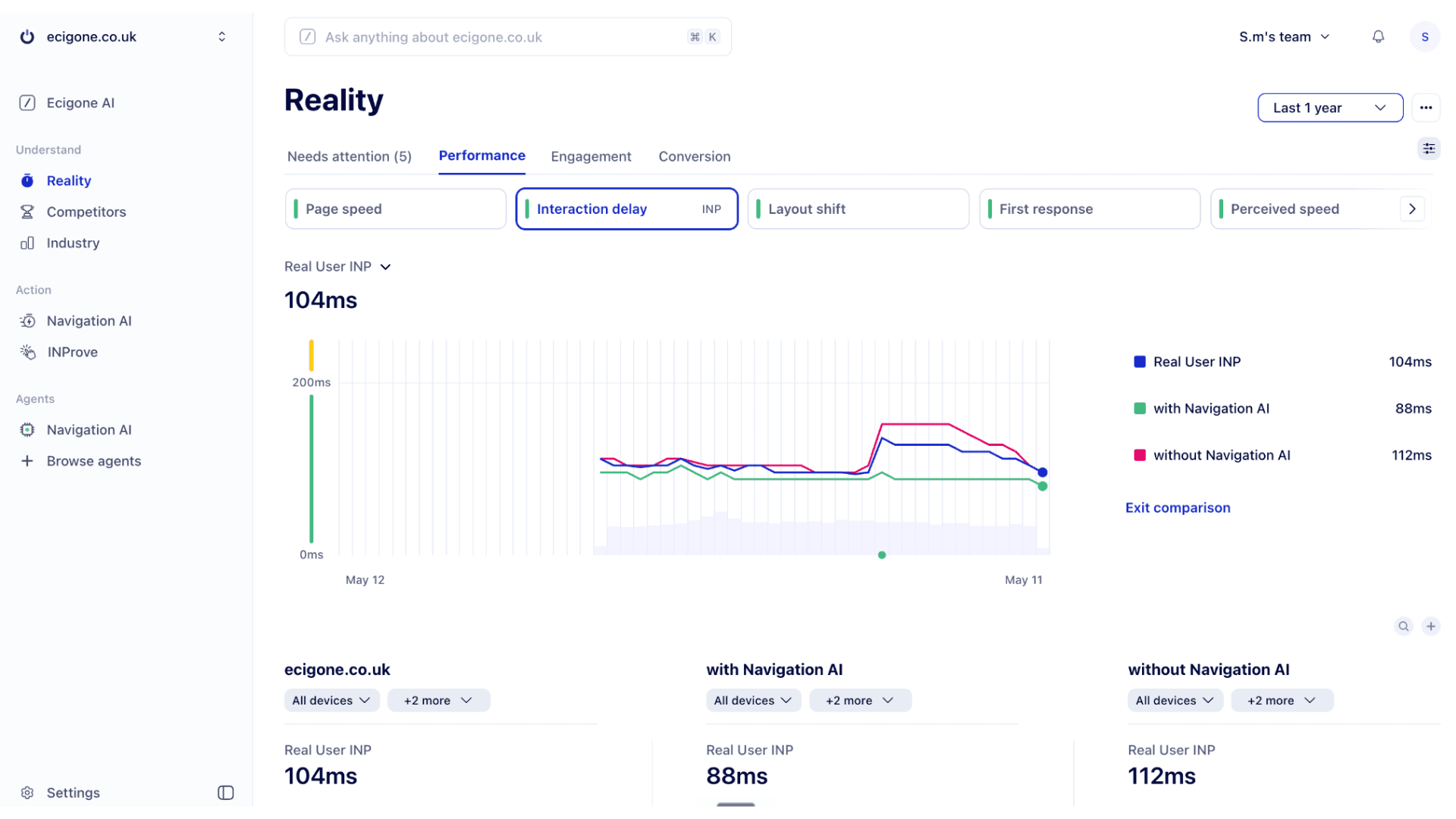
With Navigation AI running, server response times (TTFB) dropped massively - from 0.4 seconds to 0.01 seconds. That's not "a bit faster" - it’s a page that's already loaded when your finger hits the screen. Interaction delay (INP) improved by 21% alongside it, falling from 112ms to 88ms - well inside Google's "good" interactivity range, where the conversion numbers tend to be strongest.
For a returning customer, this is the whole game. The person coming back for their usual nic salt isn't there to admire the site. They want a brand page, flavour, cart, checkout - ideally without thinking about it. Navigation AI made that whole sequence feel like one continuous move.
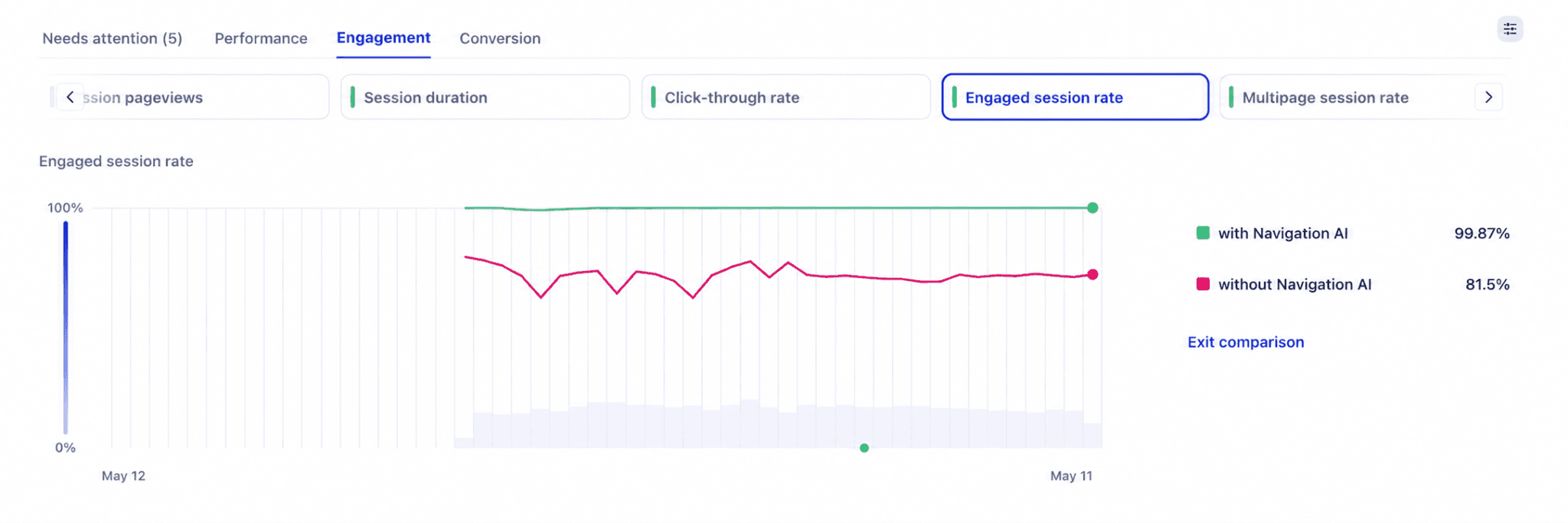
The engagement numbers told the same story but louder. On Navigation AI multipage sessions, engagement session rate increased by 22% - from 81.5% to 99.87%. In other words, when Navigation AI was running, almost every visit resulted in some form of customer engagement. And when it wasn’t - nearly 1 in 5 sessions didn’t yield any engagement. This is a strong sign that when the next page loads instantly, hesitation stops being part of the experience.
Customers stayed longer and came back more often
The speed gains showed up everywhere downstream, but the most interesting lift wasn't inside a single session. It was in how customers behaved between visits.
Returning user rate on Navigation AI sessions climbed to 77.31%, from 71% on multipage sessions without it. In other words, roughly 6 more out of every 100 visitors came back - a 9% lift in repeat traffic. Doesn't sound like much on its own, but in a replenishment business where the same customer reorders every few weeks for years, that 9% compounds fast.
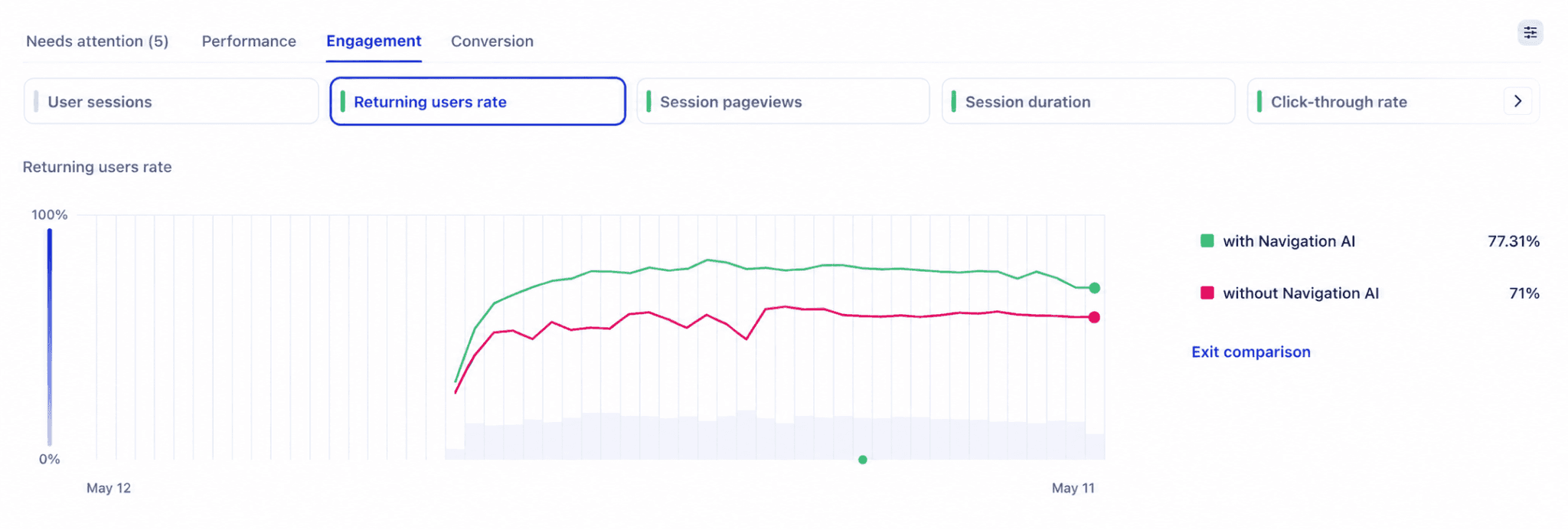
For a brand whose entire model is built on people coming back to order again, that's the number that matters most. A 3x add-to-cart lift is a great quarter, but a sustained 9% lift in returning customers - that’s a great year… and then a great year after that, and a great year after that.
The within-session story was strong too. Session duration on Navigation AI sessions doubled - from 6 minutes and 44 seconds to 12 minutes and 42 seconds - people were browsing twice as long. Мultipage session rate, or in other words - sessions with at least 2 pageviews, also climbed - up by roughly 30%. So basically: when the site felt good, almost everyone explored more than one page.
That's not really a "time on site" story. It’s a story of how Ecigone provided their shoppers a website worth spending time in.
Deeper engagement turned into stronger conversion
The smoother browsing, backed by the lift in time spent on page, meant that more shoppers made it past the "just looking" phase.
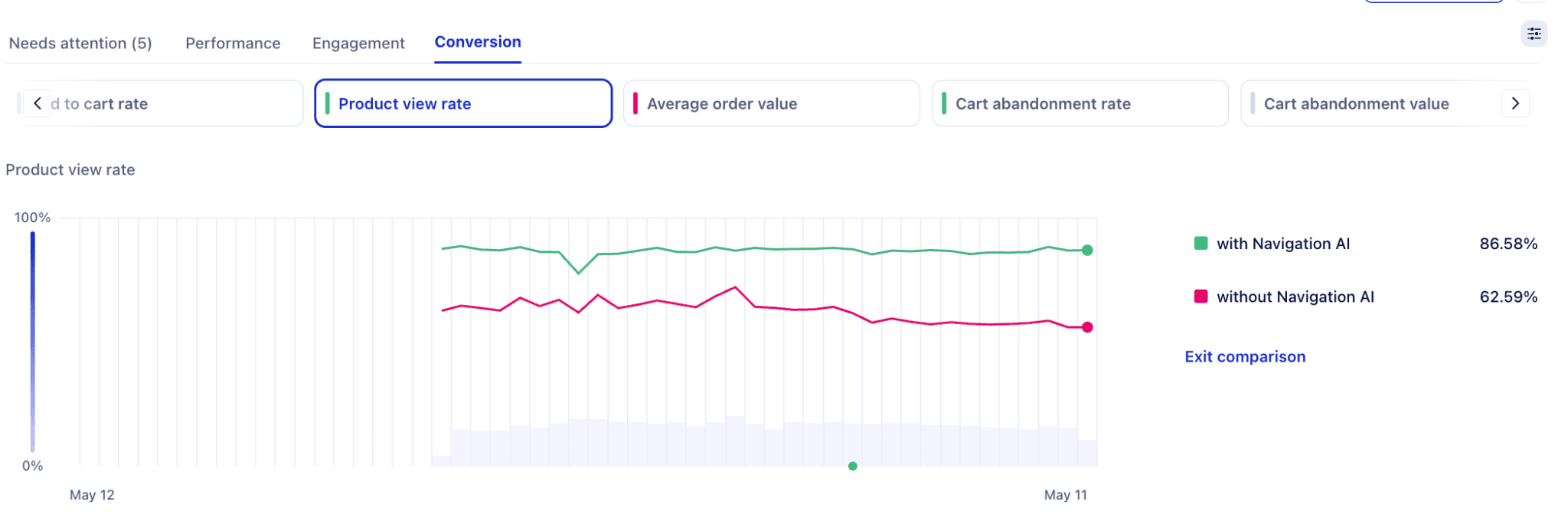
And the data backs up that claim quite well. Product view rate climbed to 86.58% on Navigation AI sessions, versus 69.2% without it. In plain English: more people found something worth looking at, instead of bouncing off a category page that didn't grab them.
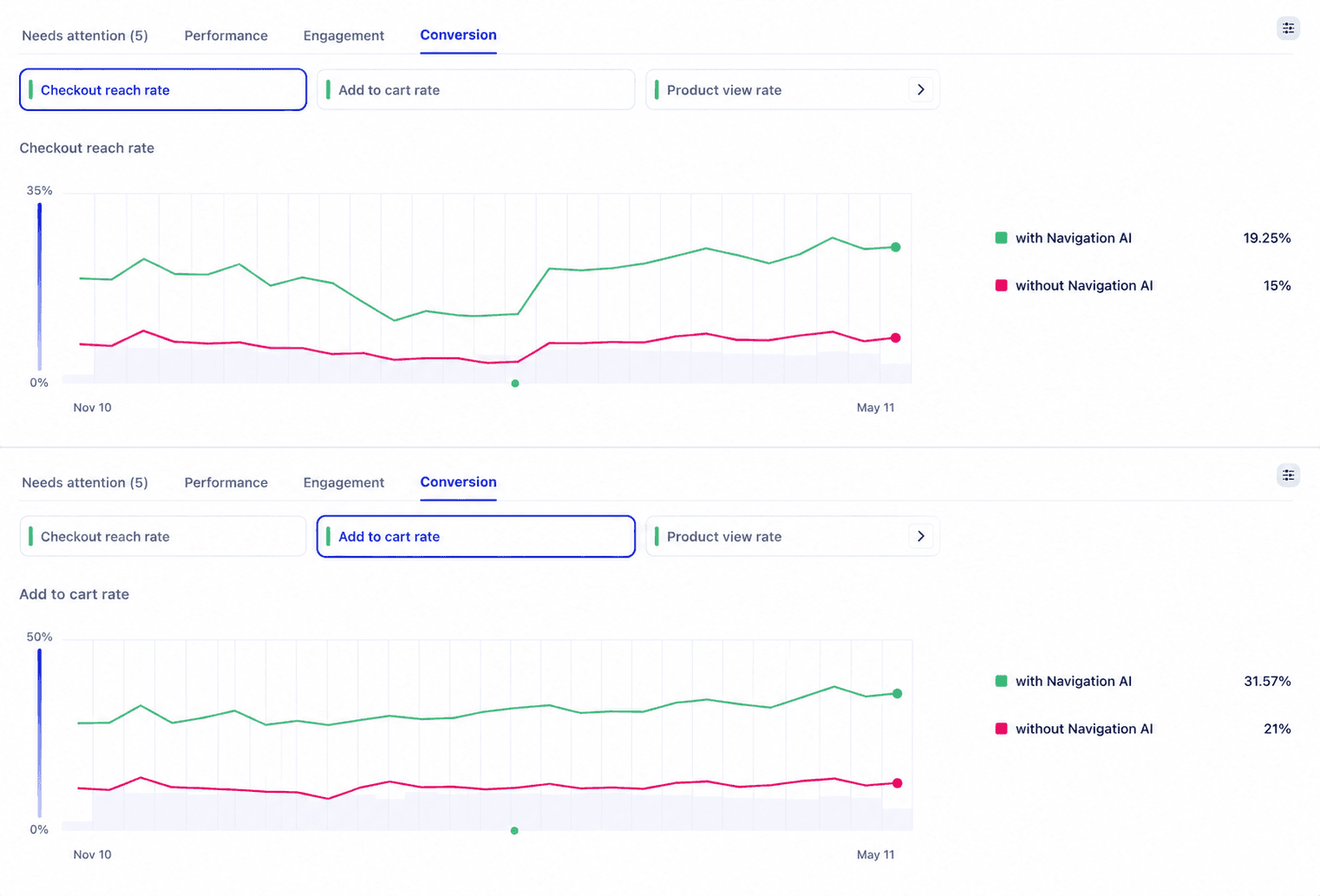
Add-to-cart moved even harder. On Navigation AI sessions, 31.57% of users added a product to cart, against 21% without it. That's about 10 more carts for every 100 visitors - a 50% lift in the share of shoppers actually pulling the trigger. Same traffic, same products, same prices - just way less friction along the way.
Checkout was the same story. Checkout reach rate hit 19% on Navigation AI sessions versus 15% on multipage sessions that weren’t optimized, or roughly 1 in 5 optimized shoppers reached checkout. A 27% lift at the most expensive stage of the funnel to move.
What actually changed on the site
Navigation AI did the technical work behind the scenes, but the visible change was in how the site felt to use.
Product pages started loading instantly based on what customers were most likely to do next. So the person comparing two pod kits side by side stopped waiting between clicks. The shopper scrolling for the e-liquid they ordered last month stopped losing momentum between pages. The whole thing felt continuous instead of step-by-step. Which is why almost every visit turned into time on site that actually impacted conversions.
Discovery got sharper at the same time. With such a huge product catalogue, finding the right thing used to mean clicking through a few layers - fine in theory, exhausting in practice, ineffective for both sides and in every way. Navigation AI surfaced the right paths faster, especially for returning customers who already knew their brand or flavor and just wanted to get there without thinking.
The result - fewer interruptions, less hesitation, more people just continuing forward once they were already on a roll. And, critically, more of them enjoying the experience and coming back the next time they needed a reorder.
The takeaway
For Ecigone, Uxify helped nurture a better customer relationship - the kind where every visit makes the next one a little more likely, and where the friction that quietly eats at loyalty just stops being a thing.
In a category where the second purchase outweighs the first, that's the win. Growth didn't come from spending more on acquisition. It came from giving every customer Ecigone had already earned a reason to come back - engaged on nearly every visit, considerably more often, and far more likely to actually buy when they did.
And here's the fun part: this is the early result, not the finish line. Navigation AI is only active on about 16% of pageviews right now. The other 84%? That's where the next year of growth is hiding. And with Uxify's AI agents now in the mix, the team has even more levers to pull.

" height="200.00000219726564px" id="j9Mmwfnw8" transform="translate(143.5 0)" width="479.5329973144531px"/><path d="M 0 15.944 C 0 7.139 7.154 0 15.98 0 C 24.804 0 31.959 7.138 31.959 15.943 L 31.959 59.637 C 31.959 68.442 39.113 75.58 47.938 75.58 C 56.763 75.58 63.917 68.442 63.917 59.637 L 63.917 15.944 C 63.917 7.139 71.071 0.001 79.897 0.001 C 88.721 0.001 95.875 7.139 95.875 15.944 L 95.875 56.095 C 95.875 82.51 74.413 103.923 47.938 103.923 C 21.462 103.923 0 82.51 0 56.095 Z" fill="rgb(59, 63, 91)" height="103.923px" id="KJCDMITFE" transform="translate(0 53)" width="95.875px"/><path d="M 0 15.943 C 0 7.138 7.154 0 15.979 0 C 24.804 0 31.958 7.138 31.958 15.943 C 31.958 24.748 24.804 31.886 15.979 31.886 C 7.154 31.886 0 24.748 0 15.943 Z" fill="rgb(252, 200, 0)" height="31.885999999999996px" id="q2K9EYOvZ" transform="translate(0 53)" width="31.95799999999963px"/><path d="M 0 15.943 C 0 7.138 7.154 0 15.979 0 C 24.804 0 31.958 7.138 31.958 15.943 C 31.958 24.748 24.804 31.886 15.979 31.886 C 7.154 31.886 0 24.748 0 15.943 Z" fill="rgb(63, 184, 126)" height="31.885999999999996px" id="bBya7XCj7" transform="translate(64 53)" width="31.95799999999963px"/><path d="M 0 14.171 C 0 6.344 6.359 0 14.204 0 C 22.048 0 28.407 6.344 28.407 14.171 C 28.407 21.997 22.048 28.342 14.204 28.342 C 6.359 28.342 0 21.997 0 14.171 Z" fill="rgb(229, 0, 106)" height="28.341999999999985px" id="WNzwBFOi7" transform="translate(34.5 128.5)" width="28.407000000000153px"/></g></svg>)