Just recently, Shopify quietly added more than a thousand apps to its marketplace in one go. LinkedIn lit up - some impressed, most just amused. Another thousand? The store already had north of 16,000.
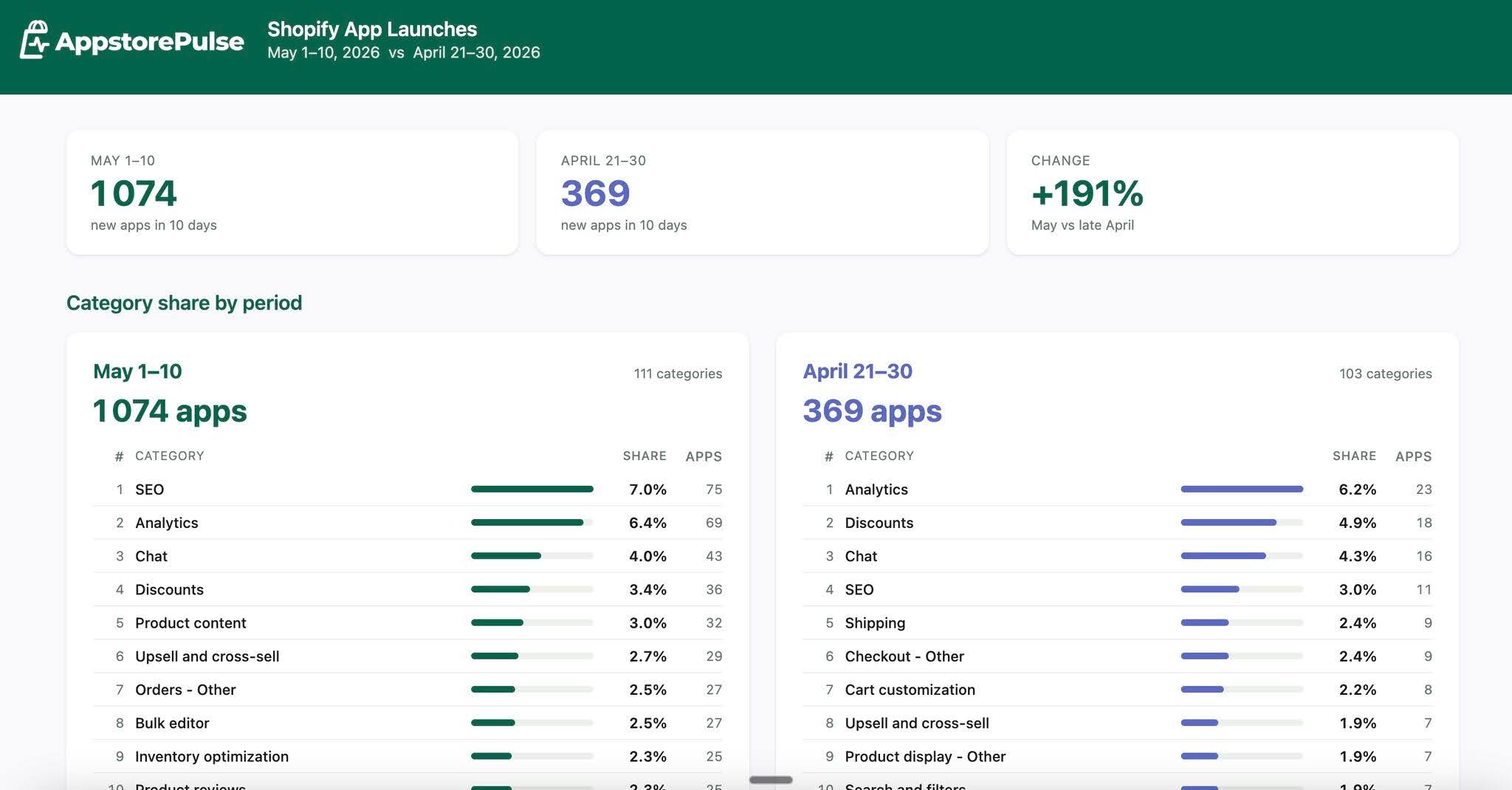
The reaction wasn't outrage. It was a kind of bemused exhaustion. Most of the apps are genuinely useful. The ecosystem is genuinely thriving. And yet the merchants running these stores - the ones with multiple apps installed and dashboards open - they are already sensing something the headlines miss: the way ecommerce gets operated is about to change completely. And AI agents are why.
Why did the Shopify app ecosystem get so big and where’s it going next
Ecommerce platforms grew their app ecosystems because the model worked. The Shopify App Store hit 17,591 active apps in April 2026, marking a 43% increase compared to January 2025. BigCommerce, Adobe Commerce, and WooCommerce followed similar curves at their own scales. Shopify alone paid out over $1.3 billion to ecosystem developers (Shopify, 2025), and apps are the reason platform commerce outcompeted custom builds.
But why does the app store keep getting bigger, and most importantly - why is it growing faster than ever?
Building an app has never been easier
Raise your hand if this week you’ve seen someone on LinkedIn brag about the tool they vibe-coded while on vacation.
With AI-assisted coding, you no longer need a full engineering team to ship a working Shopify app. You need a problem, an idea and a weekend. Now whether or not the apps that get built this way are sustainable and secure to use - that’s a question for another day.
Shopify doesn't charge you until you're winning
Shopify takes 0% revenue share on the first $1M an app earns. That's a structural invitation: build something, list it, and if it doesn't work, you've lost nothing but time. The downside is capped at zero, which is exactly why so many people are trying.
The developer network is mature
By joining the ecosystem, you get access to documentation, partner programs, templates, agencies, and an active community of builders - which essentially means you don't start from scratch.
AI is becoming a channel of its own, and the ecosystem is reshaping to match.
With AI agents and AI search now influencing how shoppers find and buy products, an entirely new segment of apps is emerging to accommodate that shift: agent-aware product feeds, AI-readable schema tools, conversational commerce integrations, autonomous optimization layers. The category itself is expanding faster than the existing apps can adapt.
Every app in the store started the same way: a real merchant had a real problem, and a real developer built a real solution. That's still true. What's changed is the math. When building costs nothing, the marketplace stops being a curated shelf of solutions and starts behaving like an open mic night: full of energy, mostly worth showing up for, and increasingly hard to stand out in.
So the real question is - how many of these 1000+ apps are going to come out the other end successfully?
What does the flood mean for existing apps?
Honest answer? Probably not much. The incumbents at the top of each category are fine, better than fine, actually. They've got the reviews, the rankings, the word-of-mouth, and the SEO equity. The newcomers don't. The apps that built their growth on organic category browsing, mid-tier search visibility, or steady word-of-mouth are the ones caught in the middle, absorbing the cost of expansion. Three factors influence this.
Competing gets harder, not easier
When the store grows by a thousand apps in a week, every existing listing drops a few rows in every category. Browsing breaks down as a discovery mechanism. Merchants stop scrolling categories and start searching for exactly what they came in for, giving the apps that already dominate those keywords a structural advantage. Everyone else has to fight for the leftover attention.
Built for Shopify becomes table stakes, not a differentiator.
The certification was designed to signal quality. As the marketplace floods, it's becoming the minimum threshold for visibility, meaning every serious app now has to invest in meeting the spec just to stay in the conversation, regardless of whether their customers actually care about the badge.
The App Store risks becoming a bidding war.
As organic discovery gets crowded out, paid placement on key category and search terms becomes the default path to installs. The cost of acquiring a new customer through the App Store goes up, and the apps that win aren't necessarily the best ones - they're the ones that can afford to bid highest on the right keywords.
And it's not just the apps feeling it. The merchants running them are absorbing the cost of all this expansion too.
What are the hidden costs of too many apps?
The app-centric model started showing strain not because apps got worse, but because the human in the middle got busier. 87% of Shopify merchants now rely on third-party apps to extend store functionality, and the operational cost of running them shows up in places that don't immediately get blamed on the app stack.
Core Web Vitals slip, pushing pages below Google's performance thresholds and quietly costing rankings.
Code bloat accumulates with every install. Each app injects its own scripts, styles, and tracking pixels. Stores running 15+ apps frequently ship hundreds of kilobytes of third-party JavaScript before a single product image loads. And most of it runs on every page, whether that app is being used or not.
Instability from rushed apps. When the barrier to shipping an app drops, so does the average level of testing behind each one. Edge cases get missed, browser compatibility gets thin, and merchants become the QA team, usually only after a support ticket comes in.
Operator fatigue: flipping between eight dashboards to figure out why conversion dropped on a Tuesday.
Subscription price accumulating: $30 here, $50 there, $200 for a "growth tier" that gets logged into twice a quarter.
Hidden conflicts: two apps fighting over the same DOM element, breaking checkout in a way nobody catches until support tickets stack up.
Shopify’s own research shows that every 1-second delay cuts 7% of your revenue, and the average mid-market app stack adds significantly more than that.
Put in plain English: think of every Shopify app as a passenger you have to drive home from the airport. Five passengers - five sets of luggage everywhere you go. Twenty apps means twenty sets of luggage on every trip. The store keeps moving, just slower, and the gas bill belongs to you.
Shopify itself is aware of the merchant-side pressure too, which is why the 'Built for Shopify' program exists to certify apps that meet performance and integration standards - Shopify's own acknowledgment that app quality matters at scale. But Built for Shopify solves the per-app quality problem. It doesn't solve the coordination problem. A store running 20 Built for Shopify-certified apps still has 20 dashboards, 20 sets of decisions, and 20 local optimization loops with no shared context between them.
The badge addresses how well each app behaves individually, not what happens when 20 of them behave individually at the same time. And even when apps integrate, like Klaviyo, Judge.me, and Recharge sharing event data across email, reviews, and subscriptions, those connections are still pairwise and merchant-configured, not systemic. Each app is still optimizing locally for its own metric, which is exactly the gap AI agents are designed to close.
The fact that these 17,000+ apps exist doesn’t necessarily make a merchant’s life any easier. Most merchants still use an average of just 6 apps each, while mid-market merchants run 15 to 30. And every single one of those merchants is making the same set of decisions - which to install, which to remove, which to configure, which to check this week and which to ignore.
That's the part the next chapter of the ecosystem is about to rewrite.The question worth asking now is whether anyone actually wants to be the one making all those calls in 2027.
What аre AI аgents in еcommerce?
AI agents in ecommerce are autonomous systems that observe store data, decide on actions, and execute changes without waiting for a merchant to click a button. They're not apps in the traditional sense: they don't live behind a dashboard, they don't wait for configuration, and they don't stop at giving you a report. Forecasts predict that 40% of enterprise applications will embed task-specific AI agents by the end of 2026, up from less than 5% in 2025.
And it doesn’t stop here. AI agents will intermediate more than $15 trillion in B2B spending by 2028. This isn't a forecast about future hype cycles. It's a structural shift in where decision-making authority lives, moving from human operators clicking through dashboards to autonomous agents executing in a heartbeat.
The shift applies to any ecommerce platform with an app marketplace. Shopify is the most visible example because of the scale of its ecosystem, but the same architectural change is hitting BigCommerce, WooCommerce, Adobe Commerce, and headless setups too.
That said, we need to get something out of the way: apps aren’t and shouldn’t go anywhere. They remain the building blocks. The AI agent layer is what turns blocks into outcomes. The merchants who'll be ahead in 2026 aren't the ones who pick the right next app to install, but are the ones who configure agents to run the apps they already have.
Take a familiar example. A reviews app shows you which products have low ratings. A reviews agent detects the same issue, drafts an updated product copy that addresses the actual complaints, A/B tests the variants across traffic, keeps the winning version, and never asks you to log in. Same input, same data source, but a different operating model.
The pattern holds across most of the Shopify app stack:
Session replay tools show you recordings of users struggling. A friction-detection agent spots the patterns automatically, surfaces only the clips that matter, and routes them to the team without anyone watching hours of footage.
Exit-intent and cart abandonment apps trigger popups based on rules you configure. A cart-recovery agent learns which exits are real abandonment versus normal browsing, and only interrupts when the chance of saving the cart is genuinely high.
Real user monitoring dashboards alert you when Core Web Vitals slip. A performance-monitoring agent watches the same signals, learns your baseline, and stays silent until something real breaks. No alert fatigue, no false positives.
None of these agents "kill" the categories above. They change who's operating in them and allow merchants to take a breather from having to constantly multitask and run each tool independently. Uxify's suite for agentic CRO is being built to do exactly this work.
How do AI agents differ from traditional ecommerce apps?
The architectural difference between an app and an AI agent shows up in three places:
An app reports. An agent acts.
An app gives you a dashboard. An agent gives you an outcome.
An app needs a human to interpret the data. An agent doesn’t require human input - the data is already interpreted and a fix is shipped.
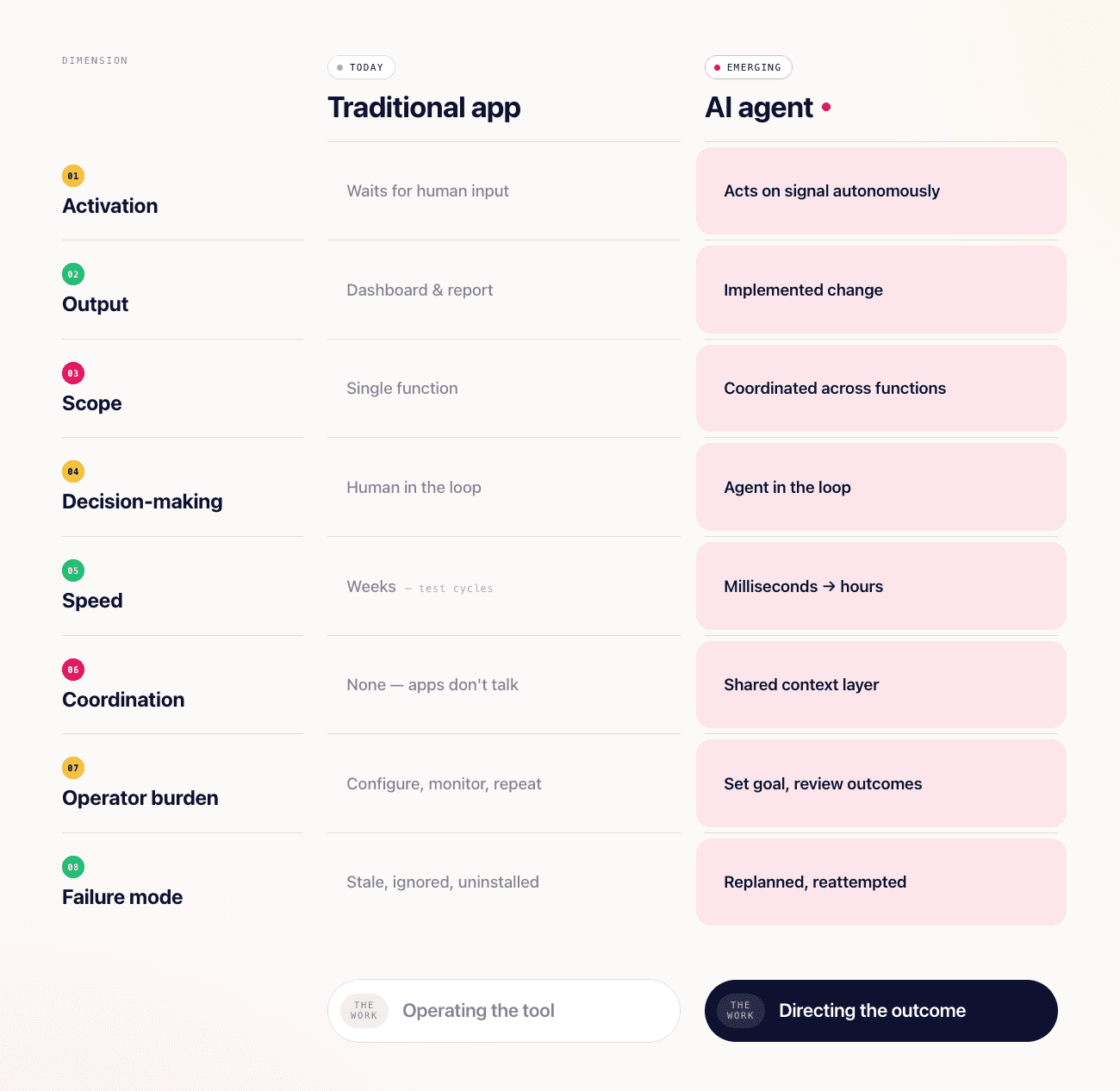
The single biggest difference is orchestration. Merchants are used to software that recommends actions, not software that takes them, so the biggest barrier to agentic ecommerce isn’t capability - it’s trust.
A dashboard can be ignored. An autonomous system changing copy, reallocating campaign spend, or modifying the onsite experience introduces a completely different operational threshold. That’s why the future of AI agents won’t be unlimited autonomy, but scoped autonomy. The strongest systems will operate inside clear guardrails: predefined permissions, rollback mechanisms, approval thresholds for high-impact changes, audit trails, and human override layers. The shift in ecommerce isn’t about removing humans entirely - it’s about moving them higher up the decision stack.
This distinction matters because trust compounds. Merchants don’t adopt autonomous systems all at once, but do it incrementally: first for monitoring, then recommendations, then low-risk execution, and eventually for broader orchestration. The platforms that win the next phase of ecommerce won’t just be the ones with the smartest agents, but the ones that make autonomy observable, reversible, and controllable.
Are AI agents replacing apps, or just re-stacking the layers?
AI agents aren't replacing apps so much as changing who calls them. Today, the customer of an ecommerce app is a human merchant who logs in, configures it, and checks the dashboard. In the agentic world, the customer is an AI agent that calls the app's API, uses its output as one input among many, and acts on the merchant's behalf. The app stays in the picture. The dashboard, in most cases, doesn't.
A growing number of platforms are building toward this, Uxify included. The category goes by a few names (agentic commerce, agentic CRO, autonomous optimization), but the shape is the same: agents that sit above the app stack, read from it, coordinate across it, and ship changes on the merchant's behalf.
What does an AI-agent workflow actually look like in practice?
Let’s put these two workflows in a practical scenario to help illustrate the difference in operating an ecommerce store before and after adopting agentic AI.
Before agents
A merchant notices conversion rate dropped over the last 7 days. The workflow usually looks something like this:
A marketer checks GA4 and Shopify analytics manually.
A UX team member opens Hotjar session recordings to look for friction points.
Customer support reports an increase in complaints around mobile checkout.
The CRO team launches an A/B test through a separate testing platform.
The email team adjusts abandoned cart flows in Klaviyo to mitigate losses.
Engineering investigates whether a recently installed app slowed down load times.
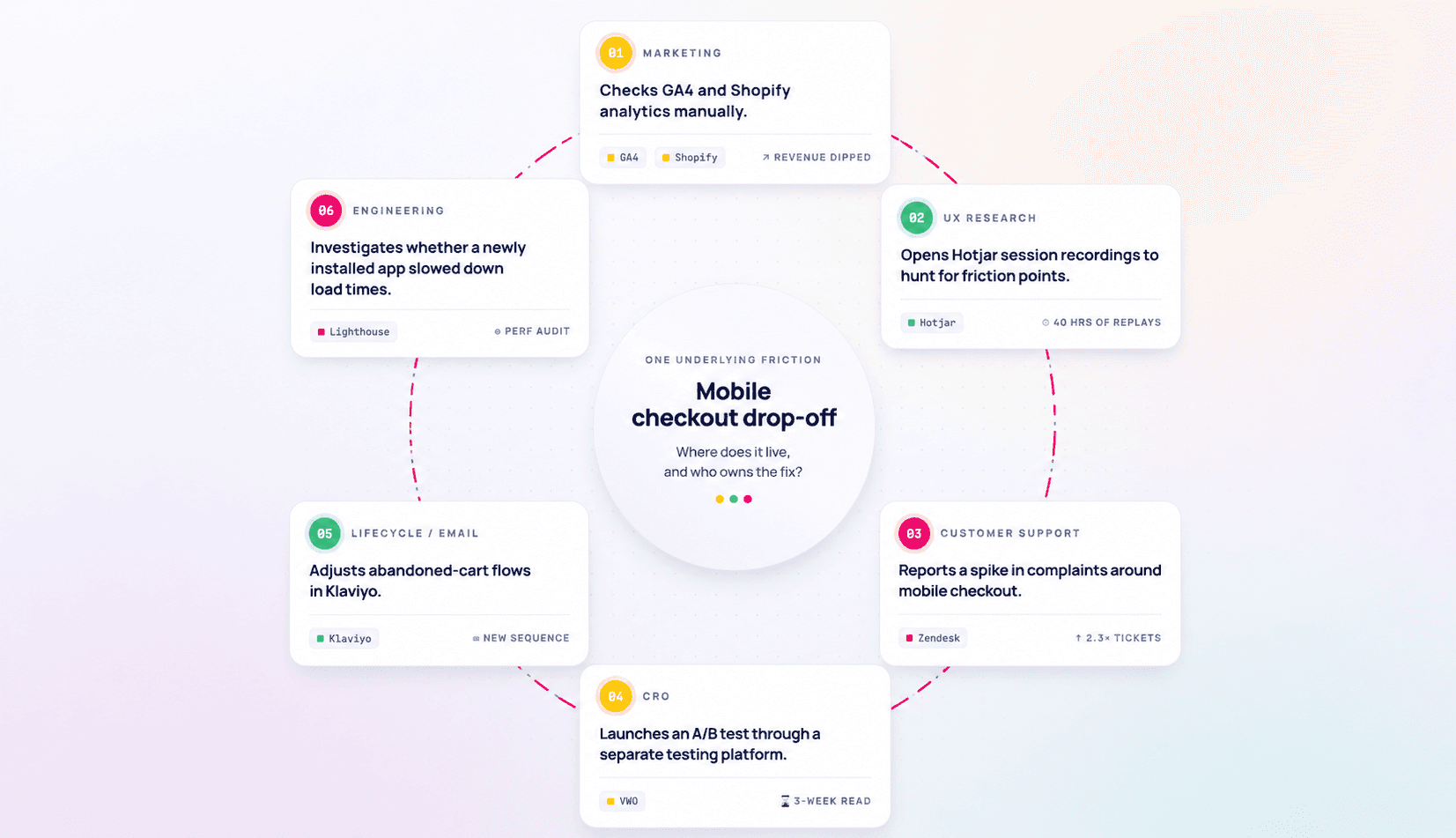
The issue eventually gets resolved, but only after multiple teams, dashboards, meetings, and testing cycles. Depending on the company size, the process can take anywhere from several days to several weeks.
After agents
An AI agent monitoring checkout behavior detects an abnormal drop in mobile conversion rate in real time. It identifies that a recently added app increased load time on PDPs and checkout pages beyond the store’s normal baseline.
The agent automatically:
correlates the performance drop with session replay data
isolates the app causing the slowdown
pauses the underperforming widget for mobile users
adjusts cart recovery flows in Klaviyo
launches a revised PDP variant with simplified copy and fewer scripts
and monitors conversion impact continuously.
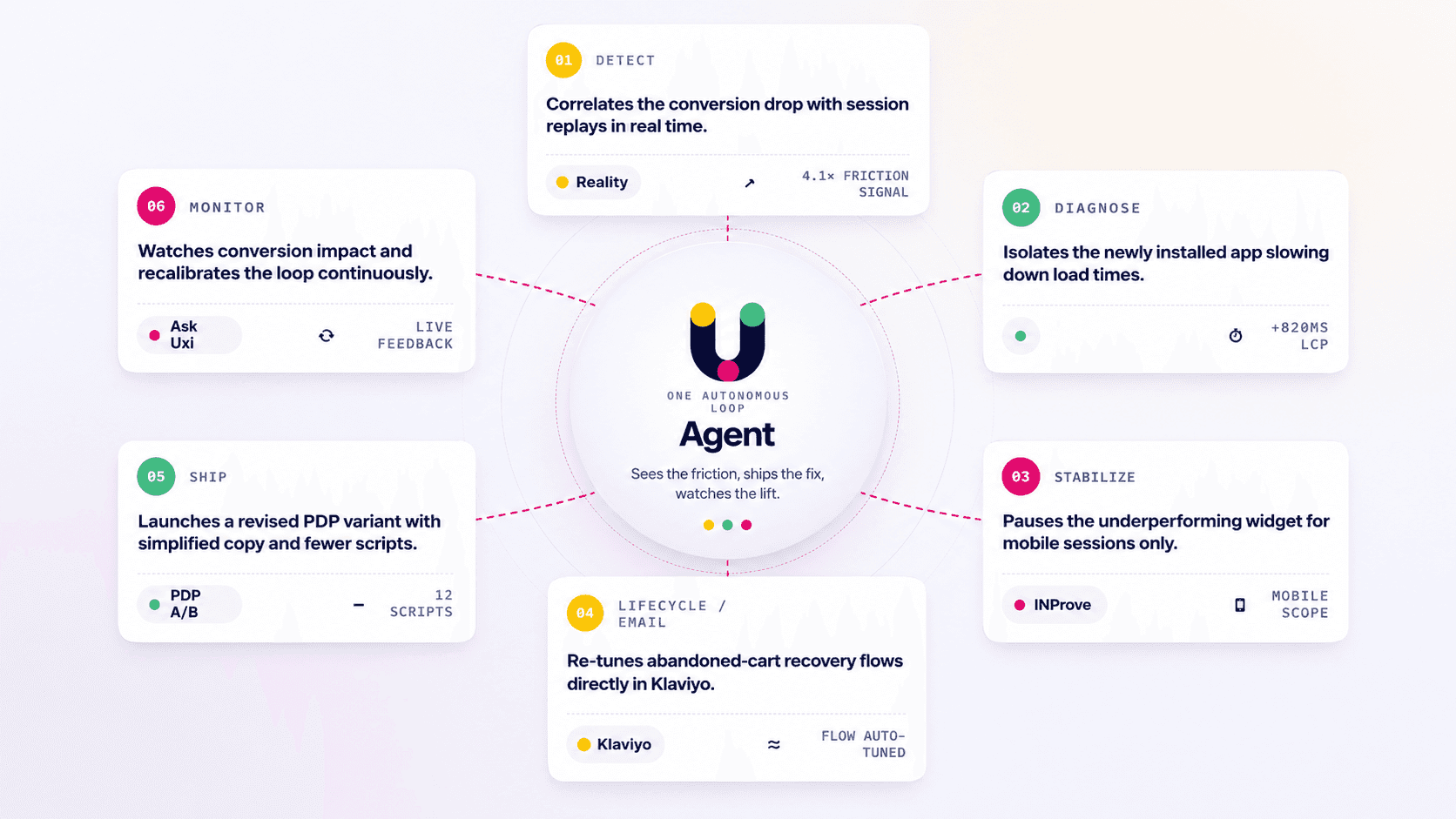
Instead of waiting for weekly reporting cycles, the store responds within hours - sometimes minutes.
Tools involved
The stack itself may not change dramatically. The difference is in orchestration.
The workflow could involve:
Shopify
GA4
Hotjar
Klaviyo
Recharge
a performance monitoring tool
an experimentation platform
The AI agent sits above the stack, coordinating across systems instead of requiring teams to operate each tool independently.
Revenue impact
For high-volume ecommerce stores, even small performance improvements compound quickly. In practice, reducing detection and response time around conversion issues can mean recovering thousands - or millions - in otherwise lost revenue over the course of a year.
What should ecommerce merchants do about AI agents in 2026?
The strategic shift for ecommerce merchants over the next 18 months isn't installing better apps, but deciding which layer of the stack their attention should go to. Projections show that AI agents will outnumber human sellers by tenfold by 2028. That's not a far-future problem - it’s a mere two years from now.
What that means in practice, regardless if you're on Shopify, BigCommerce, WooCommerce, or a headless stack:
Audit, don't hoard apps. Every quarter, look at which apps your team actually opens. The ones that don't get touched are paying rent in JavaScript, not value.
Favor apps that expose clean APIs. If an AI agent is going to use it, the data contract matters more than the dashboard design. This is also a useful filter for app developers thinking about where their roadmap should go.
Pick agents by outcome. A feature checklist tells you what an agent can do. The right frame is what it's responsible for and how its performance is measured.
Get comfortable with autonomy. Agents that need permission for every action aren't agents - they're slow apps. The value of agentic CRO shows when merchants set goals and review outcomes, not when they micromanage.
Еcommerce in 2026 is agentic, not app-heavy
Shopify dropped over a thousand apps into a marketplace that already had 16,000. But the story here isn't that apps are bad. They're the reason Shopify won and is continuing to win and why every other ecommerce platform built a marketplace too. The story is that the operating layer of ecommerce is moving up a level: from humans clicking through dashboards to AI agents acting on signal. Apps stay. Their customer changes.
Uxify is the agentic CRO platform built for this shift - an agent suite that reads from the apps merchants already have, coordinates across them, and acts on real user signals without waiting for the next testing cycle.
The merchants paying attention in 2026 aren't asking which app to install next. They're asking which AI agent should handle the next decision they used to make at midnight on a Tuesday.

Frequently Asked Questions
Will AI agents replace ecommerce apps entirely?
No. Apps remain the building blocks of every major ecommerce ecosystem. Shopify alone has paid out over $1.3 billion to developers (Shopify, 2025), and that economy is healthy. What's changing is the consumer of apps. AI agents will increasingly call apps via API rather than merchants logging in by hand.
What's the difference between an AI agent and an AI-powered app?
An AI-powered app uses AI to give you better answers inside a dashboard you still operate. An AI agent uses AI to act on its own. It observes data, decides on changes, and ships them without a merchant in the path. The dashboard becomes a review surface, not a control panel.
Are AI agents safe to run on a live ecommerce store?
When properly scoped, yes. The risk profile depends on three things: what data the agent reads, what changes it's allowed to ship, and how reversible those changes are. Well-designed agents operate inside tight boundaries, so anything underperforming gets rolled back instantly. This is how the Uxify agent suite is built too.
Should I uninstall my apps before adopting AI agents?
No, or at least not all of them. The smarter move is to audit which apps your AI agents will actually use as data sources or capabilities, and remove the ones that exist only to give you a dashboard. Agents read APIs, not dashboards. Apps that don't expose data cleanly are the first candidates to retire.

" height="200.00000219726564px" id="j9Mmwfnw8" transform="translate(143.5 0)" width="479.5329973144531px"/><path d="M 0 15.944 C 0 7.139 7.154 0 15.98 0 C 24.804 0 31.959 7.138 31.959 15.943 L 31.959 59.637 C 31.959 68.442 39.113 75.58 47.938 75.58 C 56.763 75.58 63.917 68.442 63.917 59.637 L 63.917 15.944 C 63.917 7.139 71.071 0.001 79.897 0.001 C 88.721 0.001 95.875 7.139 95.875 15.944 L 95.875 56.095 C 95.875 82.51 74.413 103.923 47.938 103.923 C 21.462 103.923 0 82.51 0 56.095 Z" fill="rgb(59, 63, 91)" height="103.923px" id="KJCDMITFE" transform="translate(0 53)" width="95.875px"/><path d="M 0 15.943 C 0 7.138 7.154 0 15.979 0 C 24.804 0 31.958 7.138 31.958 15.943 C 31.958 24.748 24.804 31.886 15.979 31.886 C 7.154 31.886 0 24.748 0 15.943 Z" fill="rgb(252, 200, 0)" height="31.885999999999996px" id="q2K9EYOvZ" transform="translate(0 53)" width="31.95799999999963px"/><path d="M 0 15.943 C 0 7.138 7.154 0 15.979 0 C 24.804 0 31.958 7.138 31.958 15.943 C 31.958 24.748 24.804 31.886 15.979 31.886 C 7.154 31.886 0 24.748 0 15.943 Z" fill="rgb(63, 184, 126)" height="31.885999999999996px" id="bBya7XCj7" transform="translate(64 53)" width="31.95799999999963px"/><path d="M 0 14.171 C 0 6.344 6.359 0 14.204 0 C 22.048 0 28.407 6.344 28.407 14.171 C 28.407 21.997 22.048 28.342 14.204 28.342 C 6.359 28.342 0 21.997 0 14.171 Z" fill="rgb(229, 0, 106)" height="28.341999999999985px" id="WNzwBFOi7" transform="translate(34.5 128.5)" width="28.407000000000153px"/></g></svg>)