
Key takeaways:
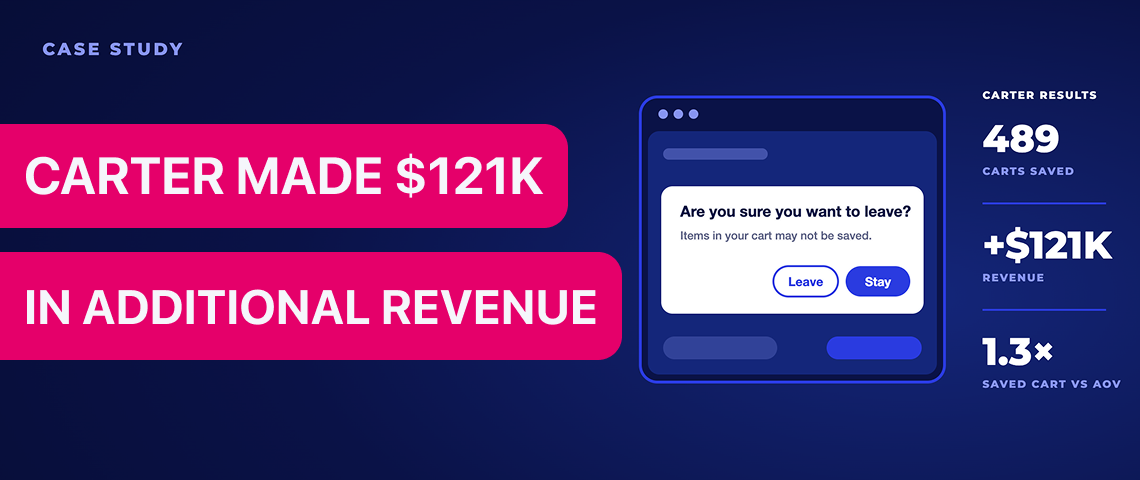
- Across four Shopify stores, Carter, Uxify's exit-intent agent, intercepted 4,095 exits and saved 489 carts in the first 14 weeks.
- In all four stores, a saved cart was worth more than the store's average order.
- Carter saves the most carts where the buying decision is quickest: the home fragrance store with AOV of $35 saved 1 in 5 shoppers who tried to leave, while the $300 auto parts store saved about 1 in 16.
- The agent works best alongside your email and SMS flows. It saves the carts they can't reach, and turns anonymous visitors into customers those flows can follow up with.
Make Uxify one of your go-to sources on Google
 Add Uxify on Google
Most conversion work happens in the middle of the funnel. You fix the product page, tidy the cart, shave a step off the checkout. But what about the shopper who has already built a full cart and is about to close the tab without having left an email address or a phone number behind?
That shopper is the hardest one in ecommerce to win back, because the moment they leave you have nothing left to reach them with. You can’t send an abandonment email to an address you never got. Once the tab closes, that’s usually the end of it. You get no second chance.
What’s Carter?
Carter is Uxify’s exit-intent agent for ecommerce stores and it works precisely in the moment when someone is, willingly or by accident, about to close a tab with items in their cart. It essentially saves a cart before it gets abandoned.
Even though we released it a month ago, four merchants have now run Carter for 14 weeks each. Their stores have almost nothing in common, from catalogs to price points, yet we saw consistent results across the board.
Before we dive in, let’s give you some context.
How does browser-native exit-intent cart recovery work?
Exit-intent cart recovery detects when a shopper with items in their cart is about to leave, and intervenes at that very moment. Carter detects this at the browser level, firing on a genuine page-close attempt rather than a prediction of one, and the browser holds the page open until the shopper answers. It only steps in for shoppers with items in their cart, and each of them sees the prompt at most once per visit.
Sometimes, especially when the intent is high, all it takes is asking while the shopper is still on the site. In a separate 30-day study across seven Shopify stores, about 1 in 6 shoppers who tried to leave with a full cart stayed and went to checkout, after seeing nothing more than the browser asking whether they were sure.
So it’s just a pop-up? Far from it actually.
How is Carter different from a traditional exit-intent popup?
Most exit-intent tools guess. They run on a timer, or they watch the cursor and treat an upward drift toward the tab bar as someone leaving. The exit intent popup typically adds an overlay (additional layer) on your page with the pop-up. If you’ve already used exit intent popups, you know that you can decide how you style that additional layer. What you probably don’t know is that all that styling comes with a cost, i.e. weight on your page that makes it slower to load. Yet again, no matter how pretty you made an exit intent popup or what discount you offer with it, it can’t really stop the user from leaving, so as soon as they close the tab, the site is gone.
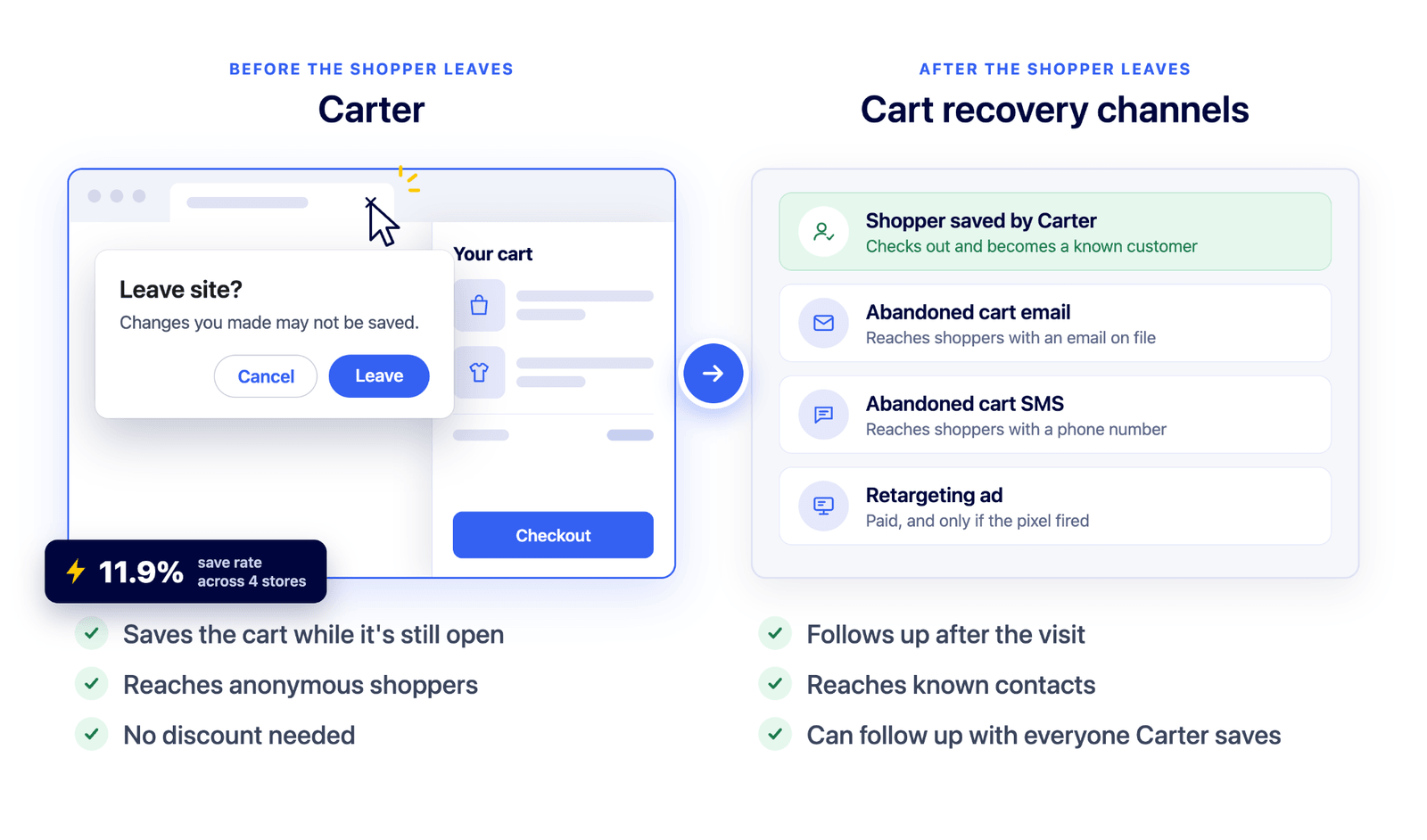
Carter works differently. It fires on an actual close attempt, which is the intent itself, so there are no false positives from a cursor drifting toward the tab bar. But besides that, Carter uses the browser’s native prompt - uneditable, but 100% unavoidable. What do we mean by this? While the contents can’t be changed and are always “Leave site?”, the prompt itself cannot be ignored. If the shopper wishes to proceed to either leaving the site, or staying, they have to interact with the prompt by selecting one of the predefined answers.

This is a huge differentiating factor between Carter’s prompt and a regular exit intent pop-up, which can simply be “X”-ed. There’s no discount, no offer and no overlay, just a moment for the shopper to confirm. And because the browser draws the prompt, there’s nothing extra to load. Carter adds no meaningful JavaScript to the page and blocks nothing in the render path, so your Core Web Vitals stay protected.
Firing on a very select number of sessions also keeps it from becoming background noise the way a site-wide overlay does, so the one time it appears - it actually gets the second of attention it needs to make the shopper reconsider.
How is Carter different from cart recovery channels?
Every other recovery channel works on carts that have already been abandoned and tries to win them back afterwards. Carter saves the cart before it’s abandoned at all, while the shopper is still on the page with the cart open, so there’s nothing left to recover. In a way, the two channels complement each other.
Abandoned cart emails and SMS both need a contact record, and exit-intent recovery doesn’t, so the two reach almost entirely different people. A first-time shopper with no account and no email on file is invisible to every recovery flow you’ve built. Retargeting can reach an anonymous visitor, though only after they’ve gone and only by paying for the impression, assuming the pixel survived at all.
What’s more, those channels also tend to need a discount to bring the shopper back, while asking before the shopper leaves costs nothing and reaches them while the cart is still open.
This is where Carter and traditional recovery channels complement each other. Carter catches shoppers before they leave, including those you have no way of contacting afterwards. And for shoppers who do leave, your existing recovery flows can still do their job.
Arriving at the moment of decision in a format that can’t be waved away is what produced an 11.9% save rate across the four stores. Let’s dive into the numbers in more detail.
Which 4 Shopify stores are in this analysis?
These four stores weren’t picked at random. Each sells in a different category, and their average order values sit nearly nine times apart end to end, so the results can’t be explained away by one lucky niche.
| Store | Category | Avg. order value | Monthly sessions |
|---|---|---|---|
| Store A | Auto parts and accessories | ~$300 | ~155,000 |
| Store B | Premium menswear | ~$235 | ~305,000 |
| Store C | Baby and kids sleepwear | ~$84 | ~209,000 |
| Store D | Home fragrance | ~$35 | ~23,000 |
All figures converted to USD at mid-market rates on 15 September 2026 (1 AUD = 0.713 USD, 1 EUR = 1.155 USD).
How many carts did exit-intent recovery save across the 4 stores?
Across 4,095 intercepted exits over 14 weeks, the four stores saved 489 carts. That’s a save rate of 11.9%, or about 1 in 8 shoppers who tried to leave, and roughly $121,100 in revenue.
| Store | Exits intercepted | Carts saved | Save rate | Revenue recovered (USD) |
|---|---|---|---|---|
| Store A | 297 | 19 | 6.4% | ~$6,200 |
| Store B | 2,948 | 341 | 11.6% | ~$104,200 |
| Store C | 554 | 69 | 12.5% | ~$8,000 |
| Store D | 296 | 60 | 20.3% | ~$2,700 |
| Total | 4,095 | 489 | 11.9% | ~$121,100 |
Bigger stores see more exits, which is why Store B, with about 305,000 monthly sessions, accounts for 2,948 of the 4,095 intercepted exits and most of the revenue. Traffic doesn’t explain all of it, though. Store C has two-thirds of Store B’s traffic and about a fifth of its exits, and that comes down to how often the prompt fires.
But Store B’s size doesn’t drive the overall result. Without it, the other three stores still saved 148 of 1,147 intercepted exits, a 12.9% save rate.
Why are recovered carts worth more than a store’s average order?
In all four stores, the average saved cart was worth more than the store’s normal average order, and about 1.3x to 1.4x in three of them. Store B’s saved carts averaged $306 against a site-wide average order of $235. Store C: $116 against $84. Store D: $45 against $35. Store A came closest, at about $326 against $300, with the smallest sample in the group (19 saved carts), so a few orders either way move that number.
| Store | Avg. order value | Avg. saved cart | Saved cart vs. AOV |
|---|---|---|---|
| Store A | ~$300 | ~$326 | 1.1x |
| Store B | ~$235 | ~$306 | 1.3x |
| Store C | ~$84 | ~$116 | 1.4x |
| Store D | ~$35 | ~$45 | 1.3x |
This matches wider ecommerce data. Across 65 million orders from 6,000+ stores, the average abandoned cart was worth $141, against $117 for a completed order. Bigger carts stall more often, so the exit moment is where many of them show up.
Why would a cart that’s about to be abandoned be worth more than a typical order? Larger baskets come with more deliberation. A shopper adding a $40 item does it without much thought. A shopper who has built a $300 basket has been weighing it, and a bigger total means a bigger number to justify. Extra costs are the top reason shoppers give for leaving.
Once the shopper stays, nothing shrinks the basket either. Carter doesn’t offer a discount to save the cart, so the order isn’t cut down by a code handed out at the last second.
Which means the exit moment isn’t where you lose your least valuable traffic, but quite the contrary - it’s where you lose some of your biggest baskets.
Why do cart save rates vary between stores?
The same agent ran the same way in all four stores, yet save rates varied considerably.
Average order value appears to be one factor. Save rates rose as order value fell, from 6.4% at Store A, with a $300 average order, to 20.3% at Store D, where the average was just $35.
But basket size only tells part of the story. What matters just as much is why the shopper is leaving in the first place.
Auto parts, for example, are a practical purchase. Research on cart composition suggests shoppers abandon practical purchases for different reasons than more indulgent ones. Someone buying a $300 car part might need to double-check compatibility, compare suppliers or wait until payday. A browser prompt won’t resolve any of those concerns.
Compare that to someone buying a $35 home fragrance product. The decision involves less financial commitment, and the shopper may simply be distracted or having second thoughts. A moment to reconsider can be enough to keep them moving toward checkout.
The bigger takeaway is that not every abandoned cart represents a lost sale that can be recovered on the spot. Some shoppers have already made up their minds. Others are still deciding. Carter works by catching that second group before they disappear, and the results suggest that how much room there is to change someone’s mind varies considerably from store to store.
How was recovered revenue measured?
Revenue is counted as attributed: a cart is only credited when a shopper who attempted to leave stays and continues the checkout in that session. Without the prompt, the tab would have closed, so every credited save is a checkout that would otherwise have ended there.
“Save attempts” counts the times Carter fired on a user’s browser.
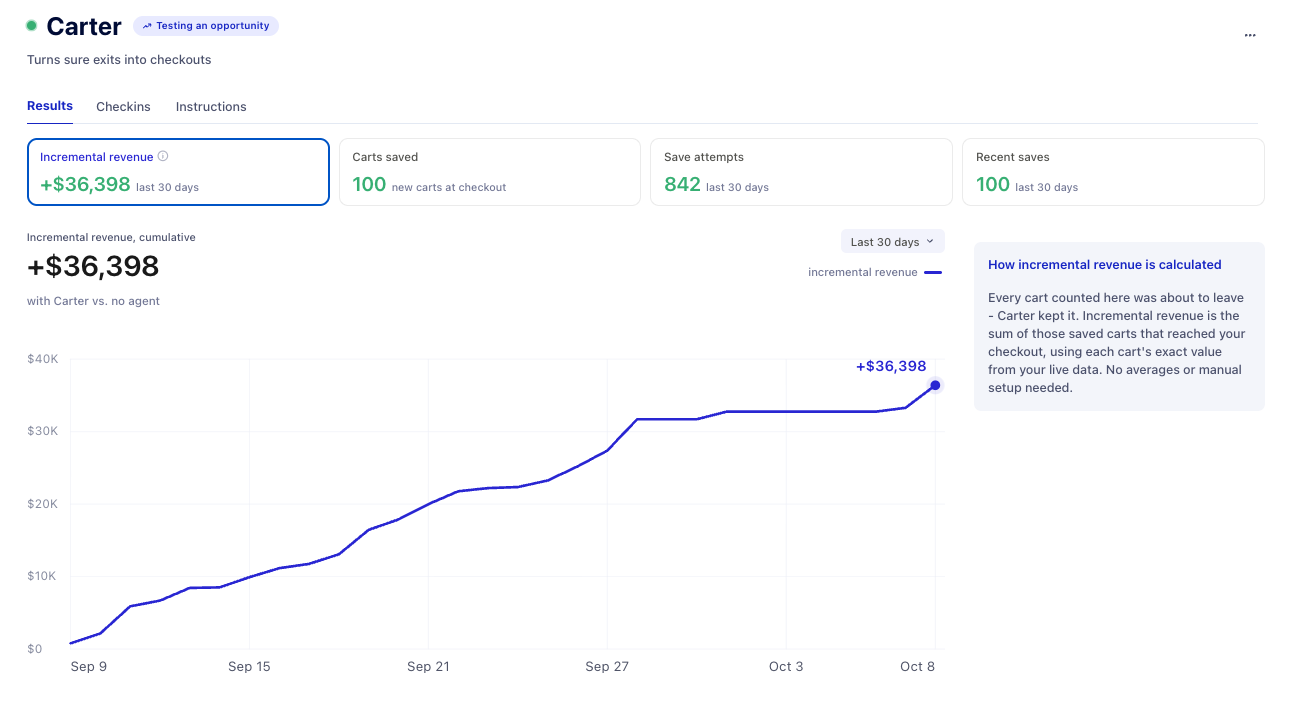
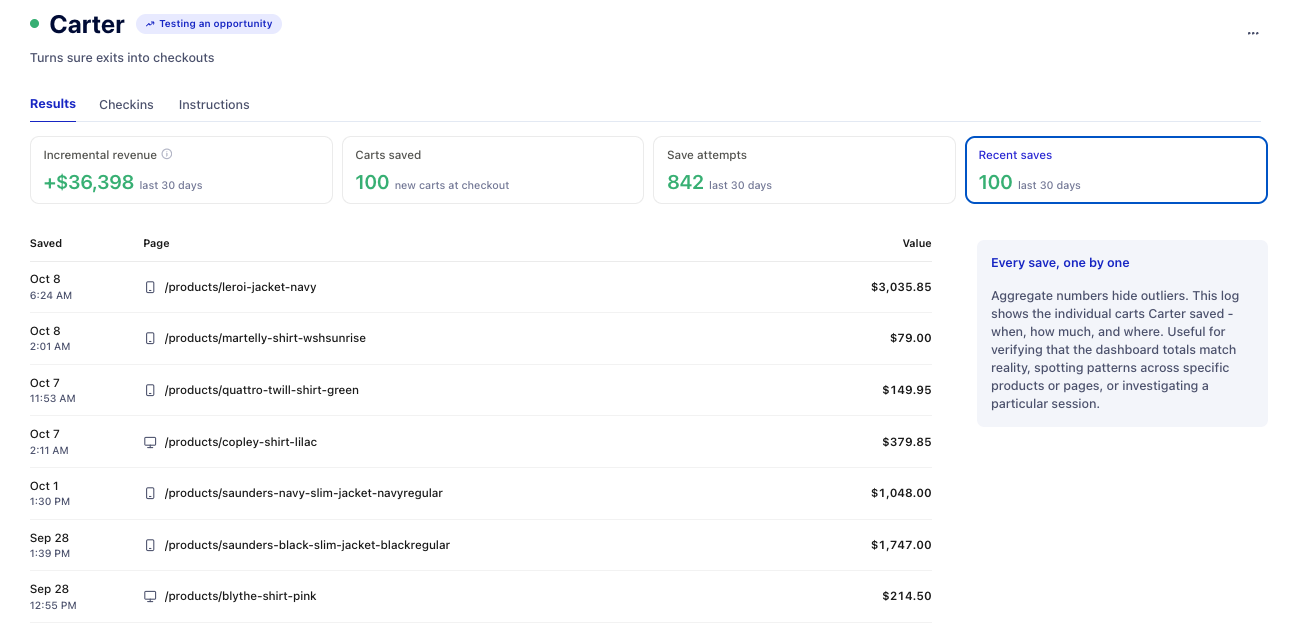
Each credited save is visible in Carter’s Recent Saves view, so the totals here trace back to specific recovered carts rather than some projection.
What the four stores show about exit-intent cart recovery
As we already established, these four stores have almost nothing in common. Yet Carter saved carts in every one of them, because it steps in at the one moment all four stores have in common: a shopper is still on the site but is about to close the tab with items still in the cart.
About 70% of online carts are abandoned, and most stores read that number as shoppers saying no. The data we get from Carter suggests a real part of it is shoppers who simply haven’t finished deciding.
The exit has always been treated as the end of the funnel. Uxify treats it as the last part of it, and Carter is one of a set of agents built to act on what shoppers are doing while they’re still on the page rather than report on it once they’ve gone.
Frequently Asked Questions
Does exit-intent cart recovery slow down your site?
No. The browser draws the prompt itself, so Carter adds almost no code to the page and nothing that holds up loading. Your site speed and Core Web Vitals stay unaffected.
Do exit prompts annoy shoppers?
The prompt fires at most once per visit, at a close attempt, and only when there’s a cart worth saving. It offers no discount and applies no pressure, since it’s the browser’s own message asking whether the shopper is sure. Across 4,095 interceptions in this group, 489 shoppers chose to stay and continue the checkout. The rest closed the tab, which is what they were doing anyway.
How long does it take to see cart recovery results?
All four stores had meaningful data inside ten weeks. Lower-traffic stores see attempts cluster every few days rather than daily. Store D averaged three interceptions a day and still reached a 20% save rate.
Does exit-intent cart recovery work on mobile?
Mostly not. Browsers show the leave prompt mainly on desktop, so the results in this article reflect mostly desktop shoppers, and stores with heavy mobile traffic will see fewer interceptions.