
Datadog shows you a slow page. Uxify’s agents make it faster.
Uxify measures every real session on every browser and ties Core Web Vitals to conversion. AI agents then improve navigation speed and INP on your live site, with no code changes.
 Datadog
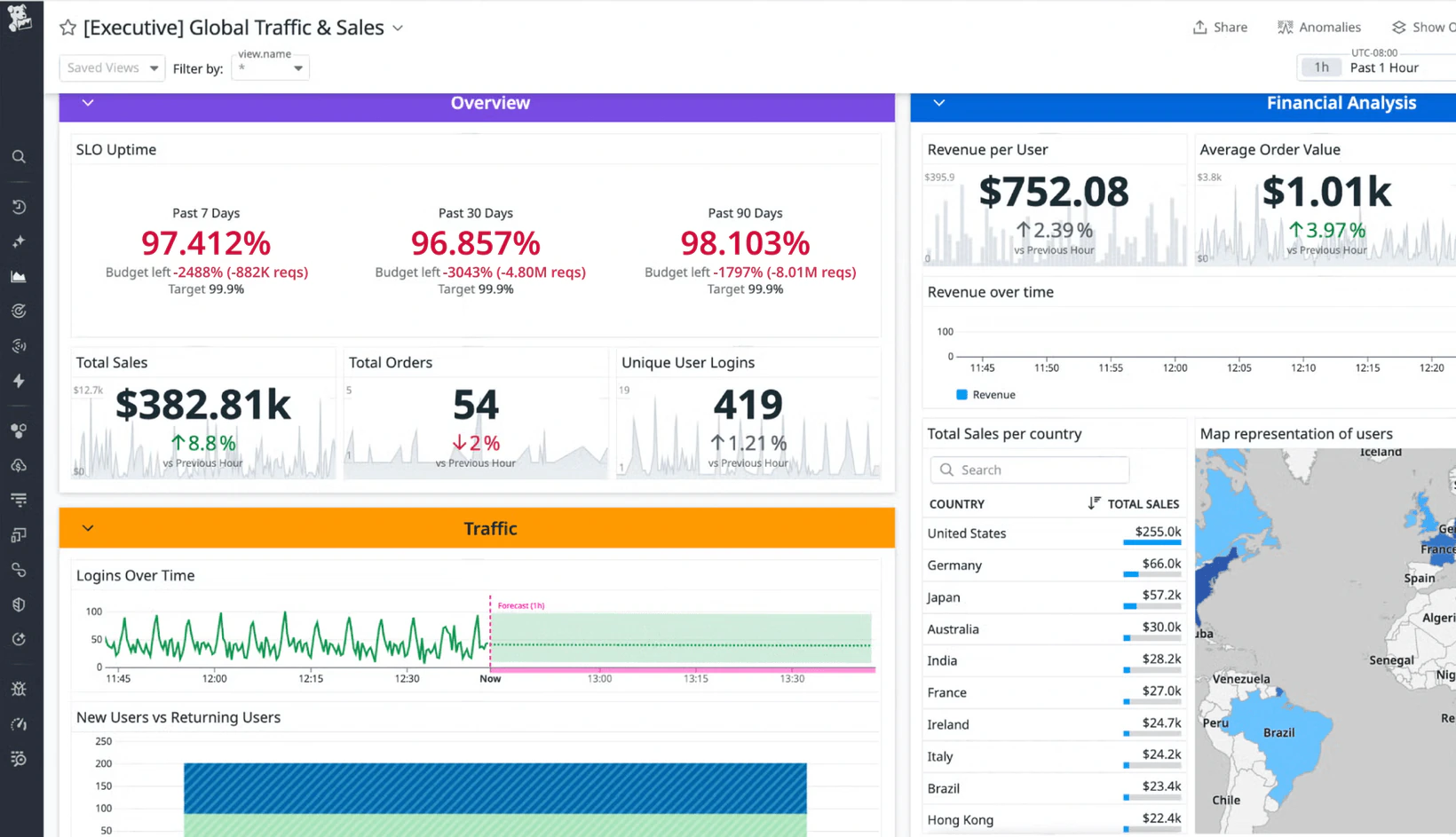
 Every vital on a dashboard.
Someone still has to ship the fix.

Done for you.
Automatic optimizations, measured on real users.
Why teams look for a Datadog alternative
Built for the whole stack, priced by the meter
Datadog bills every product feature like RUM or analytics separately. Web teams end up forecasting sessions, retention filters and add-ons before they can answer a simple question about page speed.
Finding the cause takes an engineer
Datadog can follow a slow page down to traces, profiles and code, which is powerful if you know where to look. With a steep learning curve, growth teams usually need engineering help to build the views they want.
Recommendations stop at a pull request
Datadog’s RUM recommendations and Bits AI can investigate a slow page and suggest a code change or open a pull request. Someone still has to review, merge and deploy it, and visitors keep getting the slow page until then.
Powerful, but hard to predict and hard to learn
What to look for in a Datadog alternative
Most RUM tools track Core Web Vitals similarly. Before you switch, check what the tool can see, and what happens after a metric turns red.
Does it see every browser your visitors use?
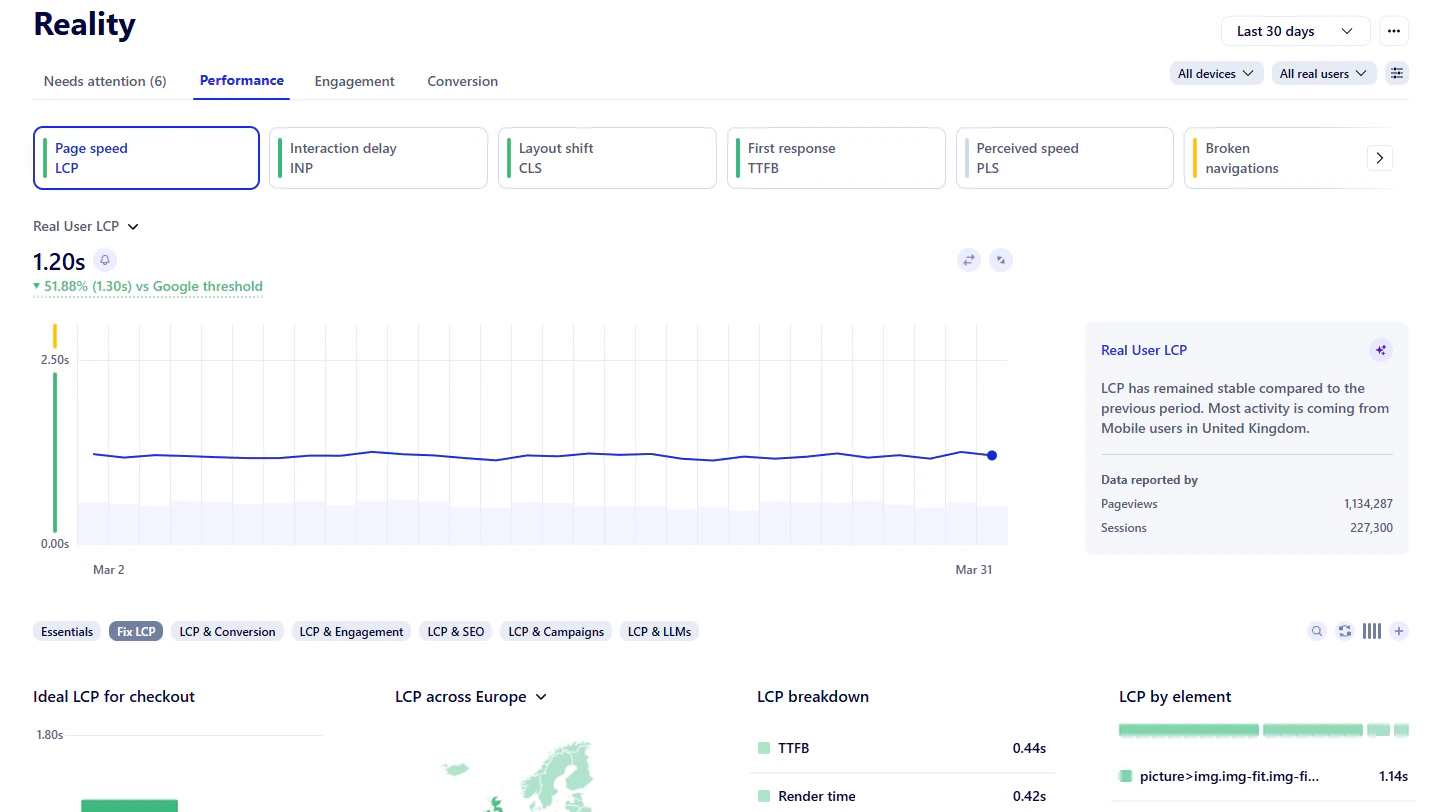
Many RUM tools rely on browser APIs that Safari only partly supports, so iPhone traffic shows up with missing vitals. Look for field data from every browser and device, including Safari and iOS.
Is every session measured, or only a filtered slice?
Sampling and retention filters can limit the sessions you can drill into later. Check that every real session is measured and can be segmented by page, device, browser and campaign.
Does it act on what it finds?
Alerts and code suggestions still wait for a sprint. Look for agents that improve LCP and INP on the live site and show the before and after on the same real-user data.
Does performance connect to conversion?
A slow checkout costs more than a slow blog post. Your RUM tool should show which pages and segments cost you conversions, and set Core Web Vitals targets from your own conversion data.
Uxify vs Datadog
A direct comparison of how both platforms handle real user monitoring, Core Web Vitals and what happens next.
See the full comparison
Why choose Uxify as your Datadog alternative?
Real user monitoring that sees every visitor, and agents that act on it.
Field data you can trust, on every browser
Uxify measures 100% of sessions, unsampled, on every browser and device, including Safari and iOS. You get hour-level data with no 28-day CrUX delay and 60+ breakdowns by page, device, browser, country and campaign.
Agents fix what the data shows
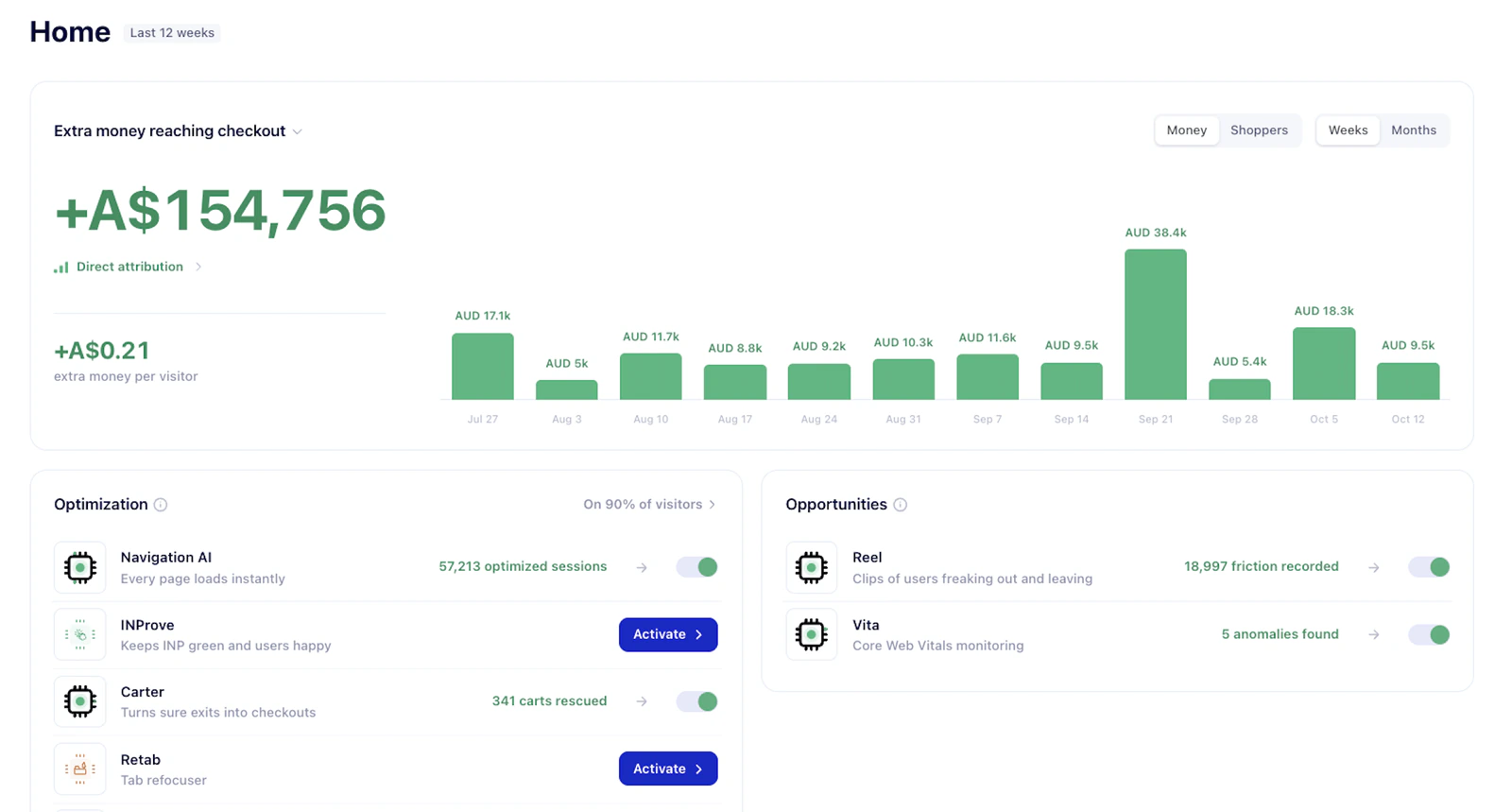
Navigation AI prerenders the page each visitor is likely to open next for up to 55% faster navigations. INProve reschedules main-thread work to target INP under 200ms, and Vita catches regressions on every page and device with the cause and a suggested fix.
Optimizations tied to conversion
See what every agent and fix has done for your bottom line, from faster pages to saved carts. Each gain is tied to the change that earned it, so you always know the value Uxify brings.
Your data, where you need it
Uxi, the assistant built into Uxify, lets you chat with your data. Uxify also connects through MCP to Claude and other AI tools, so the insights come to you where you already work, instead of you going to look for them.
Other Datadog competitors and alternatives to consider
| Tool | Best for | Main difference from Uxify |
|---|---|---|
| New Relic | Engineering teams that want full-stack observability | Browser monitoring reports problems but doesn’t fix them |
| Dynatrace | Large enterprises with complex environments | No agents that optimize the website |
| Grafana Cloud Frontend Observability | Teams already running Grafana and open-source tooling | Flexible, but you build the dashboards and alerts yourself |
| Sentry | Developers debugging frontend errors with session replay | No link between speed and conversion |
| SpeedCurve | Performance teams that want synthetic tests and RUM | Making the page faster is left to your team |
| DebugBear | Teams tracking synthetic, RUM and CrUX data | No agents that act on the live site |
Why is Uxify the best Datadog alternative?
If you need to watch servers, logs and traces, keep Datadog for that work. If your job is a faster website and more revenue from every visit, Uxify measures every real visitor, fixes performance problems automatically and ties improvements with your bottom line.
Frequently asked questions about Uxify vs Datadog
What is the best Datadog alternative?
It depends on what you use Datadog for. For full-stack observability, New Relic, Dynatrace and Grafana Cloud are the usual alternatives. If your focus is website performance and real user monitoring, Uxify is the stronger Datadog alternative because it measures every session on every browser and uses AI agents to make pages faster.
What is the best Datadog RUM alternative?
For web, ecommerce and growth teams, Uxify. It covers Core Web Vitals, TTFB and behavior signals for every real session, ties them to conversion, and adds agents like Navigation AI and INProve that improve the numbers on the live site. If you need a RUM that links straight into backend traces, Datadog or New Relic fit better.
How much does Datadog RUM cost?
Datadog prices RUM per 1,000 sessions a month. On annual billing, RUM Measure costs $0.15 per 1,000 sessions for metrics on all traffic, and RUM Investigate costs $3 per 1,000 sessions you keep for detailed analysis. Session Replay adds $2.50 per 1,000 sessions and Product Analytics is $0.80 per 1,000 sessions, with higher month-to-month and on-demand rates.
Does Datadog have a free tier?
Datadog’s free plan covers infrastructure monitoring for up to 5 hosts with 1-day metric retention. RUM, Session Replay and Product Analytics are paid products you can try during a free trial. Uxify offers free real user monitoring.
Does Datadog sample RUM data?
It can. With RUM without Limits, Datadog computes performance metrics on all ingested sessions, then keeps full session detail only for the sessions that match your retention filters, stored for 30 days. Uxify measures every session without sampling, so you can segment any of them by page, device, browser, country or campaign.
Does Uxify have session replay like Datadog?
Reel automatically clips the friction moments in real sessions, like dead clicks, U-turns and loading exits, and ranks them by revenue impact.
Can Uxify replace Datadog?
For website performance and real user monitoring, yes. Uxify does not cover APM, logs, infrastructure, synthetic lab tests or native mobile apps, so many teams keep Datadog for the backend and use Uxify for the website. For lab tests, Lighthouse works well alongside Uxify.