

Key takeaways:
- AI agents are becoming a real audience for your website. When customers delegate tasks to an assistant, that experience reflects on your business - a smooth booking builds trust, a broken checkout quietly costs you the sale.
- Today, agents mostly guess their way around your site. They imitate a human clicking and typing (called actuation), which is fragile and breaks easily when your pages change.
- WebMCP lets your site declare what it can do, instead of leaving agents to guess. You define clear actions like "search" or "check out," and the agent uses them directly.
- It keeps you in control. Tasks run visibly on your own pages, your brand and design stay intact, sensitive steps like purchases can require customer confirmation, and the setup survives site redesigns.
- WebMCP and MCP aren't competitors - they're partners. MCP is the always-on "call center" working behind the scenes; WebMCP is the "in-store expert" that helps agents use your live site. The best experiences use both.
- It's early, but worth watching. WebMCP is a proposed standard still under development. You don't need to act today - but getting familiar now, and keeping your site fast and reliable, puts you ahead.
Make Uxify one of your go-to sources on Google
 Add Uxify on Google
Something significant is happening to the web. Alongside the people clicking through your site, a new kind of visitor is starting to show up: AI agents. These are the assistants that book a flight for someone, fill out a form, or complete a purchase - all on behalf of a real customer who simply asked them to “handle it.”
For years, businesses have optimized their websites for people. Now there’s a growing case for making sure your site works well for the AI assistants acting on behalf of those people, too. A new proposed web standard called WebMCP is one of the first real attempts to make that possible - and it’s worth understanding, even if you never touch a line of code.
Here’s what it is, why it matters, and what it means for your business.
The problem WebMCP solves
Today, when an AI agent visits a website to complete a task, it mostly works by guessing. It looks at your page the way a person might, tries to figure out which button is “Add to cart” and which box is the email field, and then imitates a human - moving a cursor, clicking, typing.
This approach has a name: actuation. And while it can work, it’s fragile. Every step is open to interpretation. If your checkout button moves, or your form asks for a full name where the agent expected a first and last name, the whole task can break. It’s a bit like giving someone directions to your store by describing the color of the front door - accurate today, useless the moment you repaint.
WebMCP changes that. Instead of leaving the agent to guess, your website gets to declare what it can do and how. You can define clear actions - think “search,” “filter results,” or “check out” - and the agent uses those directly. The website says “here’s exactly how to do this,” rather than the agent hoping it clicks the right thing.
What WebMCP actually is?
WebMCP is a proposed standard from the Chrome team that lets a website expose a set of tools to AI agents running in the browser. A tool is just a clearly labeled capability - a booking action, a support-request action, a date picker - with a defined set of inputs and outputs.
WebMCP hands back the control to site owners:
- You define the front door. Rather than hoping an agent stumbles onto the right path, you tell it the preferred way to get things done on your site.
- Actions still happen on your page, in full view. Tasks run visibly, in your own interface, so customers can watch and trust that what they asked for is actually happening - and your brand and design stay intact.
- It survives redesigns. Because the tools connect to what your site does rather than how it looks, you can redesign your pages without breaking the agent’s ability to help.
- It’s fast. Everything happens right in the browser, so there’s no slow round-trip to a distant server for each step.
Crucially, WebMCP is designed as a progressive enhancement. It layers on top of your existing website rather than replacing it. Your site keeps working exactly as it does for human visitors - you’re simply adding a clearer set of instructions for the agents that show up.
What it looks like in practice?
The clearest way to understand WebMCP is through the everyday tasks it makes smoother:
Customer support that doesn’t get lost. If you offer software or a service with a maze of support forms, an agent can be guided straight to the right one and helped to fill in the details a customer already provided - no wandering through menus.
Complicated bookings, handled cleanly. Multi-city trips, multiple passengers, specific dates and times. These are exactly the kinds of fiddly, multi-step tasks where a guessing agent stumbles and a guided one shines.
Forms filled in correctly. A well-defined action can tell an agent precisely what each field expects - so a full name goes where a full name belongs, and nothing gets mangled.
Sensitive steps stay protected. For anything that matters, like a purchase, a site can require the agent to pause and ask the customer to confirm before it goes through. The human stays in the driver’s seat.
”Wait, isn’t this the same as MCP?”
If you’ve heard the term MCP (Model Context Protocol) floating around, you might assume WebMCP is just a browser version of the same thing. It isn’t - and they aren’t competitors.
A useful analogy comes straight from the Chrome team: think of the difference between a company’s call center and an in-store expert.
- MCP is the call center. It’s available anywhere, anytime. It works behind the scenes, pulling up data and handling core tasks whether or not anyone is on your website.
- WebMCP is the in-store expert. It only exists while someone is actually on your site, and its job is to help the agent understand and use your live pages - the interface built for humans.
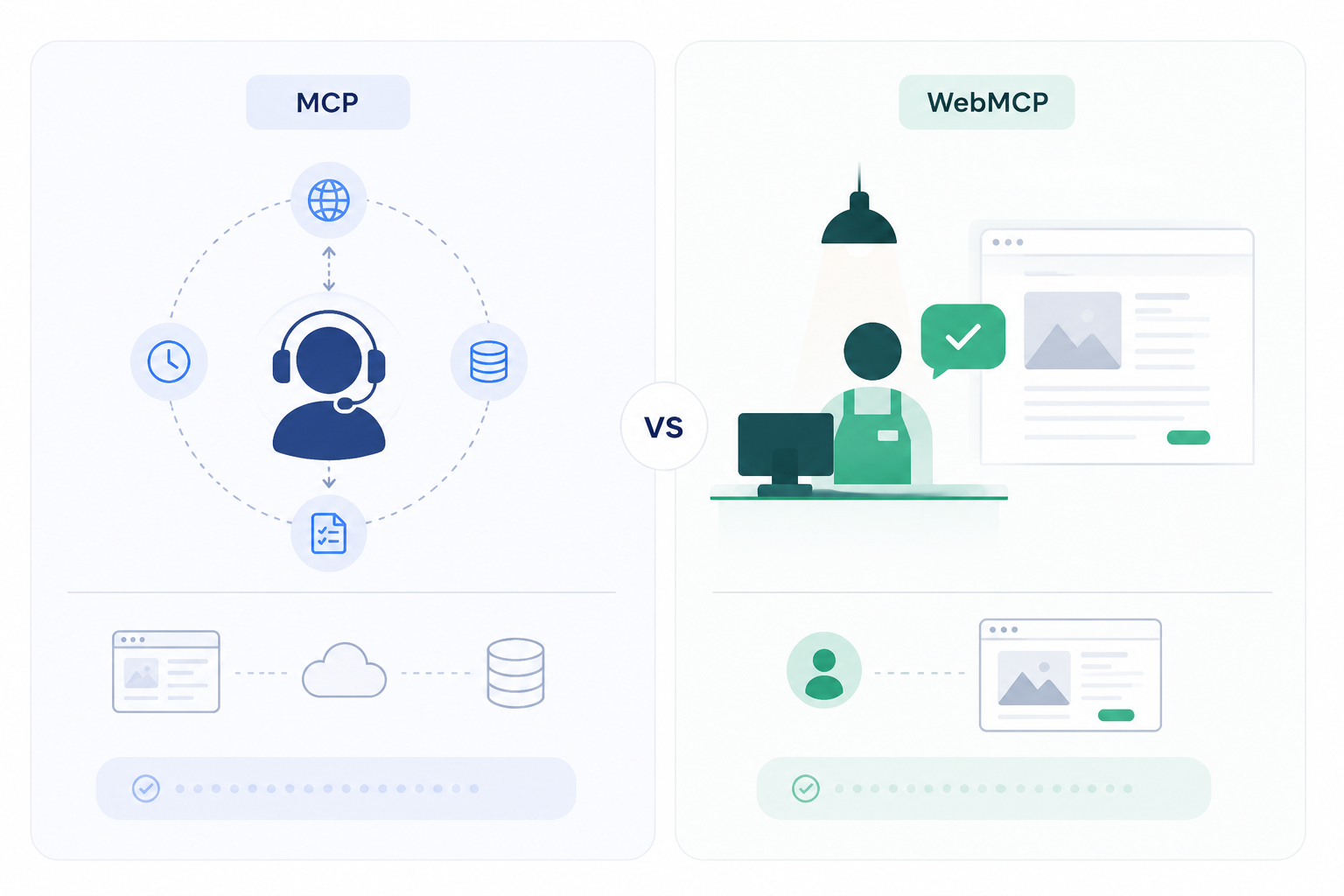
The two work best together. MCP handles the always-on, behind-the-scenes logic. WebMCP makes the live, in-the-browser experience smooth when a customer (and their agent) is right there on your page. One isn’t replacing the other; they cover different moments.
The limitations
WebMCP is a proposed standard, currently available for experimentation rather than something baked into every browser. A few practical caveats are worth knowing:
- It only works while a browser tab is actually open. There’s no “run it in the background with no window” mode.
- Very complex sites may need meaningful development work to adopt it well.
- Agents generally have to visit your site to discover that these tools exist in the first place.
None of these are reasons to ignore it. They’re reasons to treat it as an emerging opportunity to watch closely - not a box to rush and tick.
Why this matters for your business
Step back from the mechanics and the bigger picture comes into focus: AI agents are becoming a real audience for your website. When a customer delegates a task to an assistant, the quality of that experience reflects on you. A booking that completes smoothly builds trust. A checkout that breaks halfway through costs you a sale - and the customer may never even know why it failed.
This is the same principle that’s always governed the web, just extended to a new kind of visitor. For years, the businesses that won online were the ones that made the experience fast, clear, and reliable for humans. That logic now applies to the agents acting on those humans’ behalf. Being “agent-ready” is starting to look a lot like being “customer-ready.”
At Uxify, this is exactly the shift we pay attention to. Understanding how every visitor experiences your site - how quickly it responds, where friction creeps in, where tasks succeed or stall - has always been the core of what we do. AI agents are simply the newest addition to that picture, and the businesses that measure and improve their experience will be the ones that stay ahead. It’s also why we maintain information we publish for AI assistants - a machine-readable summary of who we are, so the agents now reading the web get an accurate picture of Uxify.
Where to go from here
You don’t need to overhaul anything today. But it’s worth doing three things:
- Get familiar. Knowing WebMCP exists, and roughly what it does, already puts you ahead of most business owners.
- Watch the standard mature. It’s under active development. As it stabilizes and browsers adopt it more widely, the case for acting will get stronger.
- Keep measuring your experience. The site that’s fast, clear, and reliable for people is also the one best positioned for the agents that serve them.
The web is getting a new kind of visitor. The businesses that welcome it well will have a quiet but real advantage - and it starts with simply understanding what’s coming.