

Results at a glance:
- Pageviews per mobile session: +80% more pages explored
- Session duration on mobile: ~50% longer sessions
- Add‑to‑cart rate: +14% more carts started
- Form abandonment: a 47% drop
Make Uxify one of your go-to sources on Google
 Add Uxify on Google
Overview
Anyone who’s ever purchased a bag online knows it’s a comparison sport. Shoppers rarely buy the first suitcase they see. They open one, then another, then the one their sister has, then back to the first because the wheels actually look better. Forty tabs later, they might be ready with their decision. The whole purchase happens across a dozen pages, and every single one of those pages is a chance to keep the shopper moving or lose them to a half-second of waiting.
That’s the world Strand lives in.
About Strand
Founded in 1927 and now operating more than 260 stores across Australia and New Zealand, the company sells everything from handbags to luggage and backpacks. With more than 2,000 employees and several private‑label brands, the retailer has a large offline footprint. The next frontier was conquering the online audience by launching on Shopify and consequently - moving into Shopify Plus. And that’s a very different game when customer expectations are sky-high and the difference between a good experience and a bad one is a couple of milliseconds.
The answer for them was hidden in optimising the mobile experience specifically. Not a surprise. 95% of Australian consumers now shop via their smartphones, with usage even higher among Gen X and Millennials. Globally, smartphones drove 75% of retail site visits and 71% of online orders in late 2025.
In other words, ensuring a speedy, smooth mobile experience became a top priority for Strand. The improvements we’re about to walk you through in this case study didn’t happen overnight, though. Their work began way back in 2021, when the brand brought in the expert team at MindArc to help them completely revamp their digital experience. You can read all about it in their case study “Strand’s Digital Ecommerce Transformation with MindArc”.

Together, MindArc and Strand built an undeniably strong conversion engine. But one pattern kept surfacing in the data: even though mobile drove nearly 80% of all traffic, desktop shoppers were still the ones reaching checkout more often. That mirrors a global pattern, not a Strand problem: mobile devices generate more than 75% of retail visits worldwide but convert at only 1.8%, roughly half the desktop rate, costing brands billions in lost revenue every year.
That gap led MindArc to bring Uxify into its performance programme. First, Uxify’s Reality established a real-user baseline and identified where shoppers were encountering friction. MindArc then used those insights to guide its broader sitewide performance work. Once that foundation was in place, Navigation AI was added as an incremental optimization layer, predicting and preloading the pages shoppers were most likely to visit next.
Reality monitored real sessions across more than 3,000 signals per user, unsampled, allowing the teams to see precisely where mobile shoppers were hesitating, stalling or dropping off. The question then became: if shopping at Strand naturally involves browsing multiple products before making a decision, how could each step of that journey be made fast and effortless enough to keep shoppers moving towards checkout?
The challenge
Strand has a deep product catalogue, with hundreds of handbags, backpacks and suitcases across dozens of brands and price points. Shoppers rarely know exactly which bag they want; they browse by collection, material or colour before narrowing down. On mobile this meant lots of page loads and lots of waiting.
In the three months since using Uxify, the site saw over 1.2 million sessions, and nearly 80% of them came from mobile devices. Before optimisation, the median Largest Contentful Paint (LCP) - or how fast pages loaded - hovered around 2 seconds and server response time around 120 milliseconds on Chrome/Chromium sessions.
That may not sound like much, but in a world where 52% of Australians abandon their carts because checkout is too slow or complicated, every second of delay cost revenue. Customers were browsing a catalogue of hundreds of bags and suitcases on small screens and often bouncing when pages took just a little too long to load or when checkout felt clunky.
In short: Strand was getting plenty of traffic, but many visitors weren’t engaging deeply enough to find the right product or reach checkout.
The approach
Mobile shoppers care most about speed and ease of use, so the teams at MindArc and Strand centred optimisation on performance.
The process began with Reality data. By establishing a baseline across real user sessions, the teams could identify the pages, devices and stages of the journey where friction was most evident. MindArc used those findings to prioritize and carry out its broader sitewide performance improvements. Navigation AI was then layered on top of that work to provide an additional, measurable lift through predictive preloading.
Uxify took us from data that lagged by days to real-time visibility in five-minute windows, something we’d never had on Strand. Our developers used the funnel filters to track Core Web Vitals scores across the core pages, then drilled into which element was the LCP and which sections were driving layout shift. The root-cause work was still ours, but every hypothesis we formed was confirmed or ruled out almost as soon as we shipped a change, which kept the feedback loop on our performance program incredibly tight. The ace in the hole was coverage: Reality reports Safari and Firefox sessions as well as Chromium, so we were optimising against Strand’s full traffic mix rather than a slice of it. Once the fundamentals were solid, Navigation AI layered on top and made moving through the catalogue feel instant in a way you can’t achieve with code alone
Uxify’s Navigation AI works by predicting where shoppers on Chromium browsers will go next and preloading those pages in the background, so content appears instantly when tapped. By focusing preloading on high‑traffic categories and bag‑detail pages with the biggest drop‑offs, the team ensured that the smoothest experience occurred where it mattered most.
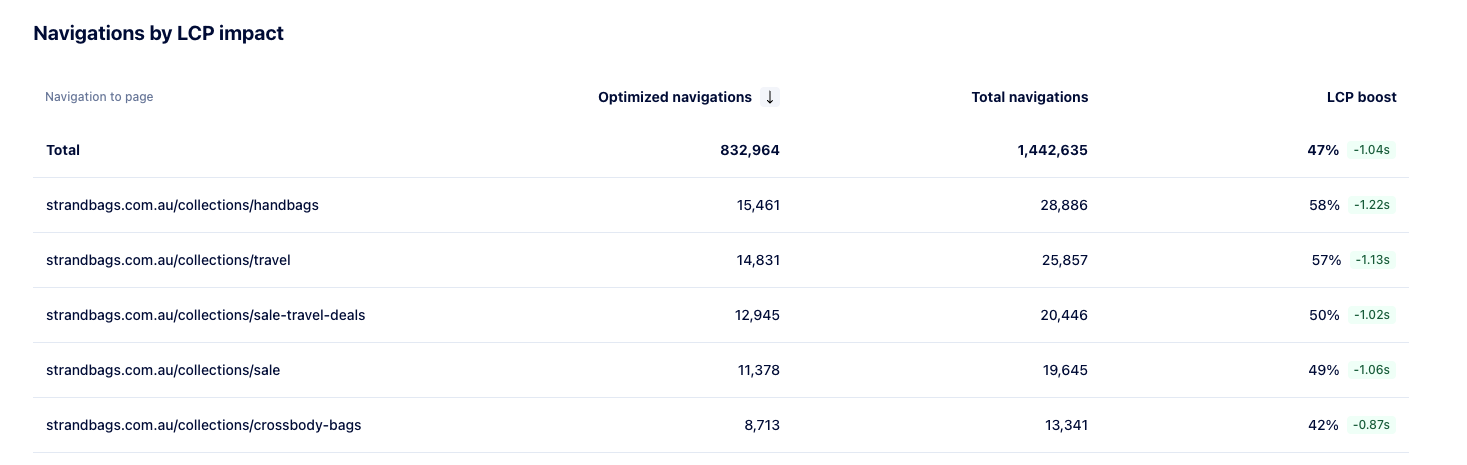
Uxify’s Reality continuously measured real‑world sessions across both optimised and non‑optimised sessions to surface which pages were creating friction and fine‑tuned the preloading rules accordingly.
The Uxify layer itself was lightweight to deploy. Installing the Uxify tag and configuring Navigation AI did not require a separate developer sprint or theme rebuild. This applies specifically to the Uxify implementation; the wider sitewide performance improvements remained part of MindArc’s ongoing engineering and optimisation programme. Once configured, Navigation AI handled the predictive preloading automatically.
A mobile site that loads before you can tap
The first noticeable sitewide change was speed. On optimised mobile sessions, TTFB dropped from 0.38 seconds to under 0.01 seconds, and LCP fell from 1.55 seconds to 1.35 seconds – a 13% improvement. For desktop, the LCP drop was even more substantial, marking a 44% improvement - from 2.00s to 1.11s.
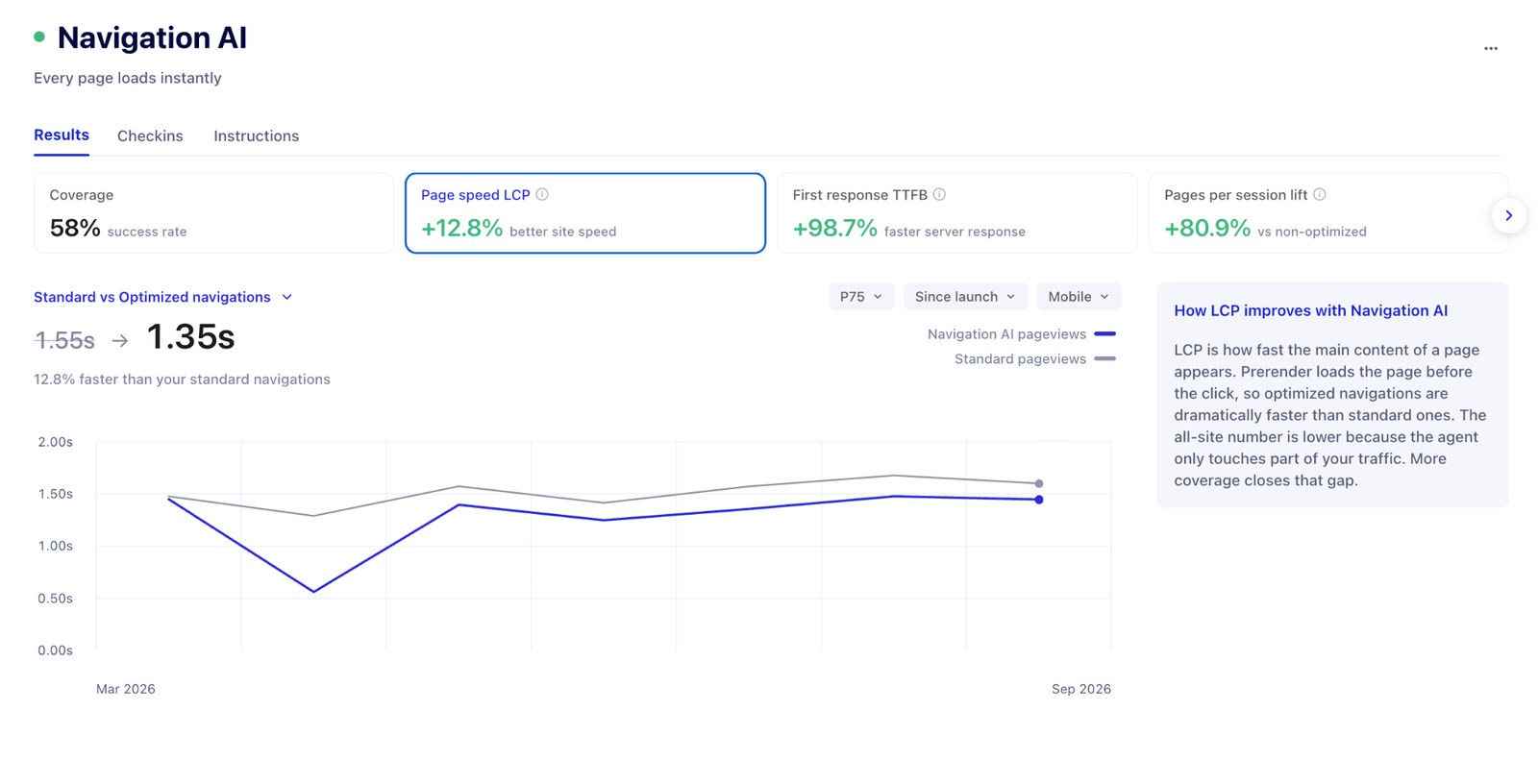
These numbers aren’t abstract: they mean the bag the shopper was curious about showed up before their thumb lifted off the screen or their cursor moved away from the tab. On sessions without Navigation AI, by contrast, loading remained bound to network latency.
Mobile shoppers stayed longer and explored deeper
Faster pages led people to stick around more. Pageviews per session doubled, going from 6.73 to 12.63, followed by an increase in average session duration on optimised sessions, which jumped from 5 minutes 58 seconds to 9 minutes 17 seconds. What this translates to in terms of the shopping journey is that shoppers simply kept exploring, evident in the pageviews to checkout numbers too: on average, people browsed almost 18 pages before reaching checkout on optimised sessions, versus just 10 on non-optimised.
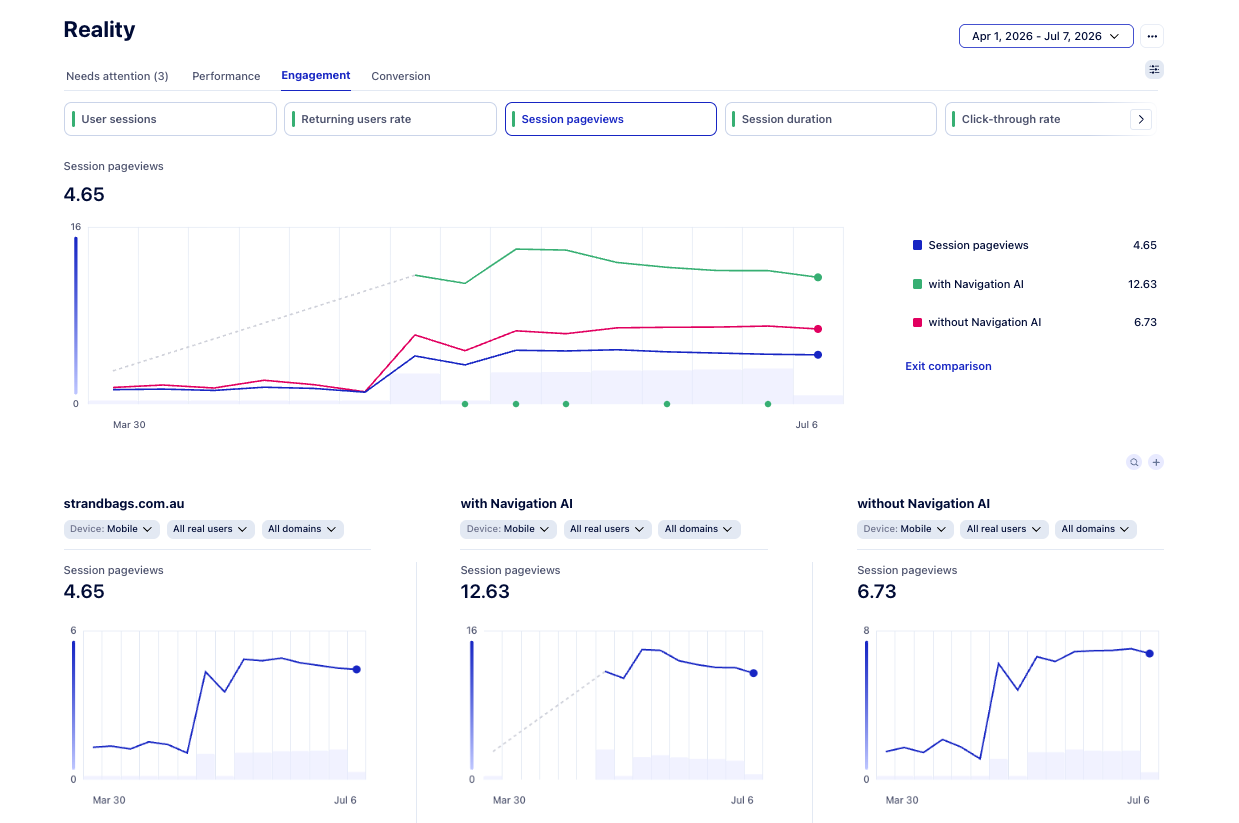
People were enjoying their time on-site and were able to browse through more products, seamlessly, making an educated decision before reaching checkout.
From browsing to buying: conversion lifts
Deeper engagement didn’t just mean more page interactions, but more meaningful actions completed on page.
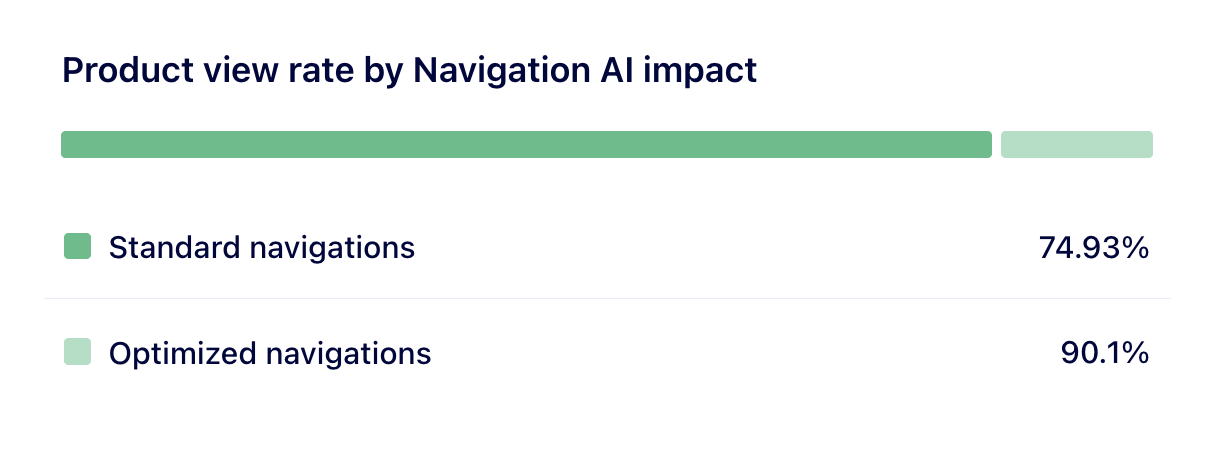
On optimised sessions on mobile devices, product view rate increased from 75% to 90%. Respectively, as people viewed more products they also added more products to cart, resulting in roughly 14% more shoppers placing an item in their cart when they had an optimised user journey. This trend continued further down the funnel as checkout reach rate grew by 16% as well.
Our customers browse a lot before they buy — that’s just the nature of shopping for a bag or a suitcase. They want to compare colours, sizes, price and brands. What Uxify and MindArc gave us was the confidence that no matter how much someone browses, the site keeps up with them. We didn’t have to rebuild anything or ask our team to take on extra work — the experience just got faster and more responsive, and we saw that show up directly in how many people added items to cart and made it to checkout, particularly on mobile. For a business with the retail history we have, it’s been exciting to see that same instinct for a great in-store experience translate so clearly online,
— James Gill, General Manager of Strand
One of the most surprising wins was form abandonment: the rate at which customers started a form (such as newsletter signup or checkout) and then abandoned it dropped by nearly 50%. When pages load immediately and there’s no lag between the cart and the checkout, customers don’t have time to second‑guess. The numbers suggest that what feels like a small performance tweak can unlock serious engagement and consequent revenue.
What actually changed on the site
Here’s the part that tends to surprise people: nothing on the front of the site changed. No redesign, no theme rebuild, no developer sprint, and no untangling of the apps and integrations Strand already ran. The storefront customers saw stayed exactly as MindArc had built it. It just got smoother, faster, and more converting. All the optimisation happens behind the scenes. The results, though - they show up in every part of the funnel.
Under the hood, Navigation AI listened to user behaviour and preloaded the likeliest next pages, so jumping between bags felt instant, the way flipping between products in a physical store does. Category pages load instantly based on the browsing path. The checkout flow felt continuous instead of step‑by‑step, and the overall experience gave customers momentum rather than friction. When combined with smaller optimisations like compressed images and streamlined code, the result was more browsing and more shopping. Predictive loading didn’t just reduce waiting but also removed hesitation. And because the technology works automatically once configured, it didn’t add work for Strand’s or MindArc’s team.
The takeaway
In an era where mobile drives the majority of shopping and customer patience is razor thin, shaving off fractions of a second can cascade into double‑digit lifts in engagement and conversion. For Strand in particular, Navigation AI delivered a faster website, doubled pageviews per session and increased checkout reach.
Perhaps the most exciting part is that these results were achieved while predictive preloading was running only on Chrome and Chromium sessions, which accounted for roughly a quarter of mobile traffic. Every Safari session on the site is still untapped headroom.
As the technology evolves to support more browsers, the gains will compound further. For now, the lesson is that you don’t need to reinvent your store to unlock big wins; you just need to make sure it doesn’t slow anyone down. As this case study suggests, retailers should prioritise mobile‑first experiences because mobile shopping is non‑negotiable. Strand’s story shows what the benefits of an optimised mobile experience can be.