
Key takeaways:
- Optimising for AI means going past the rigid keyword matching of traditional search and focusing on conversational intent.
- Your primary goal is to secure visibility by providing highly original content that AI search engines like Perplexity can easily retrieve and cite.
- You must structure your content clearly so AI systems can easily extract facts for Google AI Overviews and similar search features.
Make Uxify one of your go-to sources on Google
 Add Uxify on Google
SEO is shifting, as AI engines now synthesise web information to answer user queries directly, often without requiring a click to go to the website. We’re looking at a new infrastructure that crawls and reconstructs your content to serve immediate answers, moving away from a purely link-based referral model.
While your expertise still builds trust with human readers, even your formatting choices carry massive weight in helping AI algorithms actually parse and cite that expertise.
How AI search differs from traditional SEO
Traditional SEO strategies focus heavily on mapping specific user intents to dedicated landing pages through optimised content and authoritative backlink profiles. LLM SEO operates slightly differently: the goal shifts toward becoming a trusted, highly relevant entity that an AI engine cites when synthesising an answer.
There are two primary information sources for an LLM: training data and search. Getting into training data is easy - large language models are so data-hungry that there are predictions that we’ll run out of human-written content by 2030 or even earlier.
So, if your website exists and is findable online in any shape or form, it’s highly likely that you’ll get into the training data. The issue, however, is that models are retrained from the ground up only every few years since it’s an incredibly expensive process. So, if you missed one training iteration, it might take a bit before a second one is initiated.
To avoid pulling out outdated information, LLMs use a second way to source and synthesise information – retrieval (or, simply, internet search). ChatGPT, Claude, and many others will take your query, split it up into many different potential keyword groups, search them all on a search engine like Google, read through the answers, and return the information.
While an LLM still uses Google, Bing, and some other search engines, the ability to make dozens of searches and read through ten times as many pieces of content is what separates an LLM and a human.
In practice, there are two concepts you need to keep in mind:
- Since AI search covers more ground, the good part is that you don’t need to fight over a single SERP to get visibility on a topic.
- The bad part is that to get consistently listed, you need to appear on more searches than before.
Search rankings vs AI citations
Securing the top organic spot loses its impact if your brand is consistently excluded from the AI Overviews that appear above the fold and instantly satisfy the user’s curiosity. Seer Interactive research shows that being cited in AI Overviews increases clicks by +120% per impression.
While entity SEO isn’t new, AI search heavily accelerates it, relying completely on the complex relationships between concepts and brands rather than traditional keyword mapping.
Entities solve an underlying problem for all information retrieval systems – how can you deduce whether something (e.g., a business) or someone exists outside of text? After all, you can write just about anything online.
So, an entity is often understood as a subject with a definite description that can be confirmed on various sources. It’s not entirely clear how AI and search engines attach subjects and descriptions, but consistency seems to be a key factor.
How large language models find information
The mechanics of how these platforms pull data shape your approach to optimizing content, meaning you need to understand the difference between static training weights and live retrieval.
- Training data vs real-time retrieval. Models rely on massive historical datasets for baseline knowledge, but constantly ping live web sources to ground their answers with current facts, product details, and up-to-the-minute data.
- RAG (Retrieval-Augmented Generation). This specific architecture allows AI systems to fetch relevant external documents during the generation process so they can inject accurate, cited facts directly into their responses.
- Crawlers and AI bots: Specialized agents like PerplexityBot and OAI-SearchBot continuously scour the internet to build fresh search indexes that feed these generative summaries.
A lot of the above involves either searching and then visiting your website; therefore, blocking AI crawlers is not recommended. You must ensure these bots can easily crawl and parse your pages. If they hit a robots.txt block or rendering issue, your data will never reach the final user.
There are also ways you can improve content findability for when the AI crawler arrives. The file llms.txt (just like robots.txt) is a hotly debated topic – it was proposed and added to the website by many SEOs, but technical research found that AI crawlers never visit the file. On the other hand, Google recently added the same file to Lighthouse reports, so there might still be some merit to it.
The core ranking factors for LLM SEO
There’s no fixed formula for getting cited by every LLM yet, since each engine picks sources differently and keeps changing how it does so. Still, a few factors show up consistently among brands that do get cited, and those are worth focusing on.
In short, you must provide clear trust signals so these algorithms can confidently present your data to users, regardless of how simple or technical their query might be.
Third-party brand mentions
According to Ahrefs, accumulating authentic brand mentions across various industry publications builds immense trust within algorithmic knowledge graphs. While backlinks are still important, AI search seems to give as much weight to third-party mentions, even if there’s no link included.
Entity SEO becomes more important as it’s likely that the crawler would check to confirm that it’s the same entity (e.g., Apple the company, not apple the fruit); therefore, having different descriptions of your company, people, or service might confuse the crawler and reduce the likelihood of getting cited.
Topical authority and content freshness
Publishing a focused, tightly interconnected cluster of detailed articles establishes your site as a definitive source for a specific subject area. Showcasing real human expertise with provable credentials is also highly important as it strongly signals to algorithms that your insights should carry more weight than generic scraper sites.
Another key factor is content freshness, especially for AI search. Updating your articles regularly ensures that real-time retrieval bots find the most current statistics when they scan your domain. AI models seem to prefer fresh content more than traditional search engines.
Structured data
Another hotly debated topic is content structuring. As far as it’s known, no extremely novel website structuring is required. Most AI crawlers are built with scraping HTML code in mind; therefore, they remove all code syntax before even processing.
Strategies like chunking are merely new names for what we’ve been doing for hundreds of years – writing well-written paragraphs. There’s a small technical optimization that can be made for headings that are direct or pseudo-questions, which is answering the question in the first sentence.
One option that seems to work is adding Schema markup. It’s also used by Google, so adding markup for FAQs, companies, persons, authors (as much as is reasonable) usually helps with content categorisation.
LLM SEO technical optimization
Your brilliant content accomplishes absolutely nothing if the generative bots time out while rendering your complex JavaScript framework. At Uxify, we see this constantly: companies publish great content but fail at the delivery.
Site speed, structure, and rendering
Delivering your content quickly ensures that real-time retrieval bots can fully parse your page before hitting their strict timeout limits. While they’re likely to retry, that’s simply adding a potential failure rate to your process.
Most of the time, crawlers will “walk around” your website using internal navigation, i.e., internal links. Implementing a logical structure first, then linking everything together, is the way to go. Connecting your pages with descriptive anchor text passes topical relevance throughout your site so AI models understand the relationship between your ideas, much like in traditional SEO.
Additionally, using proper semantic HTML tags creates a clear document structure, helping bots easily identify which parts of your page hold the most core information.
Getting ready for AI agents
AI tools are starting to do more than read your pages. Agents built into browsers and assistants can open a site, compare products, fill in forms, and move toward a purchase on the user’s behalf. That’s the reason Google has added an agentic browsing section to Lighthouse, which includes the llms.txt check mentioned above.
The basics that help crawlers help agents too. Pages that load fast, render without depending on heavy scripts, and use clear buttons, labels and form fields are easier for an agent to understand and act on. A pop-up that covers the page or a checkout step that only works after a long script finishes can stop an agent just as easily as it frustrates a human visitor.
How to get mentioned in ChatGPT & other LLMs
You need to take a proactive approach by associating your brand name with the specific problems you solve.
- Build brand authority. Generating consistent chatter across social platforms, forums, and partner sites creates the brand mentions these models crave.
- Earn high-authority mentions. Securing features on massive media domains injects your company directly into the highly trusted data streams these engines prioritise.
- Publish original research. Releasing unique research gives the industry a reason to cite your work, ensuring AI engines retrieve and cite you as the primary source when answering queries.
- Become a trusted source. Maintaining high factual accuracy across your published materials minimizes the risk of algorithms associating your domain with conflicting or unreliable data.
- Digital PR for AI search. Executing targeted outreach campaigns secures the high-quality placements that ultimately feed the real-time search indexes of bots like Perplexity.
Additionally, you should cover as many industry topics as possible on your own website. In some cases, that may mean producing content that is highly affected by AI Overviews and, thus, brings in low clicks.
Unfortunately, there’s no way around it. You need to both build expertise and become a source for AI, which can only be done by writing content. All AI search and SEO optimisation practices should be looked at as a long-term activity with a large overarching goal, so think of those content units as “sacrifices” that are necessary.
Finally, always try to match the EEAT guidelines as much as possible. Most of the work that needs to be done is short, quick, and simple, but the effects can be pretty large, especially if the industry is more closely monitored (e.g., finance or medical).
LLM SEO for ecommerce stores
For online stores, AI search isn’t only about blog content being cited. Shoppers now ask ChatGPT, Gemini and Google’s AI Mode which product to buy, and the answer often lists specific products with prices and links.
If you run a Shopify store, some of this is already set up for you. Since March 2026, Shopify’s Agentic Storefronts have been turned on by default for eligible stores, which means your products are shared with AI tools like ChatGPT and Claude through the Shopify Catalog. You can review these settings in your Shopify admin. OpenAI has also moved away from its own in-chat checkout, so in most cases the shopper still completes the purchase on your store. This is only one part of how AI in Shopify is changing the way stores are found and run, from product search to store operations.
That makes your own site more important, not less. A few things are worth checking:
- Product data. AI tools pick products based on what they can read about them. Clear titles, full descriptions, and concrete details such as materials, sizes and compatibility give them more to work with than marketing copy does.
- Product schema and reviews. Product, Offer and Review markup helps AI tools and Google read price, availability and ratings correctly.
- Policies and FAQs. Shipping, returns and sizing questions come up often in AI shopping answers, so make sure those pages are easy to find and up to date.
- The landing experience. A shopper who clicks through from an AI answer has usually already decided what they want. If the product page is slow or confusing at that point, the sale is lost after the hard part is already done.
How to measure LLM SEO performance
Measuring AI search is still far from clear-cut. AI tools don’t always pass on where a visitor came from, and there’s no single report that shows how often you’re mentioned, how many people click through, and what they do next. Google has started to address this, adding AI reporting to both Search Console and Google Analytics in 2026, but these reports are new and each covers only part of the journey. For now, the most practical approach is to combine a few sources and look at three things: whether you’re seen, whether people visit, and what they do once they arrive.
Are you being seen?
In June 2026, Google added generative AI performance reports to Search Console. They show how often a link to your site appeared in AI Overviews and AI Mode, and you can filter by page, country and device. The report is still rolling out, and for now it only shows impressions, with no clicks or queries.
For other chatbots, tools like Peec AI, SE Ranking, Semrush’s AI Visibility Toolkit and Ahrefs’ Brand Radar run a set of prompts through ChatGPT, Perplexity, Gemini and others, then track how often your brand is mentioned or cited. You can also test important queries by hand in ChatGPT, Perplexity and Google AI Overviews to see which sources come up.
Are people clicking through?
Since May 2026, Google Analytics 4 has a default channel called AI Assistant. It groups visits from tools like ChatGPT, Gemini, Claude and Copilot, with no setup needed. To see it, go to Reports → Acquisition → Traffic acquisition and look for “AI Assistant” in the default channel group column.
There are a few catches. The channel only counts traffic from May 2026 onwards, some tools like Perplexity may still show up under Referral, and visits from apps or copied links often end up in Direct. Clicks from Google’s own AI Overviews and AI Mode are counted as Organic Search, so you can’t separate them in GA4. If you want a second check, your server logs show which AI bots visit your site and how often.
What do those visitors do?
A visit from an AI answer is often further along than a typical search visit, because the person has already had their question answered and is clicking through to check or buy. It’s worth comparing AI-referred sessions with your other channels on engagement, pages per session and conversion.
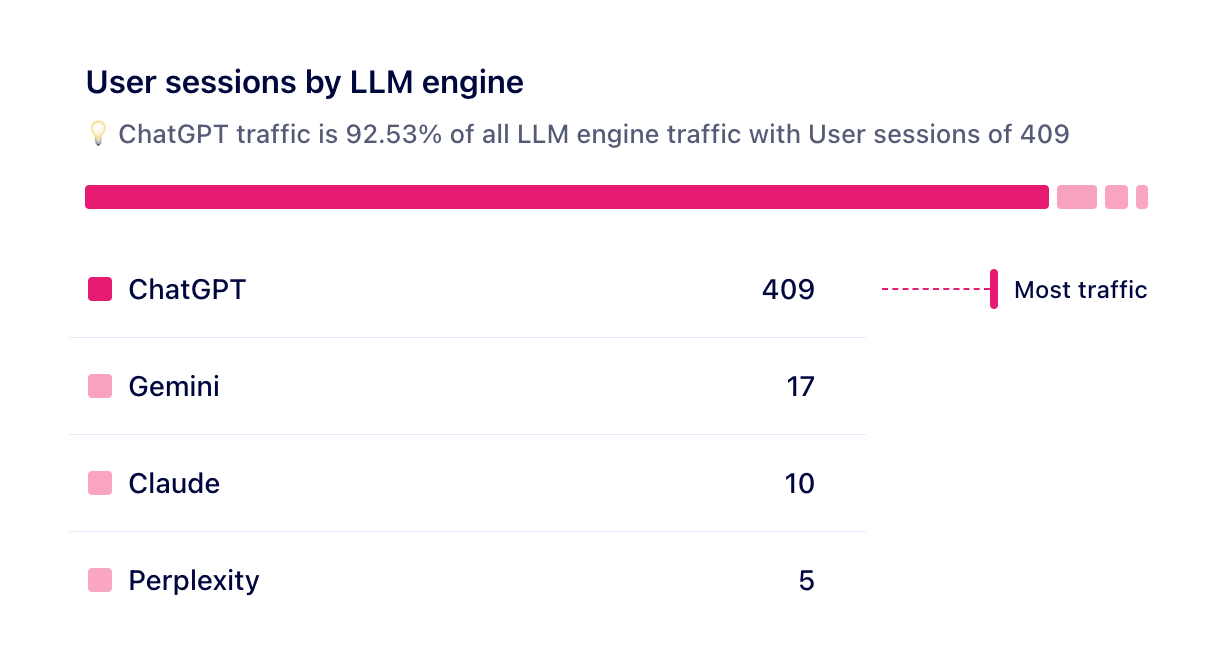
In Uxify, the Reality dashboard breaks down your real visitor sessions by the LLM engine they came from, such as ChatGPT, Gemini, Claude and Perplexity. You can then deepdive into what these users did on your website, including if they converted or not.
For one global ecommerce fashion retailer, ChatGPT brought in more than 92% of all sessions coming from AI tools, far ahead of Gemini, Claude and Perplexity. This helps you see which AI tools send you traffic, and so where it makes sense to focus your efforts.
Keep in mind that a lot of AI influence never shows up as a click. Someone might see your brand in ChatGPT and search for you on Google a week later. That’s why a rise in branded searches and direct traffic is a useful signal alongside everything above.
LLM SEO tools
Tracking success requires platforms that monitor conversational citations alongside your traditional keyword rankings.
- Google Search Console. Free, and now shows how often your pages appear in AI Overviews and AI Mode.
- Google Analytics 4. Free, and the AI Assistant channel shows visits coming from chatbots.
- Ahrefs. Tracking your inbound link profile remains critical because authority flows through the exact same pathways it always has. Its Brand Radar tool also tracks how often your brand appears in AI answers.
- Semrush. The AI Visibility Toolkit shows how often your brand is mentioned in AI answers and how it’s described compared with competitors.
- Peec AI. This platform allows you to run specific queries through various models to see exactly how often your brand appears in the synthesised responses.
- Uxify. Improving your site speed with automated preloading helps bots fetch your pages reliably before timeout windows close, protecting your LLM visibility.
- Jimdo. Building a fast-loading, easily scannable site with built-in FAQ (Frequently Asked Questions) feature gives you the technical foundation necessary to actually earn those AI citations in the first place.
Common LLM SEO mistakes
Many marketers stubbornly cling to outdated tactics that actively harm their ability to rank in these new environments.
- Over-optimising keywords. Stuffing exact-match phrases into your headers creates rigid content and ignores the semantic relationships that both modern traditional SEO and AI engines rely on.
- Ignoring entity SEO. Failing to build connections between your brand and broader industry concepts leaves the algorithms completely blind to your actual expertise.
- Thin AI-generated content. Spinning up thousands of generic articles signals to engines like Perplexity that your domain offers zero new information gain, sharply reducing your chances of being cited.
- Lack of topical depth. Skimming the surface of a subject proves to the bots that you lack the comprehensive expertise needed to act as a primary source.
- Weak brand presence. Operating quietly without accumulating substantial brand mentions starves the algorithms of the external validation they need to trust you.
- Only counting clicks. Judging AI search by referral traffic alone misses most of its effect, since many AI visits arrive with no referrer and many people who see your brand come back later through search or direct.
The future of SEO in an AI-first internet
We are moving toward an ecosystem where top-of-funnel users may rarely need to visit your website, meaning your strategy must pivot heavily toward brand syndication and ecosystem dominance.
Understanding Generative Engine Optimization (GEO) means accepting that your content often serves as retrieval data for an AI, whereas traditional SEO assumes the user will always read your actual webpage. It brings Answer Engine Optimization (AEO) into the mainstream. You must structure your content so it can be seamlessly parsed by voice assistants, embedded software agents, and AI answer engines simultaneously.
Frequently asked questions
What is an LLM in SEO?
These are large language models that process massive amounts of text to predict and generate human-like text, completely changing how we approach information retrieval. Optimising for large language models demands a focus on context, entities, and unlinked brand authority.
What is GEO in SEO?
Generative Engine Optimization (GEO) is the holistic practice of building brand authority and structuring content so generative algorithms can easily retrieve, understand, and cite your facts in their responses.
What is the difference between traditional SEO and LLM SEO?
The old way optimized for traditional search engines to secure a clickable link, while the new way optimises for inclusion within conversational AI responses directly on the results page. The goal is to earn high-visibility citations in AI Overviews, which builds immediate trust and acts as a new pathway to drive highly qualified traffic to your site.
What helps content rank in AI search?
Publishing highly original research, securing strong entity associations, and writing clear, fluff-free paragraphs drastically increase your chances of being featured in AI-generated answers.
How do I track traffic from LLMs in Google Analytics?
Since May 2026, GA4 groups visits from ChatGPT, Gemini, Claude, Copilot and similar tools into a default channel called AI Assistant. You’ll find it in Reports → Acquisition → Traffic acquisition. Some visits still show up as Referral or Direct, and clicks from Google’s AI Overviews and AI Mode are counted as Organic Search.


