Key takeaways:
- Repeated recovery questions are qualitative CRO data, not just support tickets.
- Validate a pattern with session, funnel, device, and error data before changing the site.
- Map the fix to the page or funnel step where the friction occurs, then test one meaningful change.
- Use CRO agents to monitor continuous problems such as slow pages, unresponsive buttons, dead ends, and mid-journey drop-offs.
Make Uxify one of your go-to sources on Google
 Add Uxify on Google
A cart-recovery conversation starts after a shopper leaves with items in their cart and replies to a follow-up message. Unlike a one-way reminder, the reply gives the shopper a chance to ask a question or explain what stopped the purchase.
A useful answer can help recover that order. When the same question appears across multiple conversations, it can also point to a gap in the buying experience that affects shoppers who never reply.
To get more value from recovery conversations, turn repeated questions into CRO hypotheses, compare them with behavioral data, and test the smallest useful change at the point of friction.
The loop looks like this:
Shopper question → recurring theme → behavioral validation → CRO hypothesis → site test → measured result
In practice, abandoned cart recovery conversations add qualitative evidence to the CRO loop. They show what shoppers say, behavioral data shows where the journey breaks, and testing shows whether the fix worked.
Why are abandoned cart replies useful CRO data?
Baymard Institute puts the average online cart abandonment rate at 70.22%, based on 50 studies. Among US shoppers who abandon for a reason other than browsing, 40% cite extra costs, 20% slow delivery and 9% too few payment methods. A shopper’s reply to a cart-recovery message shows which of these reasons applies to your store.
Analytics can show that a shopper viewed a product, paused at the size selector, added an item to the cart, and left during checkout. It may not explain what created the hesitation.
A two-way recovery conversation adds the shopper’s own context. An AI SMS agent can understand the reply and respond with relevant product or store information instead of sending another static reminder.
That exchange has two useful outcomes. It can answer the shopper’s question while the purchase is still recoverable. It can also surface recurring questions that analytics or session recordings may not explain on their own. CRO teams can compare those themes with behavioral data and decide which issues deserve a closer look.
Start by tagging your cart recovery replies
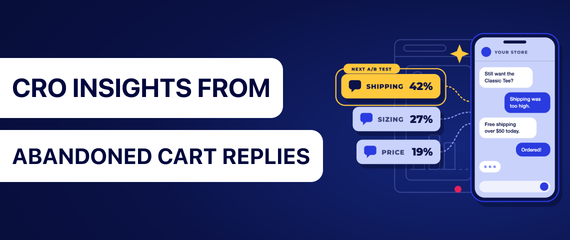
Tag each cart-recovery reply twice: once for the theme of the question and once for the funnel point where it came up. Specific tags make the pattern easy to investigate. “Checkout issue” is too broad to act on; “PayPal missing on mobile checkout” names the problem, the device and the step.
Tools such as TxtCart give ecommerce teams a place to review recovery replies and group recurring questions into themes that can be shared with the CRO team.
The two dimensions are:
- Theme: what the shopper is asking about, such as sizing, shipping, payment, promotions, trust, or a technical issue.
- Funnel point: where the uncertainty or failure appears, such as the product page, cart, or checkout.
Once a theme appears across several conversations, compare it with onsite behavior. Uxify Reality can show whether visitors on the relevant page, device, or journey are hesitating, repeating clicks, encountering slow interactions, or leaving before conversion. On Shopify, the checkout itself is closed to most tracking scripts and only shares a set of standard checkout events, so the clearest signals usually come from the product page, the cart, and the step just before checkout.
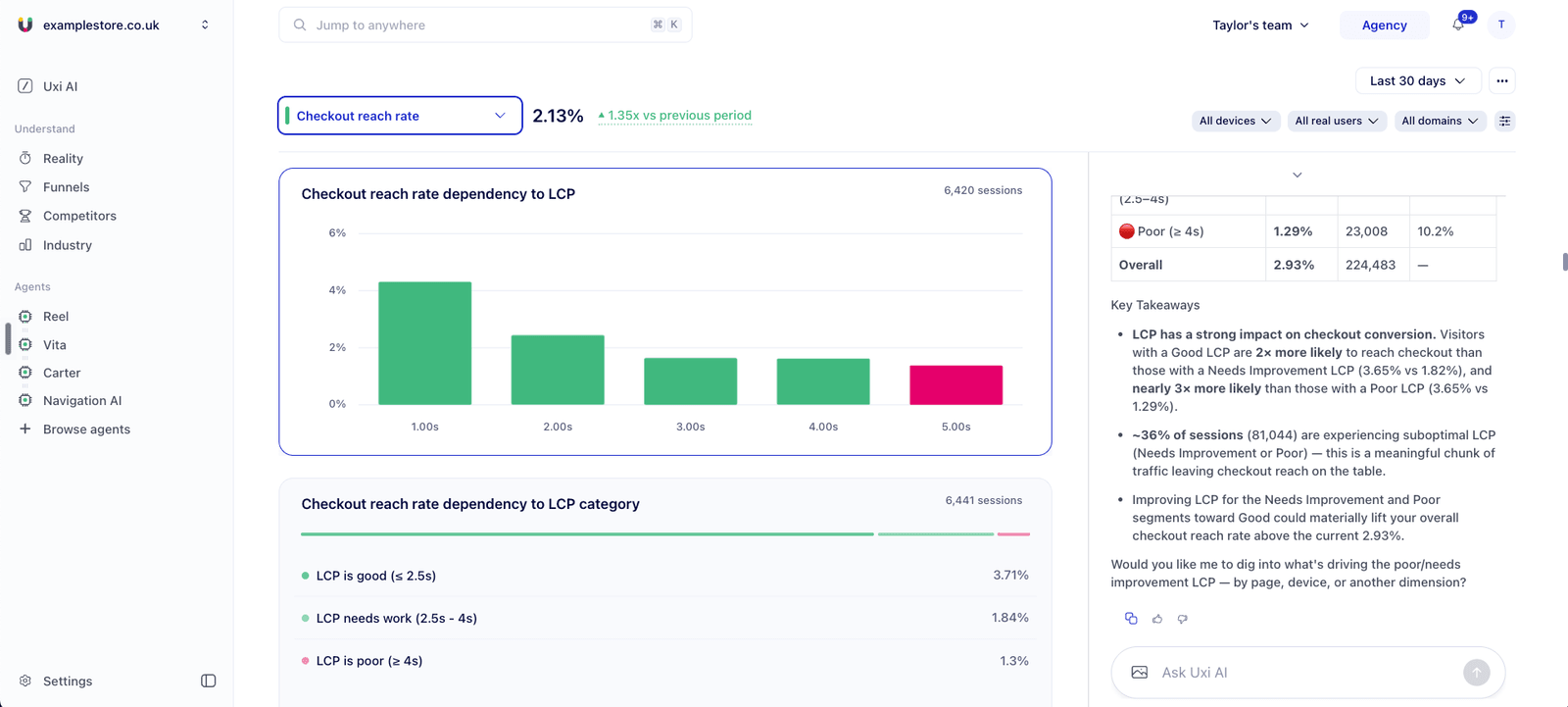
TxtCart supplies the shopper’s stated question. Reality adds the behavioral evidence needed to decide whether that question points to a broader conversion problem.
| Shopper question | Theme | Funnel point | Signal to check | Potential action or test |
|---|---|---|---|---|
| Will this arrive by Friday? | Shipping | Product page | Exits before add to cart; shipping-policy visits | Add a delivery estimate near the buy button |
| Should I size up? | Sizing | Product page | Size-guide opens; hesitation at selector | Add fit guidance beside size options |
| Why isn’t PayPal showing? | Payment | Checkout | Payment-step exits; device or browser errors | Verify availability and clarify methods earlier |
| Why won’t my code work? | Promotion | Cart | Code errors; exits after code entry | Clarify eligibility and improve the error message |
| The checkout won’t load. | Technical | Checkout | Repeated clicks; slow or failed interactions | Investigate responsiveness and checkout errors |
When is a shopper question worth a site change?
One shopper question rarely justifies a site change, although a single reply can uncover a serious defect. Before acting, check five things: how often the question repeats, its context, the supporting behavior data, how much revenue is exposed, and whether the fix can be tested. Fix confirmed defects right away and test repeated uncertainty.
The action depends on what the evidence shows:
| What you find | What to do | Why |
|---|---|---|
| A clear technical defect, such as a broken payment method or unresponsive button | Fix it | A known failure does not need an A/B test before repair. |
| One isolated question with no supporting friction signal | Answer and monitor | The shopper may need individual help, but the site does not yet show a broader problem. |
| A repeated question supported by session or funnel evidence | Run a focused test | The pattern is strong enough to justify testing the smallest relevant change. |
| A low-frequency preference with no measurable exposure | Do not change the site yet | Keep the tag and revisit it if the pattern grows. |
A single sizing question may be normal for one product. Several sizing questions, combined with hesitation around the mobile selector and weak add-to-cart performance, support a focused size-guidance test.
Answer isolated uncertainty in the conversation. Fix a confirmed defect. Test repeated uncertainty when the behavioral evidence supports it. Monitor the rest until the pattern is strong enough to act on.
That evidence supports a sharper hypothesis:
If we add a concise fit recommendation beside the mobile size selector, add-to-cart rate should increase because shoppers have less uncertainty at the point of choice.
The hypothesis is testable because it names the change, the audience, the metric, and the reason the change might work.
Put the fix where the friction happens
Among US shoppers who abandoned an order for a reason other than browsing, 20% said delivery was too slow and 13% disliked the returns policy (Baymard Institute). Questions like these start on the product page, so the answer belongs next to the buy button, not in extra copy further down the funnel.
The goal is to remove uncertainty before it interrupts the purchase. Mapping each question to the point where it arose helps the team change the right part of the journey instead of adding more copy or features elsewhere.
| Funnel point | Questions to investigate | Possible changes |
|---|---|---|
| Product page | Sizing, compatibility, materials, delivery estimates, stock, and returns | Clearer copy, a visible size guide, better variant states, or delivery information closer to the buy button |
| Cart | Shipping thresholds, discount rules, taxes, bundles, and unexpected costs | Clearer eligibility rules, cost explanations, and progress toward free shipping |
| Checkout | Payment options, loading issues, validation errors, address fields, and trust concerns | Repair technical failures, clarify payment availability, or simplify the affected form step |
How do you turn abandoned cart replies into a CRO test?
A good CRO test changes one thing at the point of friction and is judged on the funnel metric that step affects, such as add-to-cart rate on a product page. The list below matches common abandoned cart themes to the test and the metric to watch for each.
- Sizing uncertainty: test concise fit guidance beside the size selector against the current product page. Judge the result using variant selection, add-to-cart rate, and product-page progression.
- Delivery uncertainty: test a delivery estimate near the buy button against the current placement. Track add-to-cart rate and delivery-question volume.
- Promotion confusion: test clearer eligibility copy or a more useful error message. Track successful code use and checkout starts.
- Payment uncertainty: test earlier visibility of available payment methods. If a payment method is broken or unavailable when it should be present, fix the defect rather than testing it.
- Performance friction: use a controlled rollout where possible, then compare interaction responsiveness, step completion, and conversion outcomes.
Use the affected funnel metric as the primary measure. Conversation volume is a useful secondary signal: if delivery questions fall after a clearer delivery message is added, the change may have removed uncertainty. Fewer questions alone are not proof of success, so read that signal alongside the funnel result.
Build the workflow into a monthly CRO routine
A monthly review turns cart-recovery replies into a steady source of CRO tests rather than a one-off project. Each cycle takes one repeated shopper question, checks it against behavior data, tests one change, and tracks the result.
Once a month:
- Review recent recovery conversations.
- Tag recurring questions by issue and journey stage.
- Compare the themes with funnel, session, device, and error data.
- Choose the issue with the strongest combination of frequency, evidence, exposure, and testability.
- Write one hypothesis and make the smallest reasonable change.
- Track the affected funnel step and the conversation theme after launch.
The next month’s conversations show whether the uncertainty is still present.
Can AI agents handle part of CRO?
Agentic CRO uses AI agents to monitor real user behavior, find where shoppers get stuck, test a response and measure the result in a continuous loop. It suits problems that change by device, browser or traffic source, such as slow pages or unresponsive buttons.
These problems are hard to catch in a monthly review because they come and go. A page may load slowly only for some visitors, or a button may stop responding on one type of phone, and the cause can depend on the browser, the traffic source or the time of day. Uxify is built as an agentic experience platform for this kind of work: it watches signals such as rage clicks, scroll depth and drop-off points on the live store and responds as they appear, instead of waiting for someone to open a ticket.
When shoppers reply that the checkout won’t load, the cause can be a checkout button that responds slowly because the browser is busy with other apps and scripts. INProve is Uxify’s agent for interaction responsiveness: it keeps clicks, taps, forms and buttons responsive even when the browser is busy, so that problem gets handled on the live store instead of waiting in a manual backlog.
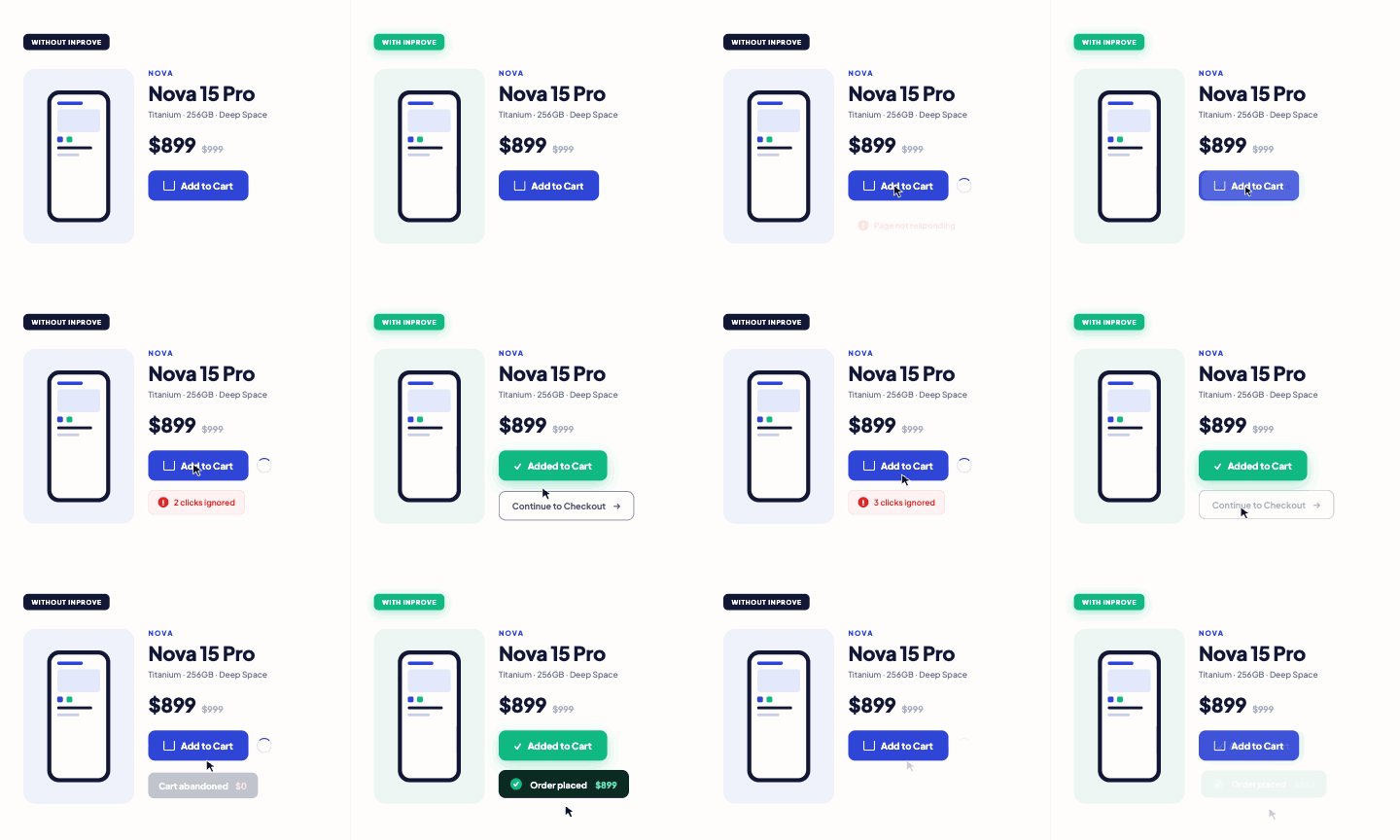
Agents don’t replace the rest of the workflow. Recovery conversations tell you what shoppers say, behavior data shows where the experience breaks, and agents handle the recurring friction, which leaves the team more time for problems that need a deeper test, a product change or a redesign. Deciding which problems an agent can own, and which still need a person, is a practical first step toward agent-readiness.
Turn recovery replies into your next CRO test
Cart recovery can serve as a feedback loop for the buying experience, not just a retention channel.
Start with last month’s recovery replies. Tag the questions that repeat, compare them with the affected sessions and funnel step, and put one focused test in the CRO queue. Then check the next round of conversations to see whether the uncertainty is still there.
FAQ: Cart-recovery conversations and CRO
How do cart-recovery conversations improve conversion rate optimization?
They provide qualitative evidence about what shoppers find confusing, risky, or difficult. Teams can group repeated questions, compare them with session and funnel data, and turn the strongest patterns into testable site changes.
How many shopper replies are needed before making a CRO change?
There is no universal threshold. Frequency matters, but so do the affected product, device, funnel step, revenue exposure, and behavioral evidence. One reply can reveal a serious bug. Many replies can still reflect a narrow product question rather than a site-wide issue.
Which CRO problems are good candidates for automation?
Continuous problems are strong candidates: slow-loading pages, unresponsive interactions, dead ends, and repeated drop-offs that vary by device or visitor context. Agents can monitor and surface these issues continuously, while people still define priorities, guardrails, and test decisions.
Should every recovery question lead to a website change?
No. Answer isolated uncertainty in the conversation. Fix confirmed defects. Test repeated uncertainty when behavioral evidence supports it, and monitor the rest.