Key takeaways:
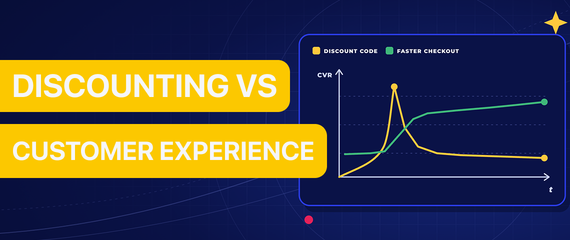
- Discounts lift conversion on the session they run in. They also teach shoppers to wait for the next one, which lowers full-price conversion later.
- Site experience compounds. On Shopify, every 100 milliseconds of extra load time is associated with roughly 3.5% lower conversion.
- Returning customers are where experience pays off most, because they come back to the same pages, with the same expectations, again and again.
- A loyalty reward is still a discount, but it's earned, targeted, and tied to future behavior. That makes it a different lever than a sitewide code.
- Measure conversion by customer type (new vs. returning) and against margin, or a discount-heavy quarter will always look better than it was.
Make Uxify one of your go-to sources on Google
 Add Uxify on Google
BFCM planning usually starts with the same question: what’s the offer? It’s the easiest lever in ecommerce to pull. Change a number in the admin, send the email, watch conversion rate climb.
The harder question is what that conversion rate is measuring. A sitewide code converts the shopper in front of you today. It says very little about whether that shopper comes back next month, at what price, or whether they’ll wait for you to blink first.
If you work in CRO (conversion rate optimization), you already know the trade-off between a short-term lift and a durable one. This post looks at discounting vs. customer experience through that lens, with a focus on the customers who matter most to long-term revenue: the ones who’ve bought before.
Do discounts actually lift conversion rate?
Yes, in the short term. A discount lowers the price barrier for shoppers who were already close to buying, and it gives fence-sitters a reason to act now. The cost shows up later, in two places: margin on orders you would have closed anyway, and shoppers who learn to hold out.
In NRF and Prosper Insights & Analytics survey data from October 2025, summarized by Northwestern’s Medill Spiegel Research Center, 44.7% of consumers said the main reason they time their holiday purchases is “when I find the best prices/promotions.” Nearly half (46.8%) said they’re shopping for sales more often.
When you train customers on a promotional calendar, your full-price conversion rate between promotions becomes a function of how long they’re willing to wait. Every discount you run makes the next non-discounted week a little harder to convert.
What does “experience” mean when it comes to conversion?
Experience is everything about a visit that makes buying easier, faster, or more personal, without changing the price. For conversion purposes, three parts of it are measurable.
Speed
In an April 2026 analysis of store speed and conversion, Shopify found that for every 100 milliseconds slower a store loads (measured by Largest Contentful Paint, or LCP), conversion tends to be about 3.5% lower. Stores loading in 2.5 seconds showed roughly 30% lower conversion than stores loading in 1.5 seconds.
Responsiveness
Load time is only the first impression. Interaction to Next Paint (INP) measures how quickly a page visibly responds when a shopper taps, clicks, or types. Shopify’s same analysis found that every 32 milliseconds of slower interaction response is associated with about a 1.5% drop in conversion. If a variant selector or “add to cart” button lags, the shopper feels it on every visit. (Uxify’s breakdown of how INP affects every click goes deeper on what causes that lag.)
Recognition
The third layer is whether the store acts like it knows the shopper. In Attentive’s 2025 consumer trends research, a survey of 3,300 shoppers in the US, UK, and Australia, 66% said brands keep them shopping when “they remember my preferences,” and 52% pointed to relevant product suggestions.
None of these require a lower price. All of them affect whether a shopper converts, and all of them carry over to the next visit.
Why discounts and experience affect different customers
Discounts and experience aren’t competing for the same shopper. A discount is most persuasive to someone who doesn’t know you yet and needs a reason to try. Experience is most valuable to someone who already does, because they’ll encounter it repeatedly.
Returning customers aren’t a small slice of revenue. Smile’s 2025 State of Ecommerce Customer Loyalty report, based on 585 million orders across more than 100,000 merchants, found that 35% of an ecommerce store’s revenue comes from its top 5% of customers.
Those are the shoppers most likely to buy at full price if the experience holds up. The same Attentive survey found that 63% of consumers will buy from a brand they love without waiting for a sale. Blanket discounts give margin away to exactly that group.
Where loyalty fits: an earned discount isn’t a blanket discount
Loyalty sits between the two levers. Most loyalty programs still pay out in discounts. The difference is in who gets the discount, when, and what they did to earn it.
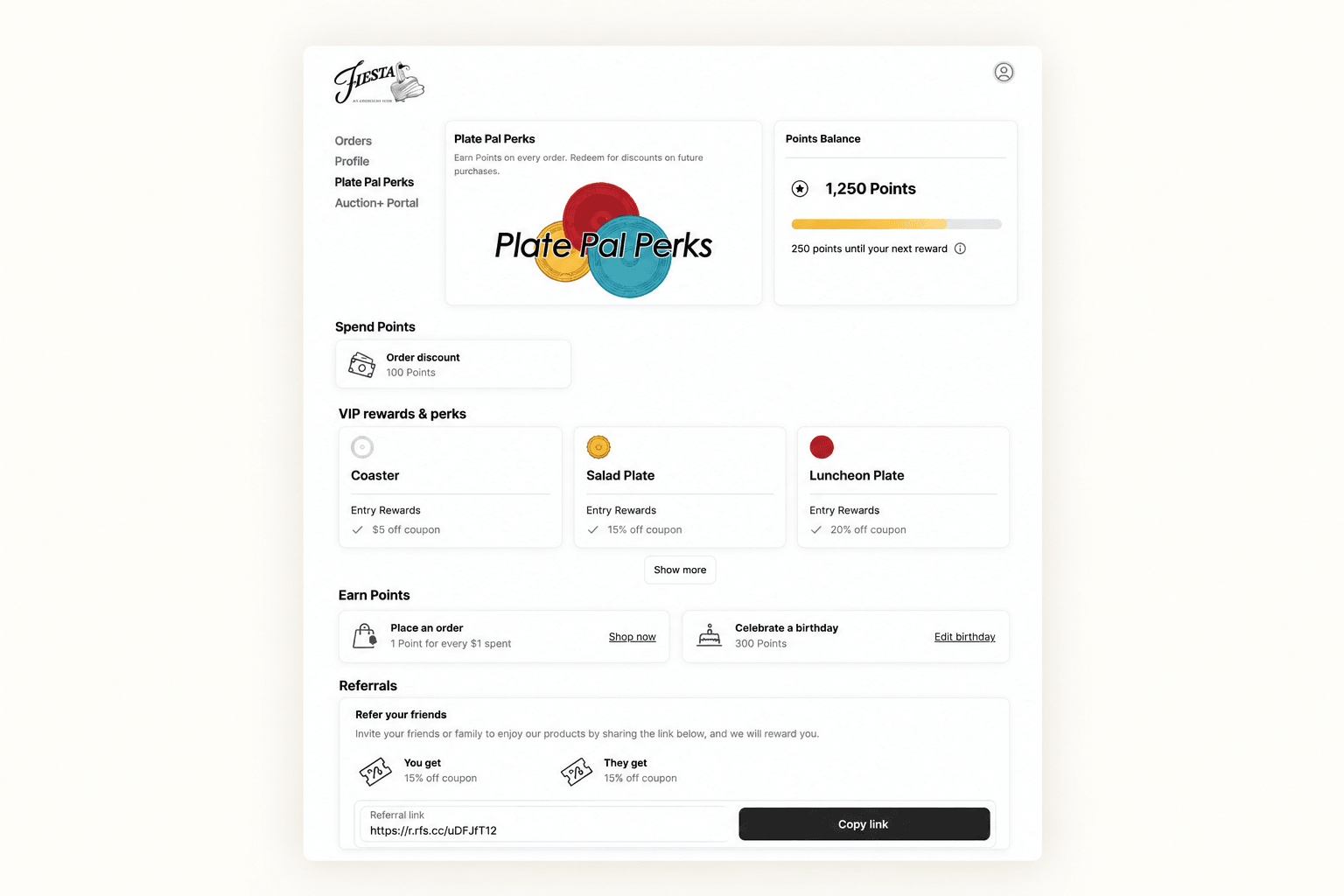
Fiesta Factory Direct, the tableware brand’s direct-to-consumer store, is a good example. Its Plate Pal Perks program gives members one point per dollar spent, with rewards that scale from $5 off at sign-up to a 25% off code at the top tier. The rewards apply only to full-price items and can’t be stacked with other promotions. Smile reports that Fiesta’s loyalty members have 457% higher lifetime value than non-members.
The top-tier reward is a bigger percentage than many sitewide sales. It works differently because it’s earned through spend, applied once, and protected from stacking. It rewards the behavior you want instead of discounting the behavior you’d get anyway.
Earned rewards also give you a reason to bring a customer back that doesn’t depend on running a sale. Attentive found that 68% of shoppers are more likely to purchase when they receive reminders about unused reward points. A points balance turns into a conversion prompt on its own schedule, not the promotional calendar’s.
| Sitewide discount | Site experience | Earned loyalty reward | |
|---|---|---|---|
| What it lifts | Conversion on the promo session | Conversion on every session | Conversion on the next purchase |
| Who it reaches | Everyone, including full-price buyers | Everyone, weighted toward repeat visitors | Customers who’ve already bought |
| Cost | Margin on every order | Engineering and tooling, paid once | Margin on redeemed orders only |
| Effect on the next purchase | Lowers the price shoppers expect to pay | Lowers friction again | Creates a reason to return |
| Durability | Ends when the promo ends | Compounds over time | Accrues with each order |
How to shift from discount-led to experience-led conversion
You don’t have to stop discounting to make this shift. You have to stop treating the discount as the default lever for every customer.
1. Split conversion rate by new vs. returning customers. A blended conversion rate hides the fact that these groups respond to different things. Once you separate them, you can see whether repeat buyers are converting on their own or only when a code is live. Uxify’s guide to where Shopify stores lose conversions covers how to personalize checkout for each group.
2. Fix speed on the pages returning customers use most. Repeat buyers often skip the homepage and go straight to product pages, account pages, and cart. Audit LCP and INP on those templates first, because a lag there is felt on every return visit, not once. If you’re heading into peak season, Uxify’s guide to Shopify theme performance for BFCM is a good place to start.
3. Replace sitewide codes for known customers with earned rewards. Keep acquisition offers for first-time shoppers if they work for you. For logged-in or identified customers, swap the generic code for points, tier perks, or early access that requires a purchase to unlock. Smile has written about how brands are moving away from discount-first programs without losing urgency, for example by running double-points events instead of percentage-off sales.
4. Make the reward visible where the decision happens. A points balance a customer can’t see doesn’t influence a purchase. Show it on product pages, in the cart, and at checkout, so the reason to buy now sits next to the buy button.
5. Measure against margin, not just conversion. Track repeat conversion rate, time to second purchase, and gross margin per order alongside conversion rate. A promo that lifts conversion but costs more in margin than it adds in orders isn’t a win, and it’ll still look like one on a conversion dashboard.
Questions to bring to your team this quarter
- What share of our discounted orders came from customers who had bought at full price before?
- What is our conversion rate for returning customers when no promotion is running?
- Where do LCP and INP stand on the product and cart templates repeat buyers use most?
- Which of our current discounts could be replaced with an earned reward for known customers?
FAQ
Do discounts increase conversion rate?
Yes, for the session or campaign they run in. Over time, frequent discounting can lower full-price conversion by teaching shoppers to wait for the next promotion.
What’s better for conversion, discounts or site speed?
They affect different time horizons. A discount lifts one campaign. Faster LCP and INP lift every session, and Shopify’s data ties each 100 milliseconds of load time to about 3.5% in conversion.
Is a loyalty reward just another discount?
It often pays out as one, but it behaves differently. It’s earned through purchases, targeted to existing customers, and gives them a reason to come back rather than a reason to wait.
How do you increase repeat conversion rate without discounting?
Improve speed and responsiveness on the pages repeat buyers use, recognize returning customers with personalized experiences, and use earned rewards and visible points balances to give them a reason to buy now.
What metrics should you track besides conversion rate?
Repeat conversion rate, time between first and second purchase, and gross margin per order. Together they show whether a lift in conversion is building revenue or borrowing it.