
Key takeaways:
- DotDev 2026 was about direction, not launches. Shopify is rebuilding commerce around two new users: AI shoppers and AI builders.
- Product data is becoming a distribution channel. AI searches powered by Shopify Catalog convert at twice the rate of those using scraped data.
- AI-referred traffic grew more than 8x year over year, and those orders carry roughly 14% higher AOV.
- Shopify is investing in Liquid and Hydrogen at the same time, rather than pushing everyone toward one storefront model.
- From August 10, 2026, partners earn 20% of subscription revenue plus 0.1% of eligible online GMV for four years
Make Uxify one of your go-to sources on Google
 Add Uxify on Google
Shopify DotDev 2026 did not have one announcement that swallowed the entire event.
There was no new product that suddenly made everything else feel outdated. Many of the technologies discussed in Toronto had already appeared in Shopify Editions, developer previews or announcements published in the weeks before the conference.
And that was the point.
Shopify DotDev 2026 set the tone for where commerce is heading next. And if we had to summarize it all in one sentence: commerce is opening up to two new users - AI systems that help people shop and the ones that help people build and operate stores.
And Shopify is ready for it.
What is Shopify DotDev?
Shopify DotDev is Shopify’s developer conference, bringing together developers, agencies, technology partners and Shopify product teams to explore what is being built across the platform and where Shopify is heading next.
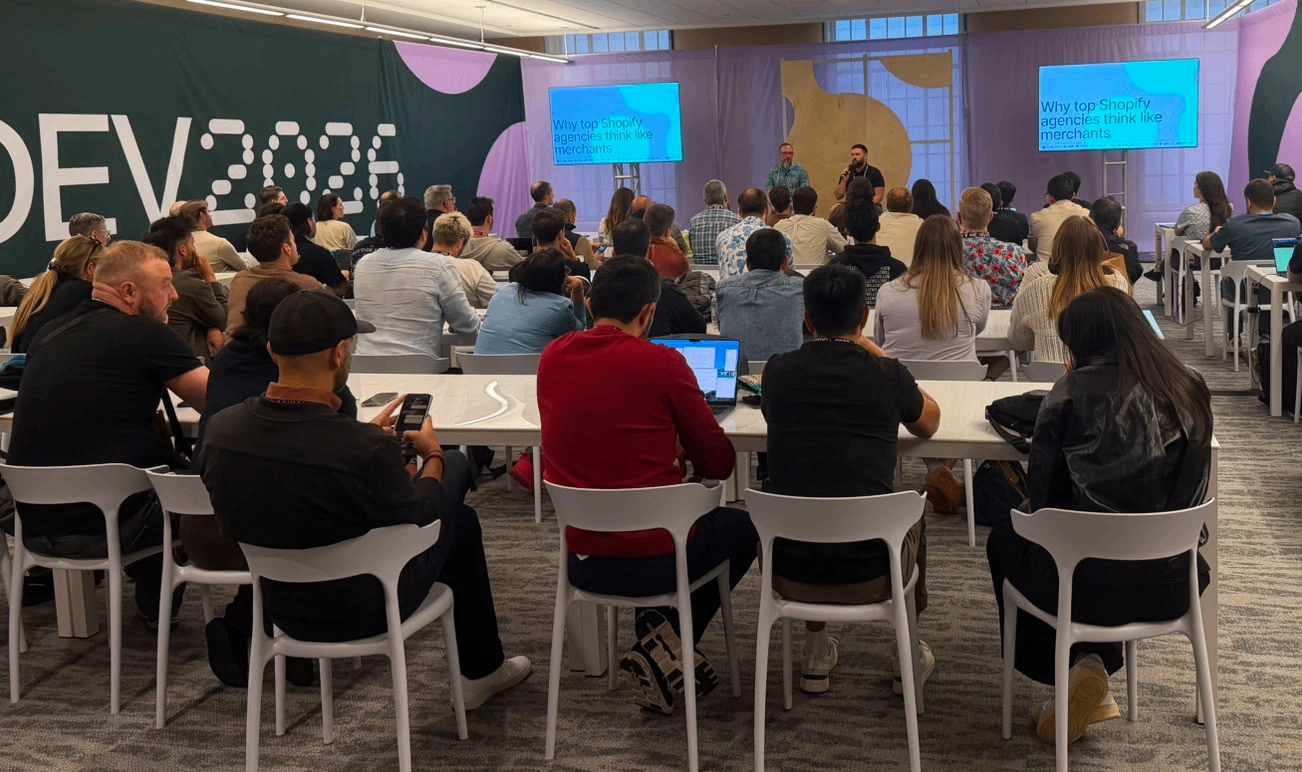
The 2026 edition took place in Toronto on July 21 and 22, with around 2,000 attendees joining two days of product sessions, technical workshops and discussions covering storefronts, apps, data and AI.

What DotDev 2026 was actually like to attend?
The Uxify team attended DotDev for the second time. Both our co-founders were there, together with members of our partnerships and community team.

The highest-value conversations happened in the satellite events around the conference - from themed parties, ladies’ brunches, morning runs to pickleball tournaments - the programme of the team was busier than that of Odyssey’s cast.
But the most valuable part of the trip was not a particular session or announcement. It was the wider group of people gathered in Toronto that week.

Atlee Clark, Shopify’s VP of Partnerships, uses the phrase “collaborative competition” to describe the ecosystem. Partners may compete for the same merchants, but they still share what they know because better-informed partners produce better outcomes for merchants and strengthen the ecosystem around them.
And it described the room accurately.
Direct competitors compared notes about what was working. People discussed changes they were seeing among merchants, problems they had not solved yet and areas where they thought Shopify was heading. These were not vague conversations about innovation. They often moved quickly into what teams were building, what merchants were asking for and where current tools were falling short.
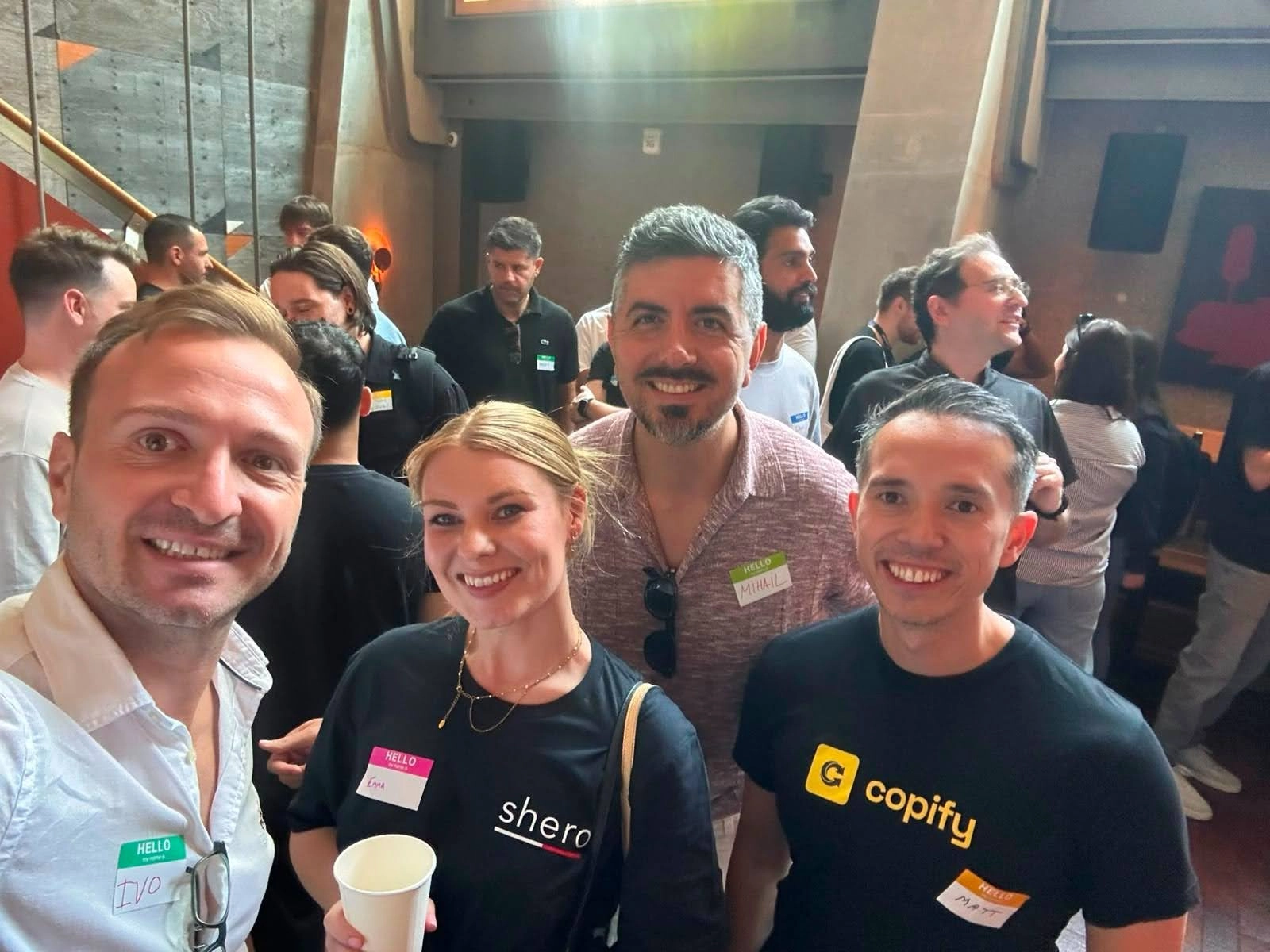
Our insider tip: Go early
We stayed in Toronto for five days, and one pattern became hard to miss: the best exploratory conversations happened before the official conference began.
Before DotDev, people arrived with open questions and few fixed conclusions. Nobody had watched the same keynote, absorbed the same framing or decided what the accepted takeaway should be. Conversations were sharper because there was still something to work out.

After two days of sessions, meetings and evening events, the mood changed.
The conversations became more relaxed and more practical. People discussed specific business problems, introductions they needed and partnerships they wanted to explore. That was useful, but it was a different kind of useful.
By the fifth day, even a strong event such as Brightwork Vol. 1 was competing with five days of accumulated conference fatigue. The programme was packed with knowledgeable speakers and useful discussions, but by the end, most people looked ready to just have fun or stay in silence for ten uninterrupted hours on the flight home.
The practical advice for anyone planning to attend DotDev is therefore simple: front-load the trip. Do not arrive just in time for the opening keynote. The sessions will eventually be summarised. The conversations around them will not.
Okay now, for the actual Shopify updates…
Biggest update: Shopify is designing for two kinds of AI user
At this point everyone knows AI is going to be the star of the show on each release. What changed the message this time was the clear direction Shopify is heading. Shopify is adapting to the new users entering its platform: AI agents.
The first is the AI shopper. This is an assistant that helps someone research products, compare options and decide what to buy, potentially without beginning the journey on a merchant’s website.
The second is the AI builder or operator. This may be a coding agent editing a Shopify theme, Sidekick using information from several apps, or an internal agent helping an engineering team investigate and fix a problem.
These users are not replacing anyone. Merchants, developers and agencies still sit at the centre of the platform. But they are joined by a new kind of participant, and that participant needs different things.
An AI shopper needs structured, accurate and current product information. An AI builder needs clear code, predictable interfaces, reliable documentation and defined actions it can perform without guessing.
That is why Shopify’s work on Catalog API, UCP, Liquid, Hydrogen, Sidekick and analytics belongs in the same story. Each development makes one part of commerce easier for AI agents to understand and work on.
Is product data the new distribution channel?
Increasingly, yes. One of the biggest shifts behind Shopify’s AI strategy is that product data now influences whether a product gets discovered at all. Shopify reports that AI searches powered by Shopify Catalog convert at twice the rate of those relying on scraped data (Shopify, 2026). Structured data is no longer just an onsite concern.
Until recently, merchants could think about product information mainly in terms of the storefront. Good titles, descriptions and attributes helped shoppers understand the product, improved onsite search and filtering, and supported SEO and shopping feeds.
As more product discovery happens inside AI assistants, merchants are no longer writing only for people who reach their store. Their product data also needs to help agents understand what they sell, compare it with alternatives and decide whether it belongs in a recommendation.
Three pieces make that possible:
- Shopify Catalog provides the structured product layer, making attributes such as colour, size, material, availability and delivery information easier for agents to search and compare.
- Shopify’s Standard Product Taxonomy creates consistency across merchants, so the same product category means the same thing everywhere.
- UCP gives agents and commerce platforms a common protocol for working with that information across the shopping journey.
Take something as simple as colour. One merchant might describe a shirt as “turquoise”, another as “light blue”, while a shopper asks for something “blue-green”. If those characteristics exist only in free-form copy, an agent has to work out whether the products belong in the same comparison. Structured attributes give it a much clearer basis for doing so.
That changes the role of product data. It no longer only helps a product rank or explains it once someone reaches the page. It can influence whether the product is discovered and considered before the merchant gets the visit at all.
Should we optimize only for AI traffic?
No. The numbers are strong enough to take seriously, but AI discovery is a channel, not the whole funnel.
Shopify’s Q1 2026 commerce data helps explain the urgency behind this work. Traffic from AI assistants grew by more than eight times year over year, while orders attributed to AI referrals grew by nearly 13 times. More than half of AI-referred visitors landed directly on a product page. Those product-page visitors converted nearly 50% better than comparable organic-search visitors, and their average order value was around 14% higher.
The numbers themselves are not surprising. This is not top-of-funnel browsing. These are shoppers already at the bottom of the funnel. They have done their research, asked the relevant questions, compared alternatives, and were ultimately guided to your product by the AI tool they used.
That is also why the channel should not be treated as a replacement. Merchants should prepare for AI discovery, but not by abandoning SEO or chasing a separate collection of vaguely defined “AI optimisation” tricks. Clear content, accurate product data and technically sound pages remain the foundation for both. In practice, ecommerce SEO and AI visibility pull in the same direction.
Liquid vs. Hydrogen? Shopify Is Investing in Both
On the development side, Shopify is investing in both of its main storefront paths.
For Liquid, the July 2026 developer preview introduced new {% block %} and {% partial %} tags. Blocks make reusable theme components easier to manage, while partials let developers refresh smaller server-rendered parts of a page without reloading everything. That makes Liquid more capable for interactive storefronts, with less need to push every interaction into client-side JavaScript.
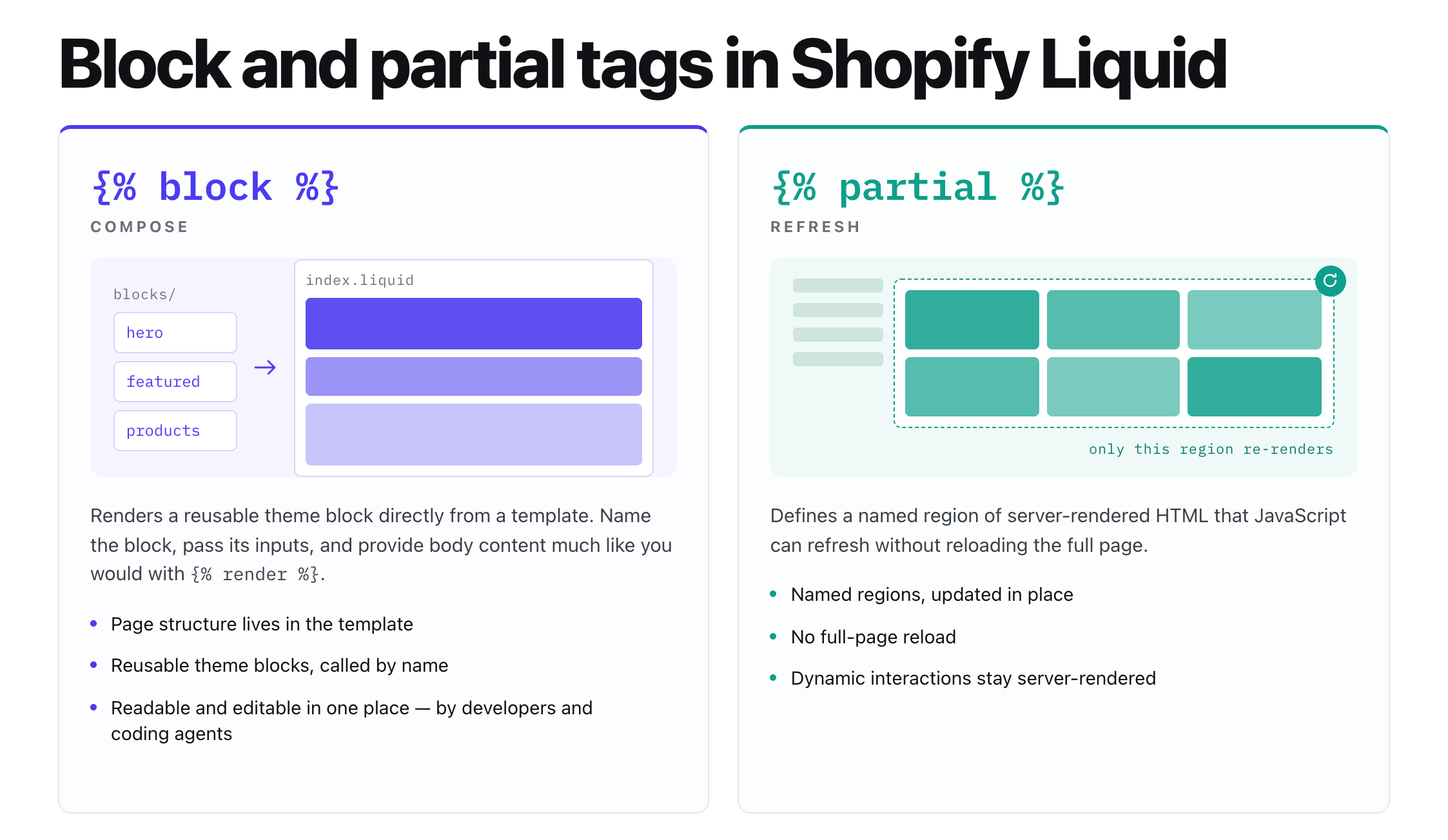
The changes also make theme structure easier for coding agents to understand. When components, inputs and validation rules are more explicit, AI-assisted development has less room to guess how different parts of a theme fit together.
At the same time, Shopify is making Hydrogen more flexible. Rebuilt with Vercel as a design partner, Hydrogen is becoming a framework- and runtime-independent toolkit that can work with Next.js, Nuxt, Svelte or a custom setup, and can run across Oxygen, Vercel, Cloudflare Workers, Node or Deno.
| Liquid | Hydrogen | |
|---|---|---|
| Best suited to | Most merchants and themes | Teams that genuinely need headless |
| Rendering | Server-rendered, now with partial refresh | Framework-dependent |
| Framework | Shopify’s own templating language | Next.js, Nuxt, Svelte or custom |
| Hosting | Shopify | Oxygen, Vercel, Cloudflare Workers, Node, Deno |
| What changed in 2026 | New {% block %} and {% partial %} tags | Rebuilt as a runtime-independent toolkit with Vercel |
The wider signal is simple. Shopify is not pushing everyone toward one storefront model. It is making Liquid more capable for most merchants, while giving teams that actually need headless more freedom over how they build and host it.
The Shopify Partner Ecosystem as the key to Shopify’s continued growth
The product announcements showed where Shopify wants commerce to go. But one of the clearest messages from DotDev was that Shopify does not expect to get there alone.
That brings the story back to the people in Toronto.
According to Shopify’s 2026 Partner Survey, the partner ecosystem generated $6.86 for every dollar Shopify earned in 2025. It supported more than 1.5 million jobs, around 2.5 times the number reported in 2021. Approximately 40,000 partners referred a merchant during the year, while Shopify says app developers earned more than $1.3 billion.
Shopify is not only maintaining software. It is maintaining an economy whose growth feeds back into its own.
When an agency brings a merchant onto Shopify, both grow. When an app helps that merchant sell more, the developer, merchant and platform benefit. When partners build useful experiences on top of Catalog or Sidekick, Shopify can enter new parts of the buying journey without having to own every product in it.
That makes partner growth part of Shopify’s own growth model. And many of the DotDev updates for app builders show where Shopify wants the next layer of that value to come from.
What changed for Shopify app developers at DotDev 2026?
A figure shared at DotDev puts the competition facing Shopify app developers into perspective: around 8,000 new apps were published over the past six months accoding to StoreLeads.
Shopify now has more than 27,000 published apps in its App Store. That gives merchants an enormous choice, but it also changes the equation for developers.
There was a time when getting into the Shopify App Store, ranking for the right category and collecting strong reviews could do much of the distribution work for you. That is becoming harder. More apps are competing for the same searches, AI is making basic features faster to reproduce, and merchants have more alternatives than ever.
So the problem is no longer simply how to build a useful Shopify app. It is how to make merchants trust it, find it and keep using it.
Shopify is tightening App Store quality
With more apps competing for the same merchants, Shopify is putting more pressure on the signals merchants use to decide which ones they can trust.
Shopify has strengthened enforcement against incentivised and untrusted reviews, while also introducing clearer rules against copycat apps, confusing names and misleading listings. Every app now needs a distinct, recognisable name that cannot be identical or confusingly similar to another app, developer or brand.
Security is part of that equation too. Fast Bundle is a good recent example. The developer detected a security attack on July 17, 2026, and Shopify temporarily removed the app from the App Store and deactivated it for existing merchants while the incident was reviewed. Fast Bundle later said it found no evidence that merchant or shopper data had been exposed, and the app has since returned to the store.
For developers, the episode was also a reminder of how much control Shopify has over distribution. A well-established app could effectively disappear from merchants’ stores while Shopify investigated a security concern. As competition grows, getting discovered matters, but maintaining Shopify’s trust is just as important as earning the merchant’s.
Sidekick is becoming another distribution surface for apps
Sidekick is becoming a bigger part of how merchants use AI in Shopify. Weekly active shops using it grew 4x year over year in Q1 2026, and its role now goes well beyond answering questions. Merchants use it to understand what is happening in their store, get suggestions on what to improve and find ways to solve specific problems.
Apps were already part of that experience because Sidekick could recommend relevant tools. Sidekick App Extensions now take that a step further. Developers can make their app’s data available inside Sidekick and let merchants initiate supported actions from the conversation itself, with confirmation where needed. Sidekick can surface the right app when the merchant is already trying to solve the problem it was built for.Often if she’s taught
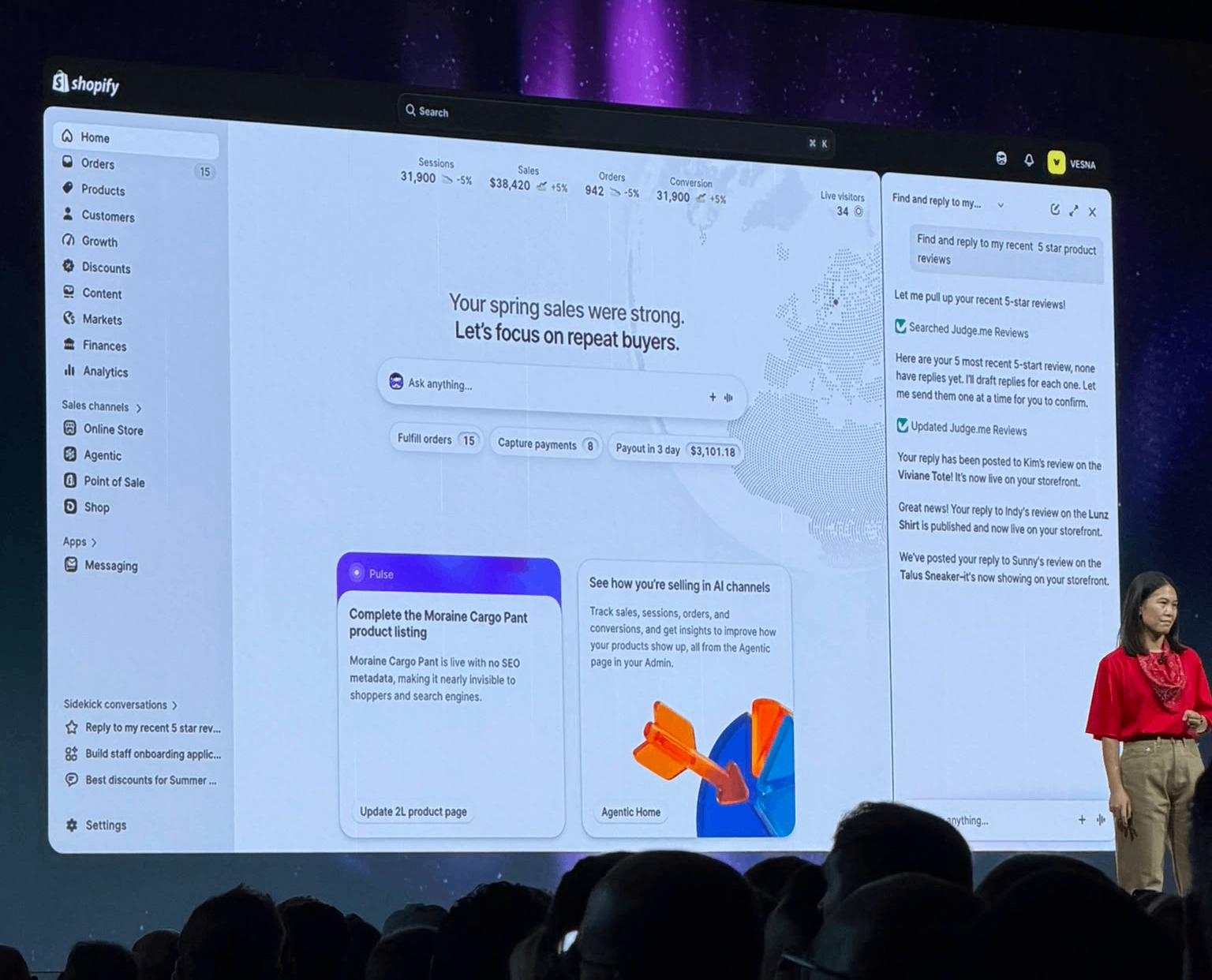
For developers that have relied heavily on App Store discovery, building for Sidekick should be near the top of their priority list for the second half of 2026.
Shopify is improving both sides of the app data layer
Two of the more technical DotDev updates are really two sides of the same problem: giving apps better access to the data they need and better ways to work with it.
Shopify Analytics is becoming infrastructure developers can build into their own products. Apps can make data queryable through ShopifyQL, embed Shopify analytics components and add their own data without rebuilding the entire reporting layer themselves.
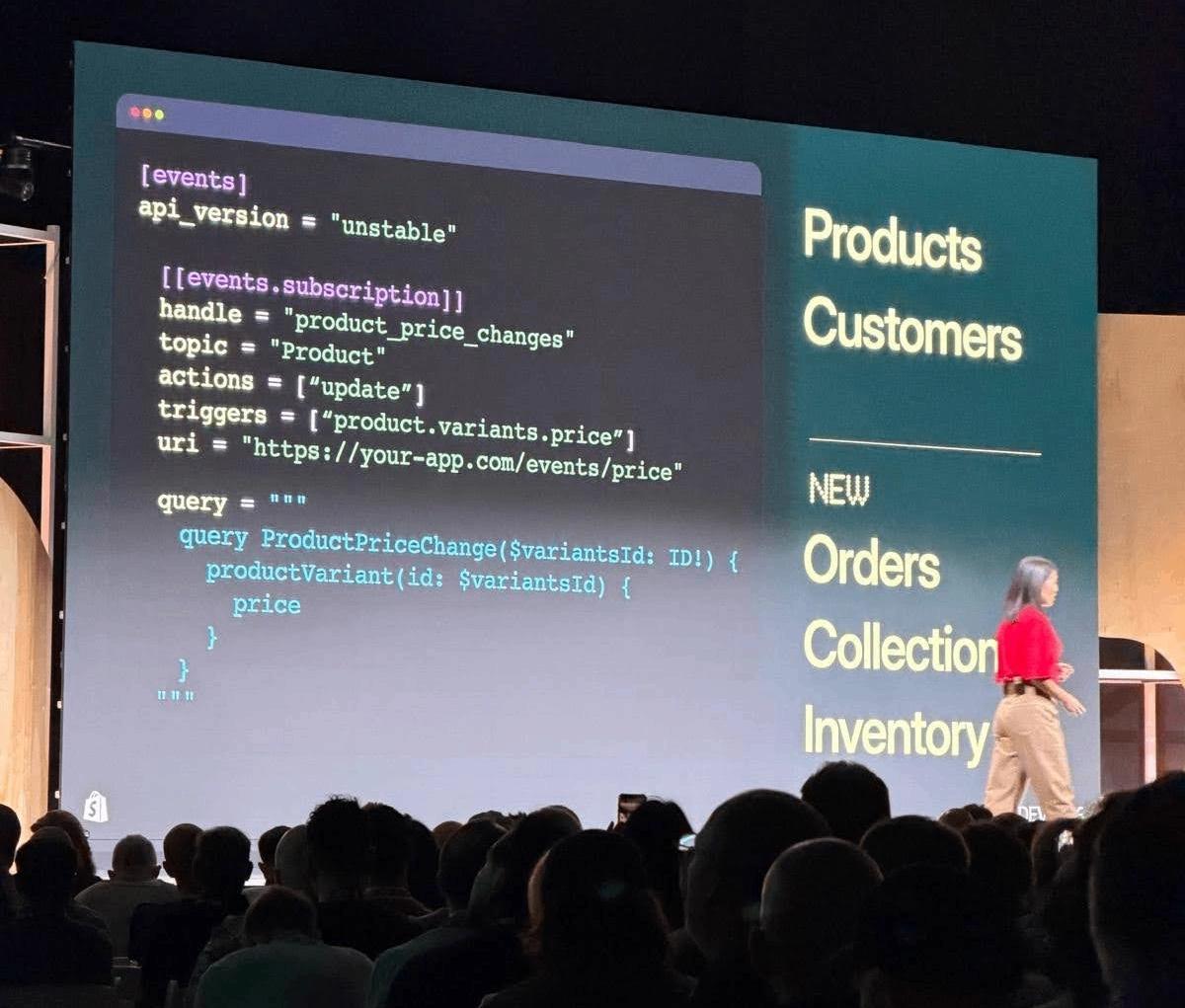
At the same time, Shopify is replacing broad webhook-style notifications with more precise Events. Instead of being told that something changed and then fetching more data to figure out what, apps can subscribe to more specific changes and request only the information they need.
In simple terms: cleaner data coming in, and a better layer for using it once it is there.
What was announced for agencies at DotDev 2026?
For agencies, the biggest concrete announcement was Shopify’s new partner earning model.
From August 10, eligible partners bringing new merchants to Shopify can earn 20% of subscription revenue plus 0.1% of eligible online GMV for four years (Shopify, 2026).
| Advanced merchant, $750,000 annual eligible GMV | Partner earnings over four years |
|---|---|
| Previous model | $2,872 |
| New model from August 10, 2026 | $5,872 |
The change puts merchant growth directly into the partner incentive. Agencies are still paid for bringing merchants to Shopify, but now they also benefit when those merchants sell more.
That fits where agency work is already moving. AI can take over more of the repetitive implementation work, and the tools agencies use are shifting to match. The value of the agency sits more in knowing what to build, where the problems are and which changes will actually help the merchant grow.
Where is Shopify heading after DotDev 2026?
DotDev 2026 did not give us one defining launch. It gave us a much clearer view of what Shopify is preparing for.

Products need to be understandable before a shopper reaches the store. Storefronts need to be easier for both developers and coding agents to work with. Apps need to surface their data where merchants are already working. And Shopify’s partner model is being shaped around what happens after a merchant launches, not just getting them there.
Shopify is not simply adding AI features to commerce. It is rebuilding parts of the platform around a world where agents take part in how products are discovered and purchased, stores are built and merchants run their businesses.
Frequently asked questions
What was the biggest announcement at DotDev 2026?
There was no single dominant announcement. The larger story was Shopify’s work across Liquid, headless commerce, Events, Analytics, Catalog and Sidekick, which together make the platform easier for both human developers and AI systems to use.
How is AI changing product discovery on Shopify?
Discovery is moving upstream into AI assistants. Shopify’s Q1 2026 data shows traffic from AI assistants grew more than 8x year over year and AI-referred orders grew nearly 13x. More than half of those visitors land directly on a product page, and they convert nearly 50% better than organic search visitors.
What is Shopify’s new partner earning model?
From August 10, 2026, eligible partners bringing new merchants to Shopify earn 20% of subscription revenue plus 0.1% of eligible online GMV for four years. Shopify’s own example shows an Advanced merchant at $750,000 annual GMV earning a partner $5,872 over four years, against $2,872 under the previous model.
What is the Shopify Catalog API and why does it matter?
Catalog API exposes structured product data from millions of Shopify merchants so AI agents can search and compare it reliably. Shopify reports that AI searches powered by Shopify Catalog convert at twice the rate of those relying on scraped data, which makes structured attributes a discovery requirement rather than an SEO detail.
Is Shopify DotDev worth attending?
For teams building on Shopify, yes, but plan the whole week rather than the two conference days. Our team found the sharpest conversations happened at satellite events before the official programme, while later events turned toward introductions and business talk. Front-load the trip.