Key takeaways:
- Using agents for CRO moves from a tool telling a human what's broken to a system that finds the friction, acts on it, measures the result, and keeps going.
- The first thing agents take care of is the gap between insight and shipped change. All seven contributors pointed at the same part of the workflow that the agents will cut — the weeks of assembly work between noticing a problem and doing something about it.
- You now have two audiences. AI-referred retail traffic converted 54% better than every other channel in May 2026, a complete reversal from a year earlier.
- There are tasks you can completely offload to an agent, and then there are those that you shouldn't.
Make Uxify one of your go-to sources on Google
 Add Uxify on Google
We asked seven practitioners the same four questions about AI in CRO between June and August 2026. What came back was one answer about speed and three about judgment. Conversion rate optimization is changing, but not in the direction most of the tooling suggests.
How to use AI in CRO?
AI in CRO means using models and agents to run parts of the conversion optimization loop: reading behavioural data, forming hypotheses, building variants, and in the agentic case, applying and reversing changes. Fewer than 1% of websites run structured experiments (Convert), and the bottleneck was never ideas. Three distinct models are worth separating.
Conversion rate optimization has always been a repetitive process, following specific steps: look at data, form a hypothesis, build a variant, run a test, read the result, ship or bin it. For twenty years that process has been powered by humans, with tools helping at individual steps.
AI-assisted CRO speeds up steps inside that process. An LLM summarizes your session recordings. A prompt generates ten headline variants. A copilot drafts the analysis. Useful, but a human still carries the work from one step to the next, and a human still deploys the winner.
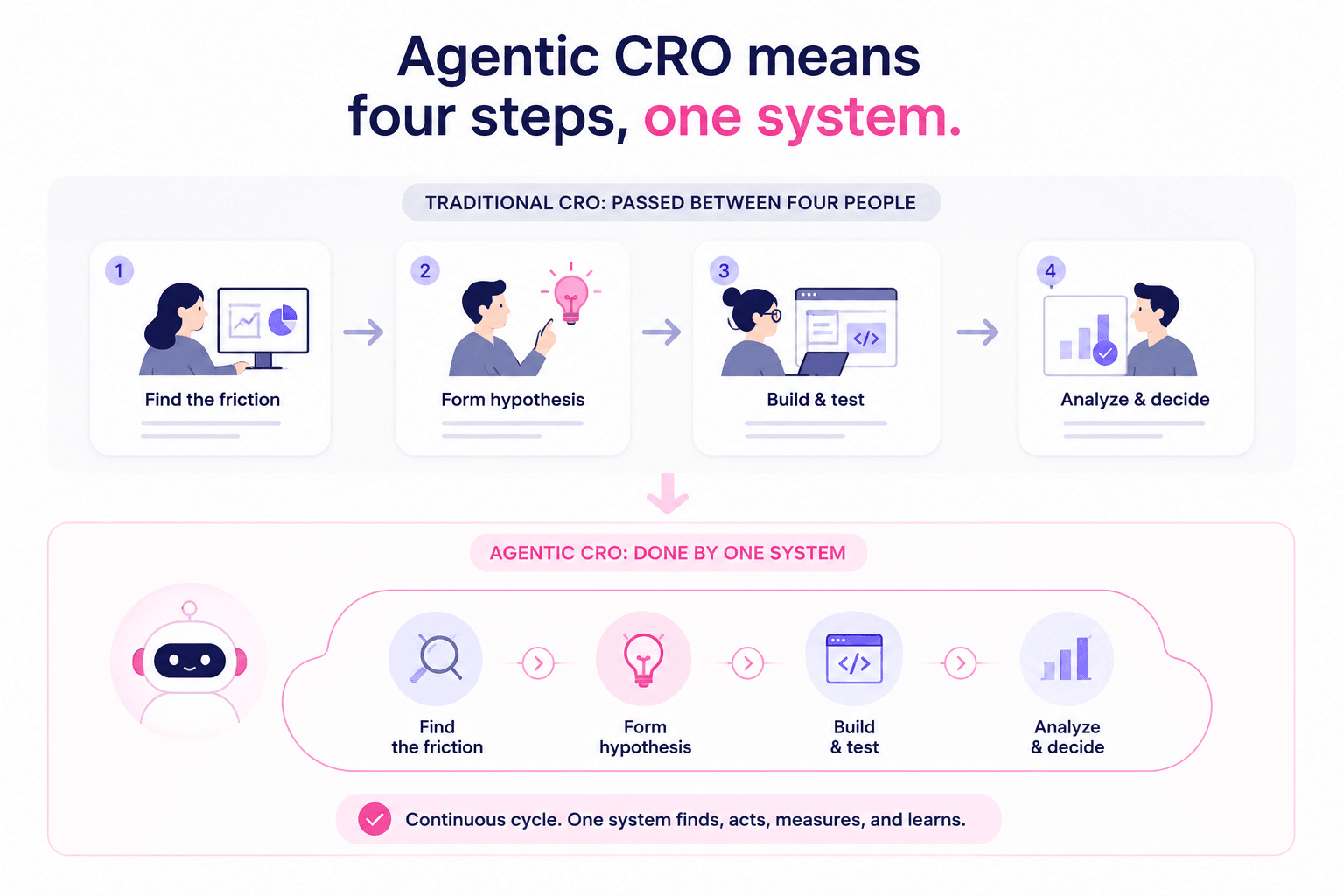
Agentic CRO is when a system carries the work between steps itself. It notices the friction, decides what to do about it, applies the change, watches what happens, and either keeps it or rolls it back. Humans set the objectives and the guardrails, but the agent does the actual work inside them.
The practical difference is not speed. It’s that finding a problem and fixing it stops being two different jobs.
We’ve written the full breakdown of how that works in our article “What an agentic CRO platform actually does”, product by product. This piece is about a different question: what seven practitioners think it does to the job.
| Traditional CRO | AI-assisted CRO | Agentic CRO | |
|---|---|---|---|
| Who finds the problem | Analyst reading dashboards | Analyst, with AI summarizing | System, continuously |
| Who builds the change | Designer + developer | Human, AI-drafted | Agent, within guardrails |
| Who decides to ship | Human | Human | Human sets policy, agent executes |
| Cycle time | Weeks | Days | Hours or continuous |
| Unit of work | A test | A test, faster | A decision, repeated |
| Main constraint | Production capacity | Production capacity | Prioritization quality |
One more piece of vocabulary, because it comes up constantly below. When people say an agent “optimizes your site,” that can mean two very different things: an agent that rewrites your source code and commits it, or an agent that works in an optimization layer sitting above the site, applying changes at runtime that can be measured, attributed, and reversed. The second is the safer starting point, and it’s the model most of the contributors below describe when they talk about keeping humans in control. It’s also the model we apply at Uxify across our suite of CRO AI agents.
Why we asked, and who we asked
Ask an AI to read a month of session recordings and tell you where people struggle, and it will. Ask it to draft the hypothesis, build the variant, write the QA checklist and interpret the result, and it will do that too. Most of the conversion optimization workflow can now be done by software, cheaply, in an afternoon.
So what’s left for the people?
That isn’t rhetorical. CRO is a discipline built around execution being expensive. The reason fewer than 1% of websites run structured experiments was never a shortage of ideas or the need for them. It is the weeks of work between having one and shipping it.
AI tools can now handle much of the analysis and execution that used to take CRO specialists, data teams, expensive software, and weeks of work.
So what happens to CRO when that work becomes faster, cheaper, and much easier to automate? What does the job look like? And which skills become more valuable as AI takes on more of the execution?
Rather than guess, we asked people working across the field.
We deliberately chose people who see CRO from different angles: agency-side practitioners, product founders, consultants, ecommerce operators, and people working directly on AI-driven discovery and visibility.
What came back was surprisingly consistent. The shift isn’t just about better tools or faster testing. What we optimize, and who we optimize for, is changing too.
| Contributor | Role | Why their view carries weight |
|---|---|---|
| Ole Gregersen | CRO Lead, Impact Commerce | Twelve years in CRO. Runs Conversionboost, Denmark’s longest-running conversion optimization conference, now in its thirteenth year. Master’s in usability from the IT University of Copenhagen. |
| Deborah O’Malley | Founder, GuessTheTest | Has produced and analyzed thousands of published A/B test case studies. Six peer-reviewed papers on eye tracking and marketing psychology. Adjunct professor at Queen’s Smith School of Business. |
| Robert Vîja | Co-founder and CPO, GEOflux.ai | Builds the platform that tracks how ChatGPT, Gemini and Perplexity recommend brands. Also COO of the agency difrnt. Sees, daily, what assistants actually say about products. |
| Richard Joe | Fractional CRO consultant, richardjoe.net | Came to CRO through front-end development on ecommerce sites, then ran programs in D2C retail, regulated financial services and healthcare lead generation. |
| Prakhar Shrivastava | Co-founder, FoxSell Bundles | Built one of the highest-rated bundling apps on the Shopify App Store. Talks to merchants about offer construction every week, at volume. |
| Tudor Goicea | Co-founder and Chief Revenue Officer, Aqurate | Builds AI personalization for ecommerce, Built for Shopify certified. Previously CRO at a behavioral biometrics startup backed by Google’s AI Fund. |
| Daniel Gurevitch | CEO and co-founder, Kimonix | Built an AI merchandising platform used by Shopify brands to sort, structure and continuously re-rank collections. Lives inside the least-automated corner of ecommerce. |
Change 1: The weeks between spotting a problem and fixing it disappear
Every contributor pointed at the same part of the workflow — the distance between noticing something and doing something about it. Up until this point it could take up to several weeks and it’s the main reason why so few teams even begin optimization in the first place.
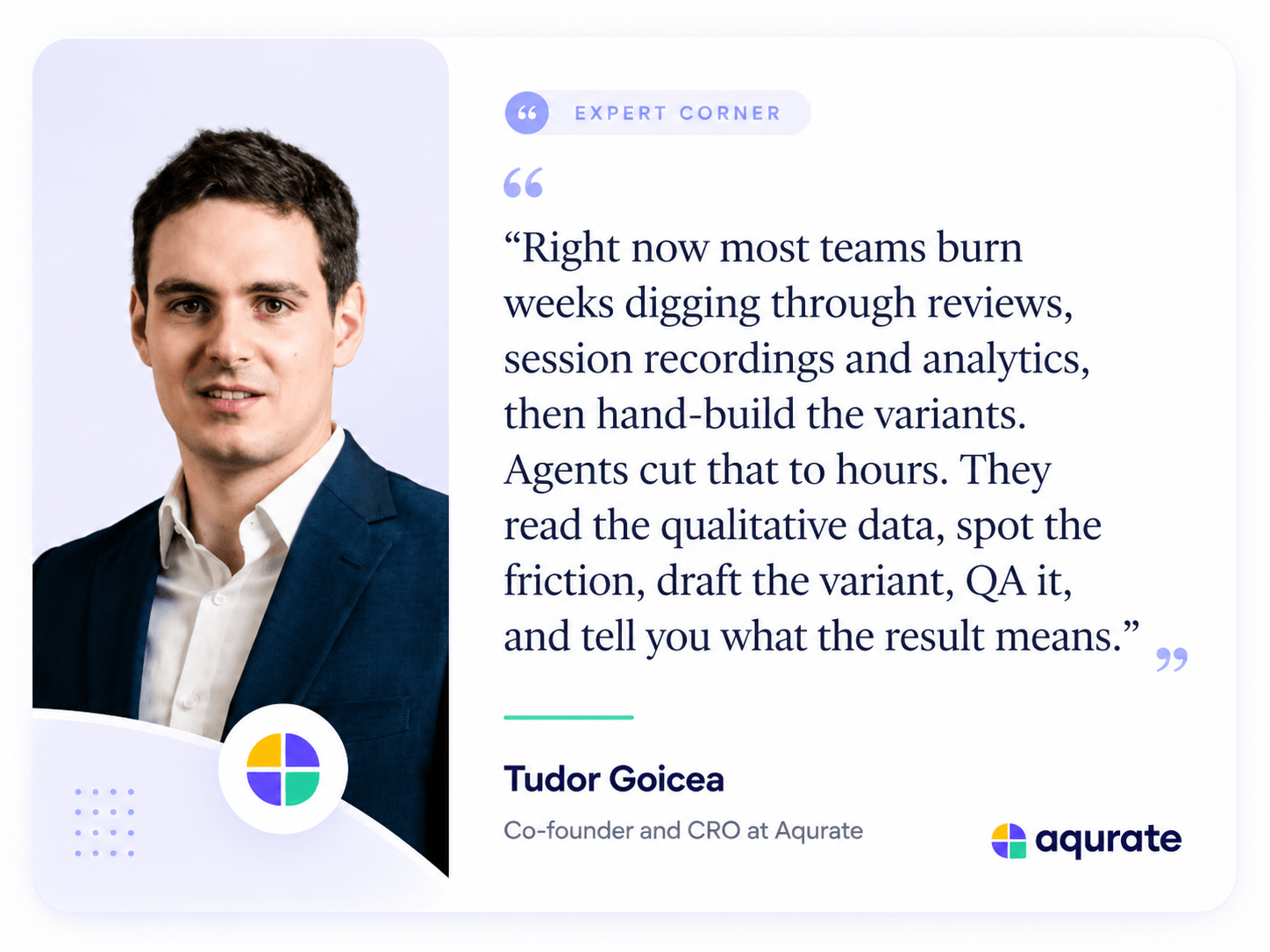
Tudor Goicea put a clock on it:
Right now most teams burn weeks digging through reviews, session recordings and analytics, then hand-build the variants. Agents cut that to hours. They read the qualitative data, spot the friction, draft the variant, QA it, and tell you what the result means.
Prakhar Shrivastava was blunter about why it matters.
That’s where most CRO work dies today. Lots of analysis, lots of opinions, very little velocity.
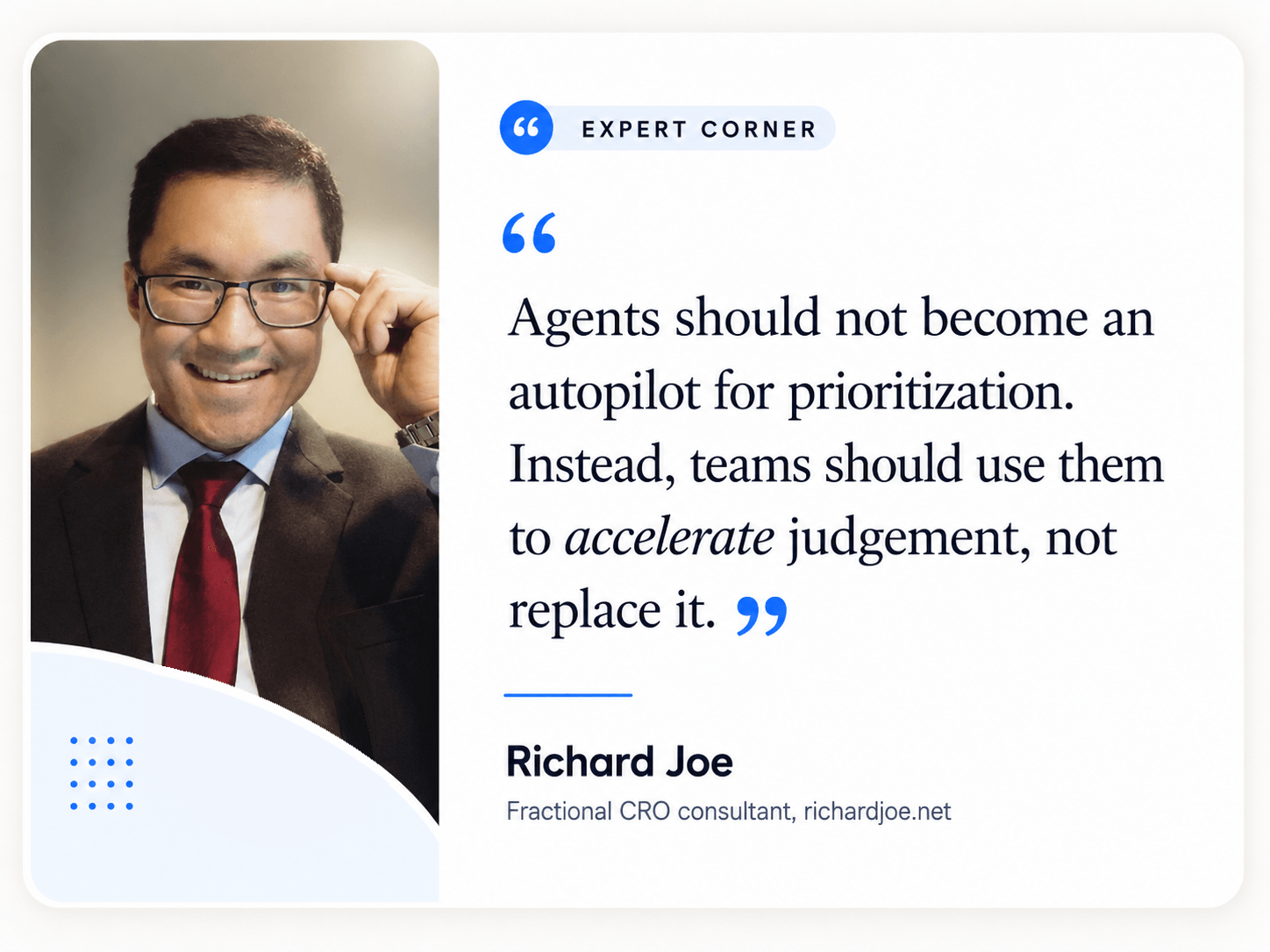
Richard Joe named the same stretch but flagged the trap inside it. Research synthesis and opportunity discovery are where teams lose time, pulling together analytics, surveys, support tickets and test results, then hunting for the pattern. Agents will do that first pass continuously, “flagging emerging friction points, connecting qualitative and quantitative evidence, and drafting hypotheses with the supporting proof attached.”
Then the caveat, which is the important half:
agents should not become an autopilot for prioritization. Instead, teams should use them to accelerate judgement, not replace it.
Daniel Gurevitch pointed at the most manual corner of that same problem:
Merchandising is the most manual part of CRO today: teams hand-sort collections, guess at product placement, and revisit it all only when something breaks. Merchandising moves from a periodic manual chore to an ongoing conversation with an agent that executes for you. Just as important, the agent doesn’t wait to be asked. It analyzes the store and recommends what to do next: which collections are underperforming, which products deserve more exposure, where revenue is being left on the table.
The hinge in Daniel’s answer is the agent that doesn’t wait to be asked, because that breaks a sequence every CRO team knows by heart. The dashboard finds it. Someone writes a ticket. Someone else builds it. A month later a variant goes live. That has been the shape of the work for as long as anyone has been doing it, because every step sits in a different tool and a different person’s week.
Change 2: To use AI in CRO successfully, your data needs to stay connected
You can automate one part of CRO, but if the data and tools around it stay disconnected, the bottleneck just moves someplace else.
Only 35% of businesses running experiments have fully integrated their experimentation technology across marketing, product and engineering, and that fragmentation keeps testing stuck on simple page-level ideas.
Ole Gregersen has watched this from inside a program that already uses AI in CRO heavily:
Research and analysis has greatly improved due to feeding AI large datasets, connecting API and MCPs to tools. More mature programmes are developing automation for reporting and documentation and experiment with asking their datasets questions about what has happened. But as all these processes are separated, the next step will be to connect them with AI agents. Use the agents to work across workflow phases, collecting and comparing from several sources and getting a wider understanding across the entire workflow.
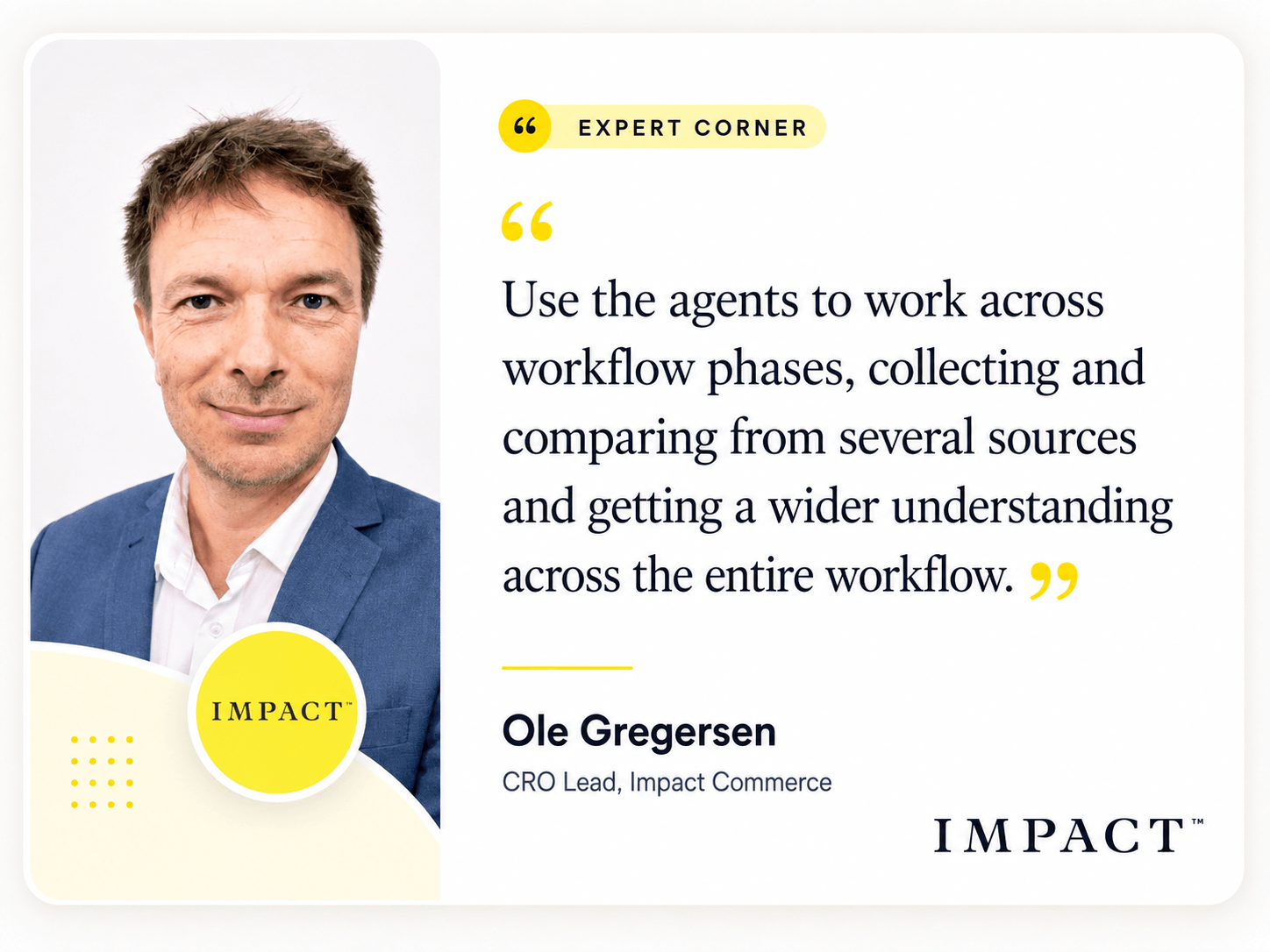
The important part of Ole’s answer falls on “across the workflow.” Most tools are already adding AI, but an AI that only understands the data inside one tool still has the same blind spots the old workflow had.
The bigger shift is having one agent that can work across those sources. Analytics, session recordings, experimentation data, customer feedback — the data doesn’t necessarily need to live in the same place, but the agent needs to be able to access and compare all of it.
Otherwise, you haven’t connected the workflow. You’ve just made each silo faster.
Which is the case for giving agents a complete view of performance, engagement and conversion data before asking them to act on any of it. That can mean connecting multiple sources well, or bringing those signals together in one place. Either way, the goal is the same: one reliable view of what users are actually experiencing.
Our read, not theirs. The panel treated “agents that read your site” and “agents that optimize your site” as separate subjects. They’re the same problem wearing different clothes. Both need an accurate, continuously updated record of what your site does and what people actually experience on it. Build that once and both get easier, which is why the next section is less of a change of subject than it looks.
Change 3: You’re optimizing for two audiences now
CRO has traditionally had one audience: the person visiting the site.
AI shopping agents change that. They’re increasingly researching products, comparing options, and shortlisting brands before a shopper ever lands on the website.
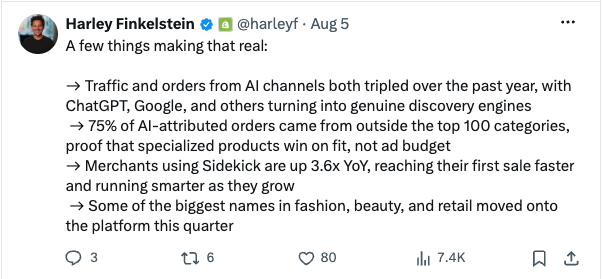
The traffic is still relatively small, but it’s growing quickly, more specifically — 393% year over year in Q1 2026 and it’s still holding momentum. Shopify also reported on its Q2 2026 earnings call that AI-driven traffic and orders to merchant stores each tripled year over year, with new-buyer orders arriving through AI channels at nearly twice the rate of other channels.
More importantly, the bigger change isn’t the size of the channel. It’s where part of the buying decision now happens.
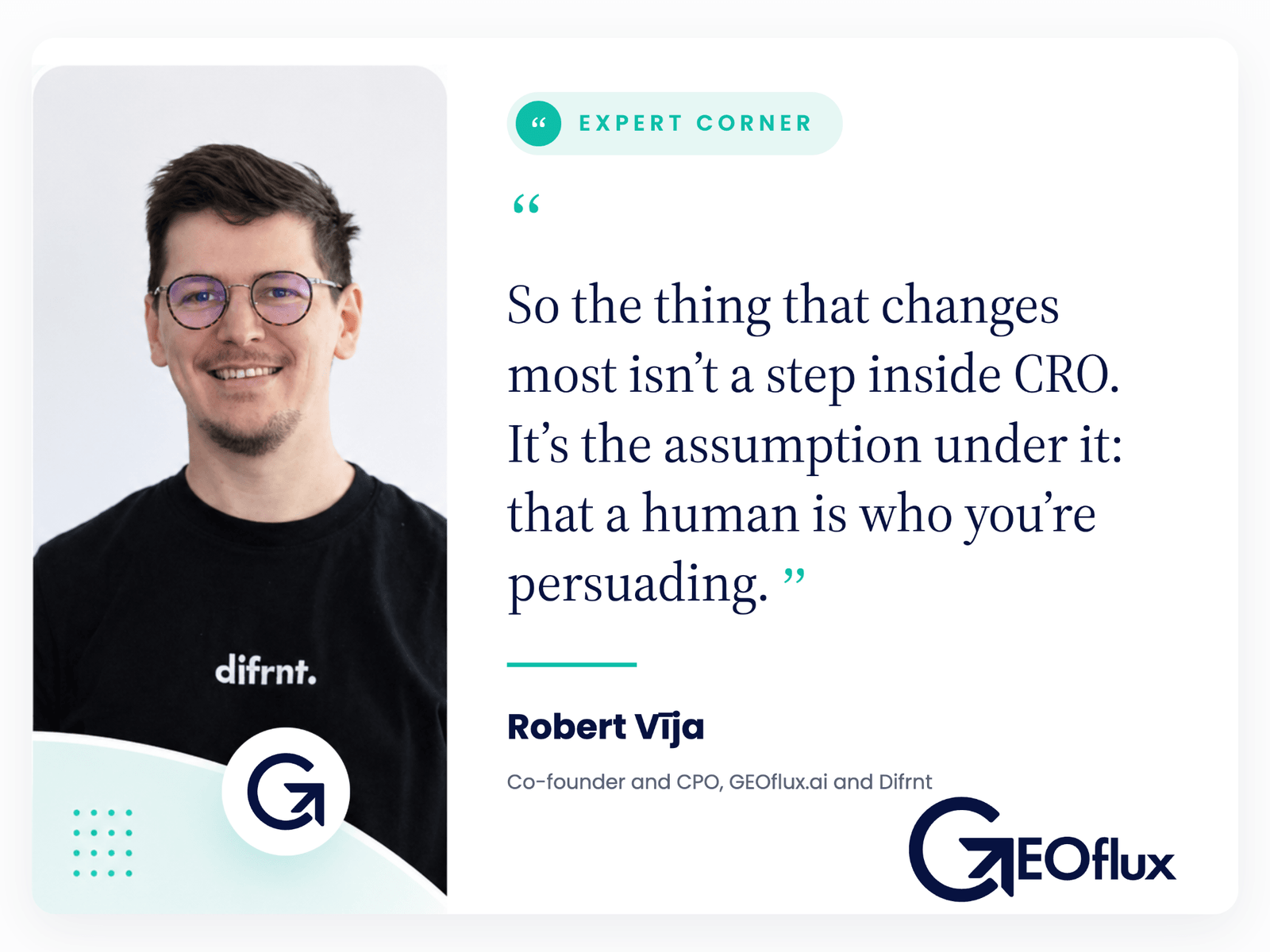
Robert Vîja put it simply:
So the thing that changes most isn’t a step inside CRO. It’s the assumption under it: that a human is who you’re persuading.
That effectively gives CRO a new persona to account for.
A human and an AI agent don’t evaluate a product in the same way. A person can respond to imagery, social proof, positioning or urgency. An agent is trying to work out whether a product actually matches what someone asked for, often by comparing information from multiple sources before the human ever lands on the site. And that introduces a new type of optimization.
Deborah O’Malley pointed directly at what needs to change:
Data will need to be structured in a way that enables the targeting and tracking of human users and in a way that AI agents can parse and quickly understand.
Daniel Gurevitch made the same point from the catalogue side, and put a timescale on it:
For twenty years, CRO and SEO people optimized for keyword engines: exact-match titles, thin tags, category logic built around how a search box parses text. AI shopping agents flip that. An agent answering ‘what should I wear to a beach wedding’ can only recommend products it can reason about. So the emerging skill is product data strategy: structuring your catalog so AI agents can match your products to real human intent.
In other words, product data becomes part of CRO. How clearly a product is described, whether its specifications and claims are consistent, and whether an agent can connect its attributes to a shopper’s intent can now influence whether that product even makes the shortlist.
That doesn’t mean CRO stops being about the human experience. It means there’s now another decision-maker in the journey, and optimizing for it requires a different kind of information.
Change 4: What is the one CRO skill that makes a difference when AI can build any test?
Judgment was the clearest recurring answer.
Only about a third of A/B tests produce a statistically significant positive result — and that figure is, if anything, flattering, since it comes from teams disciplined enough to run their numbers through a statistics tool. So if two thirds of ideas don’t work, simply generating more of them isn’t the advantage. It’s knowing which ones are worth testing.
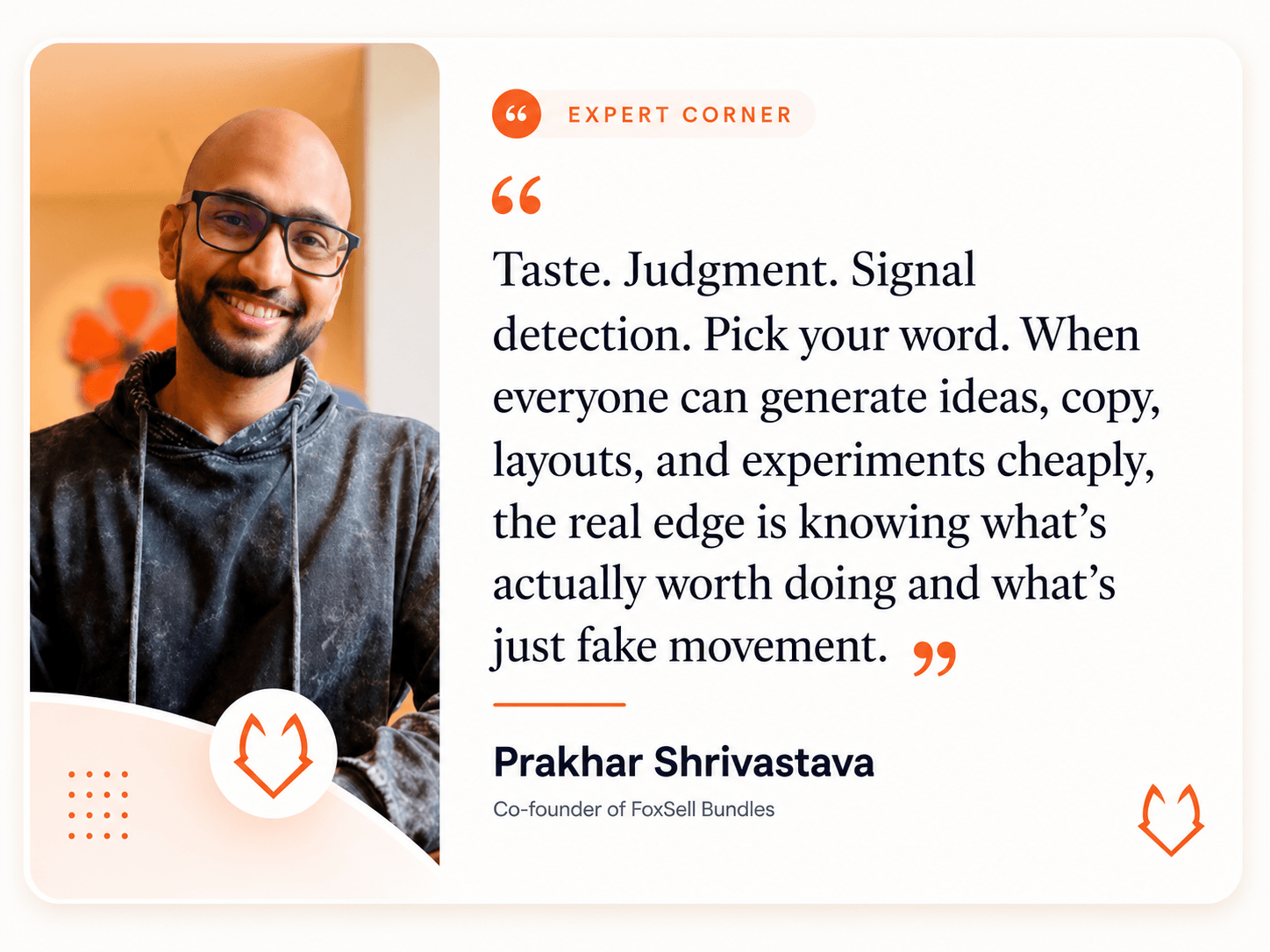
Prakhar Shrivastava put it straight and simple:
Taste. Judgment. Signal detection. Pick your word. When everyone can generate ideas, copy, layouts, and experiments cheaply, the real edge is knowing what’s actually worth doing and what’s just fake movement.
Deborah O’Malley spelled out why this is a skill rather than a personality trait.
As AI automates analysis, research synthesis, copy generation, personalization, and test ideation, many tactical CRO activities will become faster and cheaper. The scarce resource will no longer be execution. It will be judgment. The practitioners who thrive will be those who can distinguish signal from noise, challenge AI-generated conclusions, and understand the psychological, emotional, and contextual factors that drive behavior. The future CRO expert will be less of a technician and more of a behavioral scientist, strategist, and interpreter of increasingly complex decision ecosystems.
Robert Vîja was the only one to name a specific new skill rather than a category.
The skill almost no CRO team has built yet is thinking about machine-readability as an optimization surface: structuring product data, claims, and content so that an AI assistant reads them correctly and quotes them accurately when a shopper asks for a recommendation. It sits between SEO, content, and product data, which is why it tends to fall through the cracks.
And on what it’s worth, he adds:
The person who can do this, and can tell when an assistant has it wrong, is going to be worth a lot more than the person producing another test report.
Tudor Goicea broke judgment into three components:
- Framing the problem: because one sharp hypothesis built on real customer friction beats a pile of random tests.
- Statistical literacy, because someone has to catch the agent peeking, i.e. stopping a test the day a variant randomly looks ahead, or calling a winner that isn’t real.
- Understanding the customer: because the numbers tell you what happened, never why, and the why is where the next win comes from.
Test results wobble day to day, and on some days chance alone puts a variant ahead. A lot of people would be tempted to stop the moment that happens, but all that brings is noise rather than a clear win. It’s even worse with agents, even though they don’t experience things like impatience or task deadlines. An agent scored on wins will peek constantly, because it’s the fastest route to the number it’s judged on. So the rule about when a test ends has to live outside the agent.
Richard Joe framed the whole risk as volume without improvement:
AI will make it much easier to generate insights, hypotheses and even polished recommendations. The risk is that CRO teams end up with more output, but not necessarily better decisions.
Ole Gregersen supplied probably the most easy-to-memorize summary of the panel’s position:
Crap in, AI crap out.
Ole’s warning is really about inputs, and inputs are what decide the next question: what can you safely hand over, and what should never leave your desk?
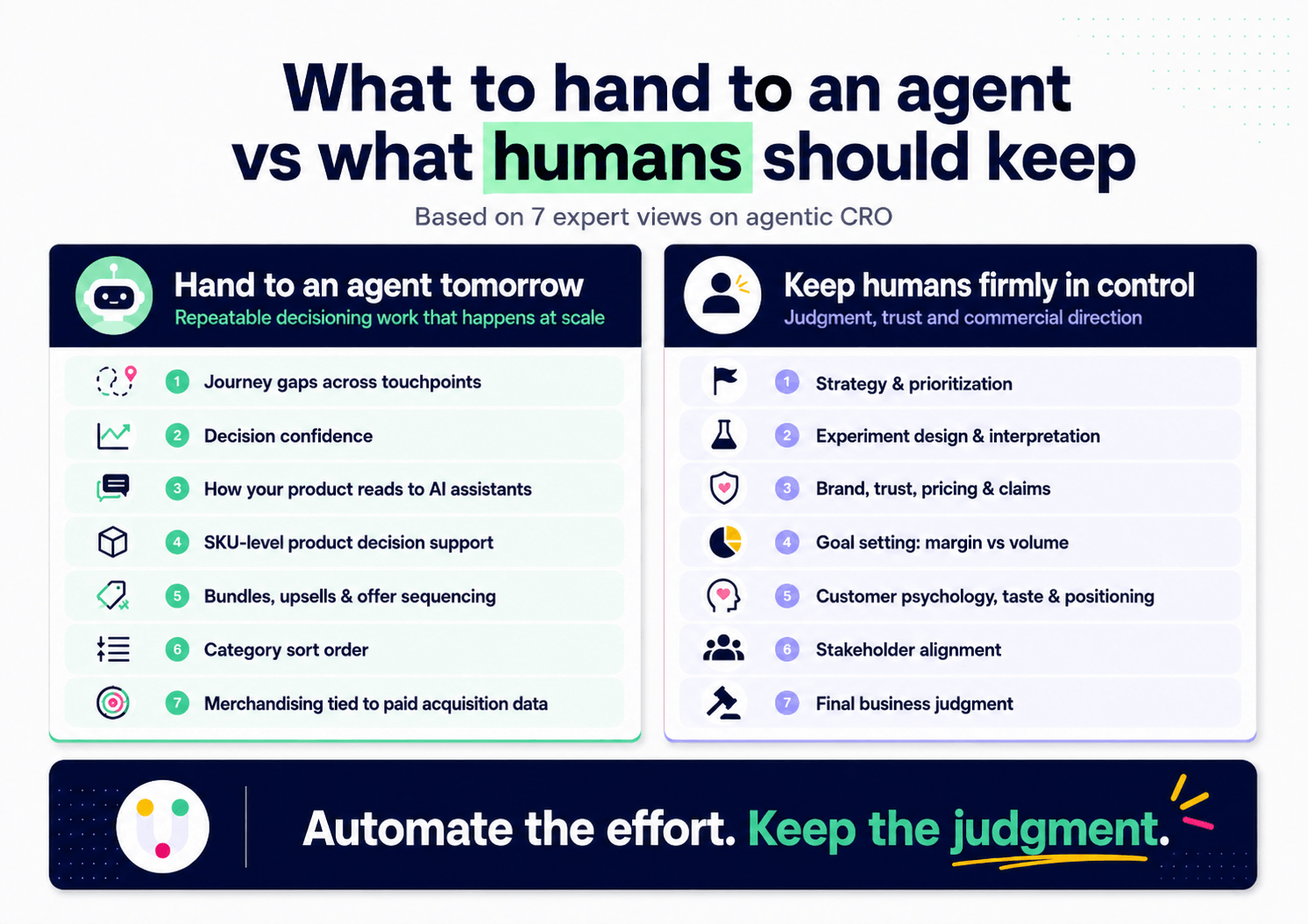
What should be handed to an agent in CRO tomorrow?
We asked each contributor to name one thing in ecommerce they’d let an agent optimize today that almost nobody is doing yet.
Nobody said copy testing or button colors. In fact, six of the seven named a decisioning problem rather than a persuasion problem — a question of what to show rather than how convincingly to show it.
| Contributor | What they’d hand over | Why it’s neglected |
|---|---|---|
| Ole Gregersen | Gaps in user journeys across touchpoints | Paid traffic lands on the same page regardless of source, and UX teams often don’t know where visitors came from |
| Deborah O’Malley | Decision confidence, not conversion rate | Purchases stall on uncertainty, but nothing in the stack measures uncertainty |
| Robert Vîja | How your product reads to an assistant comparing you to rivals | No dashboard reports a recommendation you didn’t get |
| Richard Joe | Product page decision support at SKU level | Too manual to do across a whole catalogue, so it never happens |
| Prakhar Shrivastava | Bundles, upsells and offer sequencing by source, cart, margin and intent | Treated as a design problem when it’s a decisioning problem |
| Tudor Goicea | Default sort order on category pages | Set once, never revisited, despite deciding which products most traffic ever sees |
| Daniel Gurevitch | Merchandising optimized against paid acquisition data | Growth optimizes ads, ecommerce optimizes the site, and the signals never meet |
Ole’s is the one everyone has experienced from the other side. You click an ad for a specific product and land on a generic homepage, because the team buying the traffic and the team building the page don’t share a view of where visitors came from. Multiply that by every source, campaign, device and country and no human can audit it. An agent watching continuously can catch the moment a route stops working, usually through signals of user frustration like dead taps, rage clicks and silent drop-off on a path that used to convert.
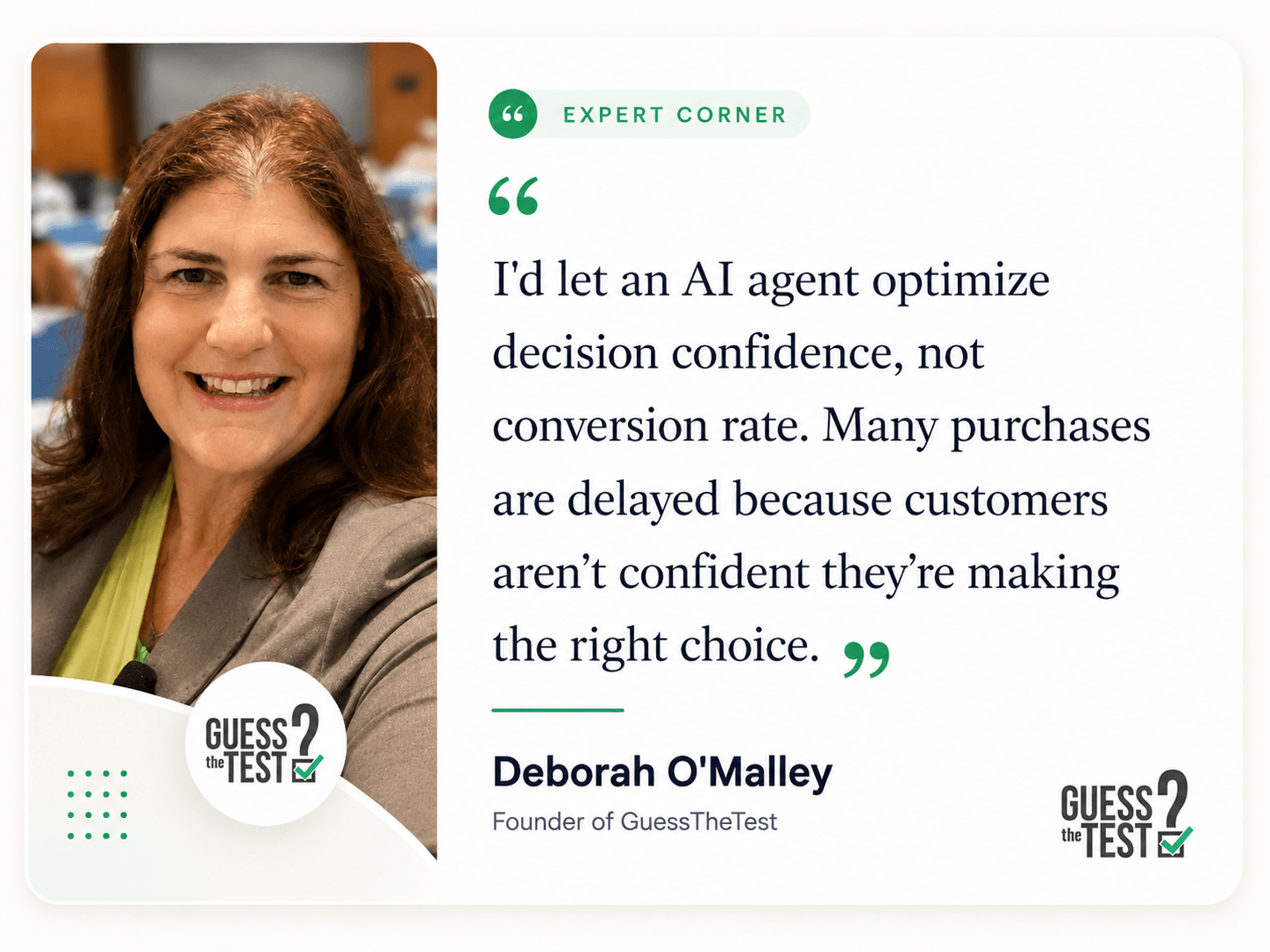
Deborah’s changes the metric itself.
I’d let an AI agent optimize decision confidence, not conversion rate. Many purchases are delayed because customers aren’t confident they’re making the right choice.
An agent mines reviews, customer questions and support chats for the specific doubt blocking a decision, then answers it, fixing the cause instead of pushing harder on the symptom. Her claim is backed by actual data too: 79% of consumers who use AI for shopping feel more confident in the purchase afterwards, and 69% say they’re less likely to return the item.
Tudor’s comes with its own evidence. 64% of ecommerce sites don’t offer all four sorting options shoppers expect — price, user rating, best sellers and newest — so the ranking underneath is usually an afterthought.
Almost every store picks one sort, featured or best-selling, and never touches it again, even though that order decides which products get the prime slots most of the traffic ever sees.
An agent can score every product in a category on conversion rate, margin and stock, re-rank the page, then test that ranking against the old default, category by category, week after week. “Most teams,” he adds, “are still dragging and dropping by hand.”
Put together, these conclusions point to the same concept: each is a place where a decision gets made thousands of times a day, currently by a default someone set once. That’s precisely the shape of work that suits an agent because it gets deferred forever in a human backlog.
It’s also why an execution layer of narrow agents tends to beat one general-purpose assistant. Sort order, merchandising rank, preloading the next likely navigation, keeping interactions responsive under load, and intervening when a cart is about to be lost are different jobs with different success metrics.
Where humans should stay firmly in control
Not one of them drew the line at “AI shouldn’t touch the site.” They drew it around commitment, interpretation and trust.
For Tudor Goicea the line falls at commitment. An agent can tell you which variant won, but only a person can decide the business actually wants it, because hitting statistical significance is not the same as having a business case. Anything carrying brand or trust sits on that same side of the line, especially pricing, claims and checkout. He condensed the whole position into four words:
Automate the effort. Keep the judgment.
Richard Joe drew almost the same boundary from the agency side. Humans hold strategy, prioritization, experiment design, interpretation and stakeholder alignment, because AI can spot patterns, but it does not truly understand brand context, customer emotion, organizational constraints or the cost of getting a decision wrong.
Daniel Gurevitch put human control at the level of the objective. The question isn’t just what an agent is allowed to change, but what goal it is being asked to optimize for in the first place.
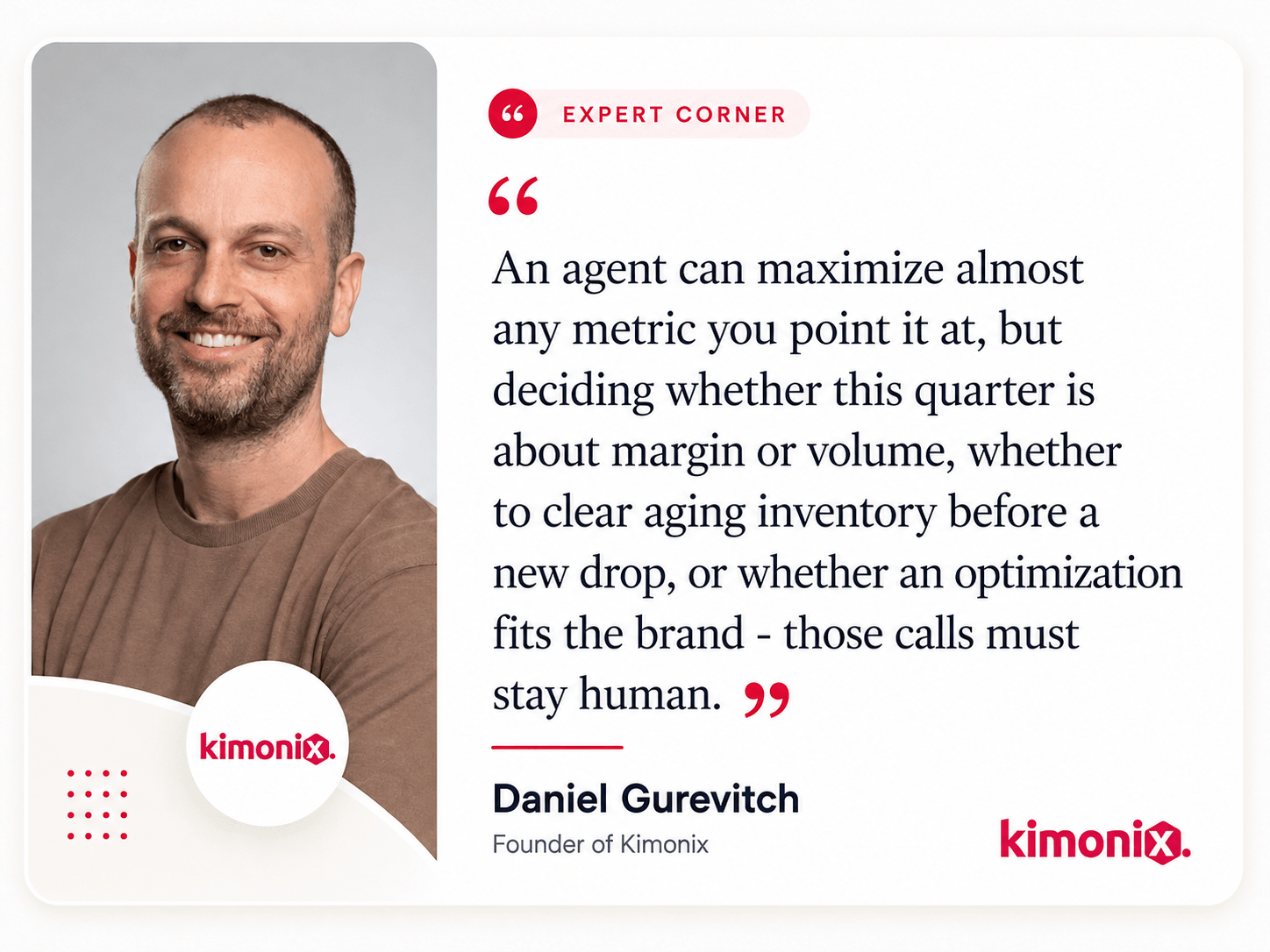
An agent can maximize almost any metric you point it at, but deciding whether this quarter is about margin or volume, whether to clear aging inventory before a new drop, or whether an optimization fits the brand — those calls must stay human.
Because otherwise you risk the agent doing a perfect job for a goal that wasn’t important at that very time.
Ole Gregersen added a completely different, but complementing perspective: humans as connective tissue between humans.
In CRO there are many skills, teams and processes at play. There are designers, UX’ers, developers, CROs, stakeholders. AI can’t connect them yet.
His warning is about who gets to participate. Velocity means more people can contribute insights and hypotheses, but the responsibility of making sure quality tags along becomes equally important.
Prakhar Shrivastava put the sharpest edge on it. “Strategy, taste, positioning, customer psychology, and knowing what not to optimize” — those are the things he would not hand over.
How to prepare for AI agents in CRO?
Preparing for agentic CRO starts with getting the basics right: what machines can read, what data they can access, and what decisions you want them making.
- Audit what machines can read. Pull up your best-selling product page and check whether specs, price and availability are present in the served HTML rather than assembled by script after load. Product pages are the weakest page type in the sector, so assume yours needs work.
- Rewrite product data for situations, not keywords. Occasion, fit, material, compatibility, use case. An assistant can only recommend what it can reason about, and vague marketing copy gives it nothing to reason with.
- Unify the signals before you automate on them. An agent reasoning across four disconnected exports inherits every gap between them. One schema, unsampled, beats a wider tool belt.
- Pick a decisioning surface, not a persuasion surface. Category sort order, merchandising rank, offer sequencing and journey routing are all set-once defaults running thousands of decisions a day. That’s where agents pay first.
- Write your stopping rules before you hand over the keys. Decide in advance what significance threshold ends a test, and make sure the agent optimizing the outcome isn’t the thing enforcing the rule.
- Insist on attribution per change. You need to know at all times which automated change produced which results.
None of this requires a platform decision on day one. It does require deciding that machine readability and runtime optimization are now the same programme.
What AI in CRO looks like next
Seven people who don’t work together, asked the same four questions, arrived at three arguments that reinforce each other.
- The grunt work of optimization is going to agents, and quickly.
- As execution gets cheaper, the real advantage shifts to deciding what’s actually worth optimizing, making human judgment more valuable, not less.
- At the same time, the population being optimized for is expanding beyond the human visitor.
That’s the model we’re building Uxify around: a diagnostic layer that sees what real users and agents actually experience, an execution layer of narrow agents that acts on it continuously in our own optimization layer rather than in your codebase, and attribution tight enough that humans can keep the judgment the panel insists on keeping.
Want to see where your own site is losing revenue before you automate anything? Book a demo and we’ll run your real user data through the diagnostic layer live, on your traffic, in the call.
Thanks to Ole Gregersen, Deborah O’Malley, Robert Vîja, Richard Joe, Prakhar Shrivastava, Tudor Goicea and Daniel Gurevitch for contributing.
Contributions were submitted between June and August 2026 and have been lightly copy-edited for length and clarity. Arguments and emphasis are the contributors’ own.
Frequently asked questions
How is AI used in CRO?
In three ways worth separating. AI-assisted CRO speeds up single steps: an LLM summarizes session recordings, a prompt drafts variants, a human still carries the work between steps. AI conversion rate optimization usually means the same thing with more of the analysis automated. Agentic CRO is when the system carries the work between steps itself, inside guardrails a human sets.
Is AI in CRO the same thing as AI-powered A/B testing?
No. AI-assisted testing speeds up producing and analyzing experiments, which still ends in a human deploying a winner. An agentic approach closes the loop, detecting friction and acting on it within the same session. Given that roughly a third of A/B tests produce a significant positive result, faster production alone has a limited ceiling.
Will AI agents replace conversion rate optimization specialists?
The evidence actually points the other way. What changes is the work: less report assembly and variant building, more problem framing, statistical oversight and commercial judgment.
Why does machine readability matter for conversion, not just SEO?
Because part of the buying decision now happens off your domain. AI-referred retail traffic converted 54% better than non-AI channels in May 2026, but you only receive that traffic if an assistant can parse your product data accurately enough to recommend you in the first place.
Do AI agents need to change my site’s code?
Not necessarily, and the safer architectures don’t. An optimization layer can apply and reverse changes at runtime, above the site itself, which keeps every change measurable, attributable and instantly reversible. That reversibility is what makes delegating to an agent a reasonable risk rather than a leap of faith.