
Key takeaways:
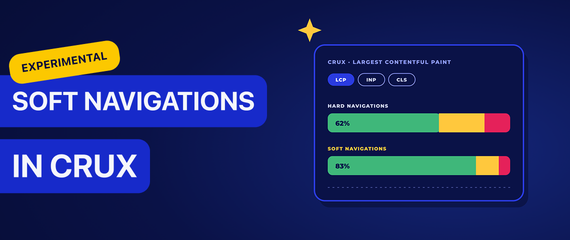
- CrUX now has experimental LCP, INP and CLS metrics that include soft navigations, the in-app page changes single-page apps make.
- Most sites won't notice a thing. Only around 7 to 11% of sites rely on soft navigations for most of their traffic.
- SPA-heavy sites will mostly see better scores, especially on LCP and CLS.
- Your official Core Web Vitals and Search Console data stay the same for now. Google is aiming to make the switch in May 2027.
- You can check your own numbers today in CrUX Vis.
Make Uxify one of your go-to sources on Google
 Add Uxify on Google
The blind spot nobody fixed
Most websites work the old way. You click a link, the browser grabs a fresh page, and that’s that.
Single-page apps (SPAs) don’t work like that. They load once, then use JavaScript to swap the content and change the URL as you click around. Google calls those in-app jumps soft navigations.
For years, Chrome’s real-user data basically ignored them. CrUX recorded the first page load and piled everything that happened afterwards onto that landing page. Every click, every layout shift, the whole session. So an SPA that felt fast after the first load could still look average in its Core Web Vitals report. Not exactly fair.
What changed
With the Soft Navigations API live in Chrome 151, Google has started publishing experimental versions of LCP, INP and CLS in CrUX that count soft navigations next to regular page loads (web.dev).
Each in-app view is now measured on its own and reported under the URL people actually landed on. That sounds like a small detail. It isn’t. It means you can finally see which page in your app is the slow one, instead of guessing.
Will your scores move?
Probably not. About 70% of sites in CrUX have little to no soft navigation traffic (web.dev). If your site loads a new page every time someone clicks, like most blogs, news sites and standard online stores, your numbers should stay put.
The big players are another story. Among the top 1,000 sites, 35% on Android and 42% on desktop use soft navigations for more than half their page views (web.dev). For SPA-heavy sites like these, here’s roughly what happens:
LCP gets a lot better. On Android, sites with 75 to 100% soft navigations go from 26% passing LCP to 87%. Not because SPAs are magically faster, but because follow-up clicks reuse files that already loaded.
INP improves, but don’t relax yet. The Android pass rate roughly doubles because responsiveness is judged per view, not by the worst moment of a whole session. SPA-heavy sites still trail regular sites here, so heavy JavaScript during page changes is still a problem.
CLS catches up. Layout shifts are no longer stacked across a long session, which puts SPAs level with regular sites on desktop and close on Android.
We checked eight big single-page apps
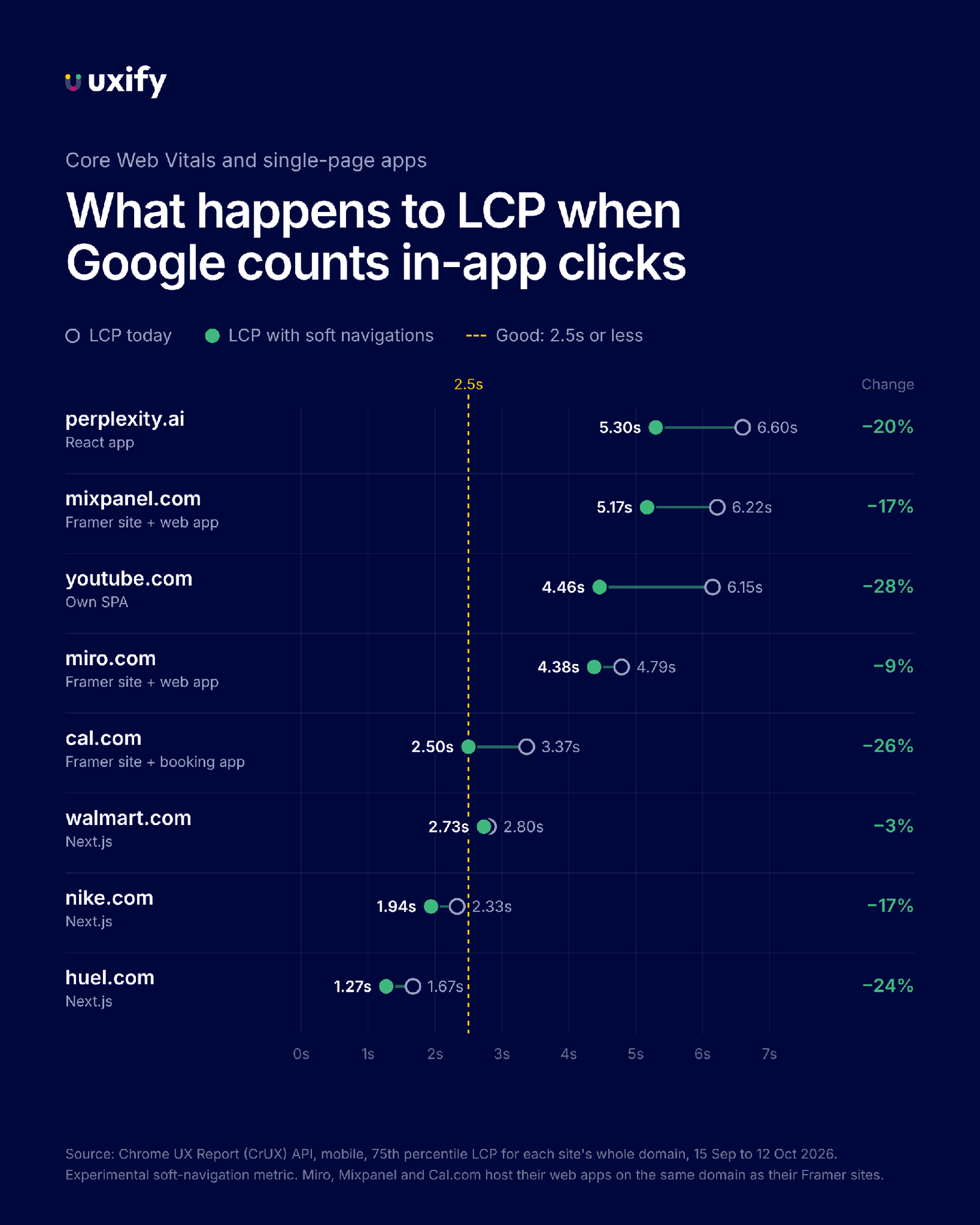
To see what this means in practice, we pulled the new numbers for eight large sites that switch pages inside the app instead of loading new ones.
| Site | Built with | LCP today | LCP with soft navigations | Change |
|---|---|---|---|---|
| youtube.com | Own SPA | 6.15s | 4.46s | −28% |
| perplexity.ai | React | 6.60s | 5.30s | −20% |
| mixpanel.com | Framer site + web app | 6.22s | 5.17s | −17% |
| miro.com | Framer site + web app | 4.79s | 4.38s | −9% |
| cal.com | Framer site + booking app | 3.37s | 2.50s | −26% |
| nike.com | Next.js | 2.33s | 1.94s | −17% |
| huel.com | Next.js | 1.67s | 1.27s | −24% |
| walmart.com | Next.js | 2.80s | 2.73s | −3% |
What stood out:
- Every site got faster on paper, from 3% for Walmart to 28% for YouTube.
- None of them went from failing to passing. Nike and Huel were already under 2.5s. Cal.com came closest at 2.504s, just 4 milliseconds over the line. Perplexity, Mixpanel, YouTube and Miro are still above 4 seconds.
- Walmart barely moved. It’s built on Next.js, which can switch pages inside the app, but most of its clicks still seem to load a full page. Your framework doesn’t tell you how your site is measured, so check your own numbers.
- The first page still decides the score. Faster follow-up clicks bring the average down, but a slow landing page keeps most of these sites from passing.
How we measured: Chrome UX Report (CrUX) API, mobile, 75th-percentile LCP for each site’s whole domain, 15 September to 12 October 2026. We compared Google’s current LCP with the experimental metric that includes soft navigations. Miro, Mixpanel and Cal.com run their web apps on the same domain as their Framer sites, so their numbers include both.
Does this change your SEO today?
No. Your official Core Web Vitals don’t change, and Search Console keeps using the current data. Google wants to drop the “experimental” label in May 2027, and that’s when Search Console makes the switch (web.dev). FCP and navigation types are expected to join in November.
Since it’s still experimental, expect the numbers to shift a bit month to month.
What we’d do this month
Open CrUX Vis, drop in your domain, and compare the regular and experimental numbers side by side. Then do the same for your competitors. If one of them runs an SPA, their scores might suddenly look a lot better, and it’s good to know why before someone forwards you a worrying screenshot.
And keep watching. Google is changing how it measures part of the web, and the final version lands in Search Console in about seven months. Vita, our Core Web Vitals monitoring agent, flags regressions as they happen, so you’re not finding out the hard way next May.