Key takeaways:
- AI agents go beyond simply recommending or answering questions: they can take action, connect to real-time store data, and complete multi-step workflows with less manual input.
- The best AI agent depends on the use case, whether that’s customer support, website optimization, product discovery, operations, or personalization.
- Businesses should consider integrations, data access, autonomy, and human oversight before choosing an AI agent platform.
- AI agents can reduce repetitive work, improve operational efficiency, speed up customer resolution, and support real-time decisions.
- The safest approach is to start with one high-volume workflow, measure ROI, and expand automation once the agent performs reliably.
Make Uxify one of your go-to sources on Google
 Add Uxify on Google
Ecommerce teams now use AI agents to answer order questions, guide shoppers to the right product, and fix storefront friction while visitors are still browsing. Each platform automates a different part of the business, so the right pick depends on what you want to hand over.
Some agents talk to customers. Others work behind the scenes, improving website performance, recovering abandoned carts, or identifying conversion issues without requiring a shopper to interact with a chatbot.
This guide compares eleven AI agents for ecommerce by use case, integrations, automation level, and pricing. It then covers the main use cases, how to choose an agent, and how agents differ from other AI tools.
What are AI agents for ecommerce?
AI agents for ecommerce are AI systems that can perform various tasks and make decisions on behalf of an online store. While assistive AI tools mainly generate recommendations or content, AI agents are more capable and can take actions based on predefined goals, permissions, and real-time data.
For example, a traditional ecommerce AI tool can help answer a customer’s question. An AI agent, by contrast, can check the customer’s order, confirm its delivery status, issue a refund when the request meets store rules, and update the support ticket without requiring an employee to oversee every step.
The ability to act is what distinguishes AI agents from many other ecommerce AI tools. They can connect to platforms like Shopify, customer support systems, product catalogs, analytics tools, and inventory databases to work with current store data rather than having to rely on constant static inputs.
AI agents can also handle multi-step workflows. A shopping agent may interpret what a customer wants, search the product catalog, compare suitable options, check availability, and recommend or add the best match to the cart.
Other agents can monitor website performance, adjust campaigns, manage support requests, or trigger actions when specific conditions are met.
Using AI agents doesn’t necessarily mean that humans aren’t involved in the decision-making process. Businesses can control what an agent can do and require human approval for sensitive or unusual actions.
A support agent may resolve routine requests independently, but escalate a high-value refund or complex complaint to a human employee.
Autonomy also varies by platform and use case. Some agents handle only specific steps, while others can complete an entire workflow with very little human intervention.
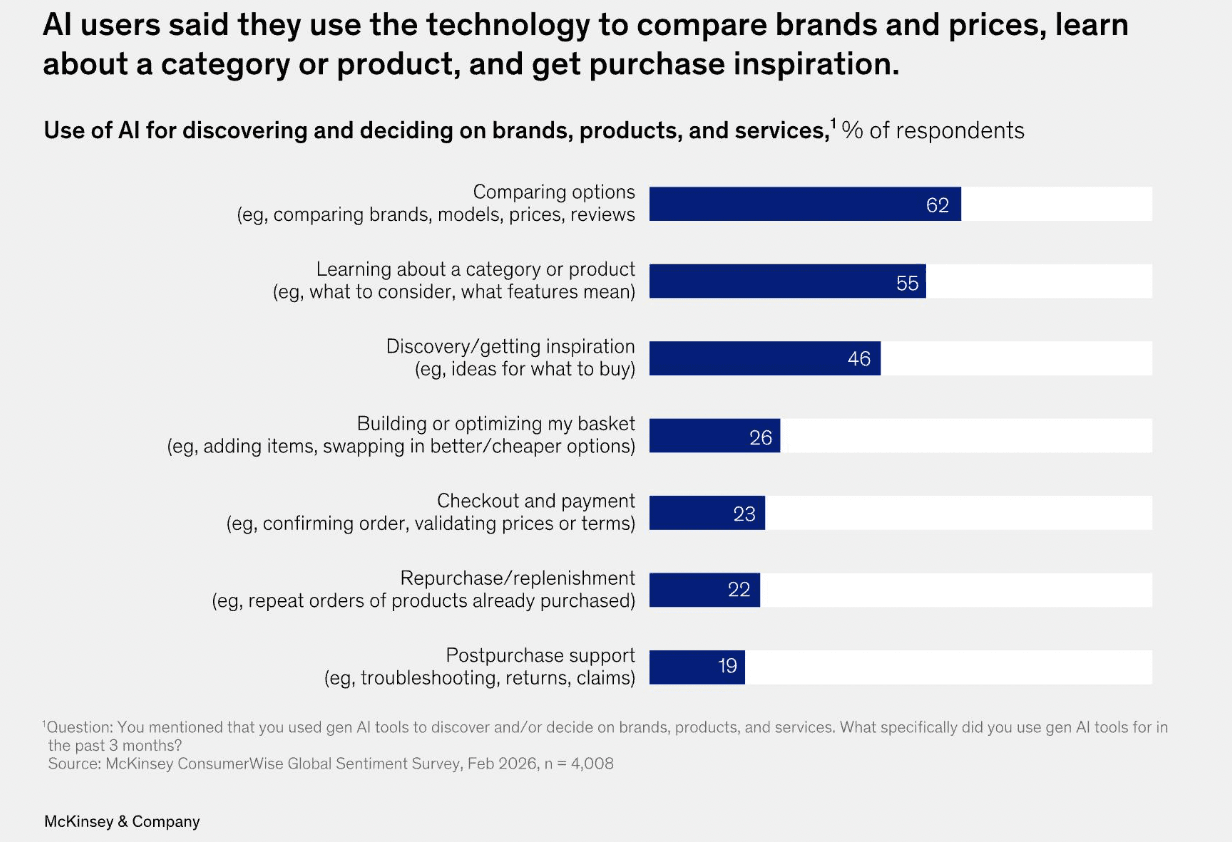
Shoppers already lean on AI across the buying journey, from comparing options to checkout and support. Source: McKinsey ConsumerWise Global Sentiment Survey, February 2026.
Best AI agents for ecommerce in 2026
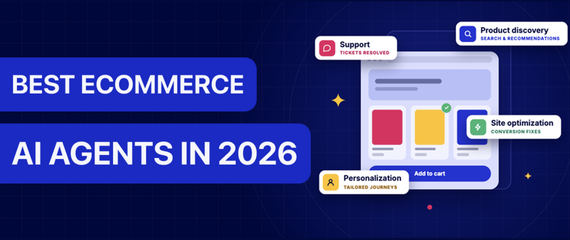
The best AI agents for ecommerce solve different parts of the customer journey. Some focus on customer support, while others handle website optimization, product discovery, personalization, or complex workflows across multiple systems.
The right option depends on what you want to automate and how much control you want to have. The table below compares leading platforms by use case, automation level, integrations, pricing, and the amount of human input they usually require.
Prices are as listed on each vendor’s website on 19 October 2026.
| AI agent/platform | Best for | Main use case | Automation level | Ecommerce integrations | Human intervention | Pricing/starting price | Free trial / free plan |
|---|---|---|---|---|---|---|---|
| Uxify | Website and conversion optimization | Finding and fixing conversion, engagement, and performance issues | High | Shopify, Shopify Plus, Salesforce Commerce Cloud, and others | Low; businesses can set guardrails and review or roll back changes | From $49/month billed yearly; all agents from $99/month; agent tasks billed per outcome | Free monitoring plan; $1 14-day Scale pilot |
| Gorgias | Shopify customer support and shopping assistance | Pre- and post-purchase customer conversations | High | Shopify and connected commerce/support tools | Low for supported requests; escalates when needed | Helpdesk from $10/month; AI Agent $0.90 per automated interaction on annual plans ($1.00 monthly) | 7-day free trial |
| Fin | AI customer service across existing support stacks | Resolving customer questions and completing support procedures | High | Intercom, Zendesk, Salesforce, HubSpot, Freshdesk, and others | Low; can hand conversations to human agents | $0.99 per outcome; $49/month minimum on another helpdesk | 14-day free trial |
| Algolia | Search and product discovery | AI search, recommendations, ranking, and personalization | Medium-high | Shopify, Salesforce Commerce Cloud, Adobe Commerce, commercetools | Mostly setup and merchandising oversight | Free tier; paid usage scales with searches and records | Free plan |
| Clerk.io | Product discovery and personalization | Search, recommendations, chat, email, and audience targeting | Medium-high | Shopify, Magento, WooCommerce, BigCommerce, PrestaShop, and others | Moderate; teams configure rules, designs, and merchandising | Public usage-based tiers per product | Free demo; free trial |
| Sierra | Enterprise customer service | Resolving customer requests and taking actions across business systems | High | 40+ pre-built integrations plus custom integrations | Low; agents can route cases to human teams | Custom, outcome-based pricing | Demo available |
| Decagon | Complex customer support workflows | End-to-end customer service automation | High | Salesforce, Zendesk, Intercom, Kustomer, Amazon Connect, and others | Low for defined workflows; escalation supported | Custom per-conversation or per-resolution pricing | No public free plan |
| Insider One | Omnichannel personalization and marketing | Personalized journeys, recommendations, segmentation, and messaging | Medium-high | Shopify, VTEX, APIs, and 100+ other integrations | Moderate; teams define campaigns, audiences, and journeys | Custom pricing | Demo available |
| ViSenze (Rezolve Ai) | Visual and multimodal product discovery | Search, recommendations, visual discovery, and AI shopping assistance | Medium-high | Shopify, Magento, BigCommerce, WooCommerce, Salesforce Commerce Cloud, and others | Mostly configuration and optimization | Custom pricing | Demo via Rezolve Ai (30-day trial still advertised) |
| Klaviyo | Email, SMS, and lifecycle marketing with built-in customer service | Planning and launching campaigns and flows (Composer) and resolving shopper questions (Customer Agent) | Medium-high | Shopify, WooCommerce, BigCommerce, Adobe Commerce, Salesforce Commerce Cloud, and 400+ others | Moderate; teams set guardrails, and Customer Agent hands conversations to human agents | Email plan from $20/month; Composer and Customer Agent billed by usage | Free plan (250 active profiles, $5 of Composer usage and 10 Customer Agent resolutions per month) |
| Prediko | Inventory planning and purchasing for Shopify brands | Demand forecasting, replenishment, and purchase order management | Medium-high | Shopify, Amazon, and 150+ WMS, 3PL, ERP, and sales platforms | Moderate; the agent prepares forecasts and draft POs for teams to review | From $49/month, tiered by store revenue | 14-day free trial |
Uxify
If you want AI agents to optimize the website itself, not just customer-facing conversations, Uxify is the best match. Monitoring real user data, its agents identify conversion and performance problems and act on them while visitors are still on the website.
Unlike customer-facing AI agents that wait for shoppers to ask a question, Uxify’s agents work behind the scenes, identifying and addressing friction that can prevent visitors from converting in the first place. This makes Uxify particularly relevant for ecommerce brands that want to improve conversion rate, engagement, and revenue per visitor (RPV), rather than focus exclusively on automating customer interactions.
Each of Uxify’s live agents handles one job: Navigation AI prerenders the page a shopper is likely to open next, and INProve makes clicks and taps respond faster. Truetap corrects missed clicks and taps on interactive elements, Carter intervenes when shoppers attempt to abandon checkout, and Vita is designed to monitor Core Web Vitals and detect performance regressions.
When an agent detects friction in a conversion path, it can apply an optimization without waiting for a team to manually analyze a dashboard or set up a separate test. Agents such as Navigation AI measure their own impact on an A/B basis, comparing visitors who receive the optimization with a control group who don’t, so teams can see the effect on conversion rate and revenue per visitor directly. To show teams which fixes deliver the most revenue, Uxify Reality brings performance and engagement data together with conversion data and ranks issues by revenue impact.
To keep control, businesses can set instructions and guardrails for individual agents and review or roll back the changes they make. Uxify supports Shopify and Shopify Plus, and it also works with Salesforce Commerce Cloud and other ecommerce platforms.
Uxify applies optimizations through its own layer of code without directly modifying the store’s source code. This allows teams to activate agents, monitor their impact, and manage changes without requiring a separate development cycle for every optimization.
On yearly billing, the Core plan costs $49/month with one agent per website, while the Scale plan costs $99/month with all agents ($59 and $129 if you pay monthly). Agent tasks are billed per outcome on top of that, although each paid plan includes an agent credit.
Scale also offers a $1 introductory 14-day pilot, after which standard plan pricing applies.
Best for: Ecommerce businesses that want to address website performance, engagement, and conversion friction through autonomous optimization rather than customer-facing support automation.
Gorgias
Gorgias is a strong choice for Shopify brands that want to automate customer conversations before and after a purchase. Its AI Agent acts as both a support agent and an AI shopping assistant across email, chat, SMS, and social channels.
The agent can answer product questions, help customers find suitable items, check order information, handle returns, and take other actions through connected systems. It can resolve supported workflows autonomously and escalate conversations to a person when human intervention is needed.
Gorgias is especially tailored to Shopify commerce and uses customer and order data to generate more relevant answers. Pricing combines the Gorgias platform with outcome-based AI Agent charges. Each AI Agent interaction costs $0.90 on annual plans or $1.00 on monthly plans, and the helpdesk starts at $10/month on the Starter plan. A 7-day free trial is available.
Best for: Shopify-focused businesses that receive high volumes of repetitive customer inquiries and want to combine helpdesk management with AI-driven support automation.
Fin
Fin (formerly Intercom, acquired by Salesforce in September 2026) is best for businesses that want an autonomous customer service agent without replacing their existing support platform. It can work within the Intercom helpdesk or connect to Zendesk, Salesforce, HubSpot, and Freshdesk.
Fin can answer questions, follow established procedures, perform actions in external systems, and escalate conversations to human agents. This makes it useful for businesses that want to automate more than basic FAQs while keeping complex or sensitive cases under human control.
The platform also works across multiple channels, including chat and email, and can use existing support content and workflows. Fin costs $0.99 per outcome, with a $49/month minimum when it runs on another helpdesk. Businesses can also use it with the Intercom helpdesk, which is priced per seat, and a 14-day free trial is available.
Best for: Businesses that want to automate customer service while continuing to use their existing support infrastructure.
Algolia
Algolia is a good fit when product discovery is the main problem you want AI to tackle. Its platform combines search, recommendations, AI ranking, personalization, and agentic shopping capabilities to help customers find relevant products faster.
Algolia can process real-time behavior signals such as searches, clicks, add-to-cart events, and purchases. Its AI models then use this data to rank results and personalize recommendations as customer behavior changes. Agent Studio adds even more conversational and guided shopping experiences.
Algolia integrates with Shopify, Salesforce Commerce Cloud, Adobe Commerce, and commercetools. A free plan includes search and recommendation usage, while Grow and Grow Plus scale based on search requests and catalog records. Enterprise AI capabilities are available through the Elevate plan with custom pricing.
Best for: Retailers with sizable product catalogs where search relevance and product discovery have a direct impact on the buying experience.
Clerk.io
Clerk.io provides several product discovery and personalization features in one ecommerce platform. Businesses can use it for AI-powered search, product recommendations, shopping chat, personalized emails, and audience segmentation.
Its recommendations use customer behavior, purchase history, and current shopping intent to decide which products to display. Search also accounts for factors such as shopper behavior, sales data, availability, and query intent.
Clerk.io supports more than 15 pre-built integrations, including Shopify, Magento, WooCommerce, BigCommerce, and PrestaShop, as well as an open API. Pricing is public and usage-based: each product (search, recommendations, chat, email, and audience) has its own tiers, and businesses can also request a free demo or start a free trial.
Best for: Ecommerce stores that want to combine search, recommendations, and personalization within one platform.
Sierra
Sierra is designed for larger companies that want an AI agent to handle customer service across several channels and business systems. Sierra agents can access connected systems and take actions on a customer’s behalf.
Businesses can customize Sierra agents by configuring customer journeys and defining how agents should handle different situations. When an issue requires a person, the agent can route the conversation to the customer support team.
Sierra supports voice and messaging alongside newer channels such as ChatGPT. Agent Studio offers more than 40 pre-built integrations, while companies with proprietary systems can build custom connections. Sierra offers outcome-based pricing, and businesses need to contact the company for a quote.
Best for: Large organizations with complex customer service operations spanning multiple communication channels and business systems.
Decagon
Decagon’s focus is on automating complex customer service workflows. Its agents can work across several systems to resolve requests such as refunds, returns, subscription changes, account updates, and other tasks.
Businesses decide how these actions should work through Agent Operating Procedures, which give the AI rules for handling each workflow. This allows companies to give agents more autonomy while controlling how agents handle customer data and connected systems.
Decagon integrates with platforms including Salesforce, Zendesk, Intercom, Kustomer, Amazon Connect, and RingCentral. It supports both per-conversation and per-resolution pricing, but the rates aren’t publicly listed, so you’d need to contact the company for a quote.
Best for: Businesses looking to automate multi-step customer service workflows that interact with several internal systems.
Insider One
Insider One (formerly Insider) works best for ecommerce teams focused on personalization and marketing across multiple channels. It combines customer data, audience segmentation, product recommendations, personalized website experiences, and cross-channel journeys in one platform.
The platform can use behavioral and customer data to build predictive segments based on factors such as purchase likelihood, customer lifetime value, likelihood to click, and product preferences. Businesses can then use these segments to personalize experiences across web, app, email, SMS, and other channels.
Insider One also connects product catalog and customer data with its recommendation and journey tools, and its Agent One system adds AI agents that adapt journeys toward the goals you set. It has 100+ integrations, including Shopify and VTEX, and pricing is quote-based.
Best for: Brands that want to coordinate personalization and customer engagement across their websites and marketing channels.
ViSenze
ViSenze, now part of Rezolve Ai, is a good option for retailers that want to improve product discovery through visual, text, and conversational search. Its Multi-Search technology lets shoppers search with natural language, keywords, images, or several inputs at once.
The platform also includes product recommendations, AI shopping assistants, and automated product tagging. It’s especially useful for visual categories such as fashion, home decor, and other stores where customers might struggle to describe what exactly they are looking for.
ViSenze connects with Shopify, Magento, BigCommerce, WooCommerce, Salesforce Commerce Cloud, and other commerce platforms. Pricing is quote-based. ViSenze’s homepage still offers a 30-day free trial, but trial and demo requests now go to Rezolve Ai.
Best for: Retailers in visually driven categories, such as fashion, furniture, and home decor, where image-based product discovery can improve search experiences.
Klaviyo
Klaviyo is a strong pick for brands that want AI agents inside the platform they already use for email and SMS. Its two agents, Composer and Customer Agent, work from the same customer profiles that power a store’s campaigns, flows, and segments.
Composer is Klaviyo’s marketing agent. It can analyze performance data, suggest what to do next, build campaigns and flows, and run recurring tasks such as audits on a schedule. Customer Agent handles the service side by answering shopper questions, recommending products, and handing conversations to a human with full context when needed. Klaviyo says Customer Agent resolves 65% of questions without human help.
Because both agents share one customer profile, a support conversation can inform the next campaign, and a shopper’s marketing history can shape how their support question is answered. Teams decide which tasks Composer takes on and can set guardrails for how Customer Agent responds.
Klaviyo integrates with Shopify, WooCommerce, BigCommerce, Adobe Commerce, Salesforce Commerce Cloud, Wix, and more than 400 other apps. A free plan covers up to 250 active profiles and includes $5 of Composer usage and 10 Customer Agent resolutions per month. The Email plan starts at $20/month, and both agents are billed by usage on top of it.
Best for: Brands that run email and SMS marketing in Klaviyo and want marketing and customer service agents working from the same customer data.
Prediko
Prediko is built for Shopify brands that want an AI agent to handle inventory planning and purchasing. It forecasts demand at the SKU level, recommends what to reorder and when, and manages purchase orders in the same place.
Its AI agent, Pia, can refresh forecasts, flag SKUs at risk of stocking out, create draft purchase orders, and generate reports through chat-based commands. Forecasts account for seasonality, growth, sales velocity, bundles, and incoming purchase orders, and Prediko’s buying table turns them into restocking recommendations for both finished goods and raw materials.
Prediko also offers an MCP server, so teams can run the same inventory commands from ChatGPT, Claude, or another MCP-compatible assistant. Write actions, such as creating or updating purchase orders, are limited to what the team approves, and draft POs can be checked before anything goes to a supplier.
Prediko syncs with Shopify in real time and connects to Amazon and more than 150 WMS, 3PL, ERP, and sales platforms. Pricing is tiered by store revenue and starts at $49/month, with unlimited SKUs, purchase orders, and users on every plan. A 14-day free trial is available.
Best for: Shopify brands with complex inventory, such as many SKUs, several locations, bundles, or raw materials, that want to plan stock and purchasing with less spreadsheet work.
AI agents by ecommerce use case
AI agents can handle very different areas of an ecommerce business. The most suitable option depends on the workflow you want to automate, the data the agent needs, and how much control you want to have.
Customer support agents
Customer support agents can answer questions, access order information, process routine requests, and escalate more complex cases to humans. Unlike basic chatbots, a support agent can use customer data and take actions in connected systems instead of only providing predefined answers.
Since the agent works across multiple channels, it doesn’t matter whether a customer writes in through live chat or email, SMS or social media. Stores respond faster as a result, and fewer repetitive requests have to be handled manually.
Website optimization agents
As visitors move through an online store, a website optimization agent watches how they interact and looks for problems that hurt engagement or conversions. With real-time data, it can spot a slow page or a weak conversion path and tell which elements cause users to leave.
More autonomous agents can also apply changes instead of just recommending them. This way, businesses can continuously optimize the site without waiting for teams to manually analyze every issue and resolve it.
Product discovery and shopping agents
A shopper can describe what they need in their own words, and a product discovery agent helps them find products that match. AI shopping assistants interpret the request and search the product catalog, then compare the options before recommending relevant products.
Since these agents can connect to live catalog and inventory data, their recommendations can reflect what is actually available. Some can also guide customers through several steps of the buying process rather than treating every search as a separate interaction.
Inventory and operations agents
Behind the storefront, operations agents track inventory and stock changes and keep connected systems updated. If they spot unusual activity, they can flag it, and when a predefined condition is met, they can trigger the next action.
If a fast-selling product starts running low, an AI agent could check the current inventory data and then either alert the relevant team or start a restocking workflow. Once repetitive tasks like this run on their own, efficiency can improve and employees can focus on the work that requires their judgment.
Marketing and personalization agents
Marketing agents use behavioral and customer data to personalize what shoppers see and how brands communicate with them. They can help choose products, messages, offers, or audience segments based on each customer’s behavior.
More advanced agents can adjust campaigns and customer journeys as new data becomes available. Instead of relying only on fixed rules, businesses can use AI-powered personalization to adapt the customer experience across websites, email, SMS, and other channels.
How to choose an AI agent for your ecommerce business
Start by identifying what workflows and processes you want to improve. Define what the AI agent should do, what data it needs, and where human approval should still be required.
Look for repetitive, high-volume tasks first. Customer support requests, product discovery, website optimization, campaign adjustments, and inventory checks are good examples because they take time and usually involve repetition.
Next, check whether the agent integrates with the systems you already use. An AI agent is much more useful when it can connect to your ecommerce platform, helpdesk, CRM, analytics tools, product catalog, and other systems.
Data access is important as well. Some agents only need product or website data, while others may require access to customer data, order histories, support conversations, or inventory information. Make sure the platform you choose gives you enough control over permissions and what the agent can access.
You should also compare autonomy levels. Some platforms mainly assist employees by suggesting actions, while others can complete complex workflows independently. A product recommendation can usually run with little oversight, while refunds, pricing changes, or account actions may require stricter control.
Before committing to a platform, test how the agent behaves with incomplete data, unexpected customer requests, and situations outside its normal workflow. Check whether it explains its actions, logs decisions, allows human intervention, and provides a way to reverse changes where technically possible.
For customer-facing agents, test both successful resolutions and incorrect or unnecessary escalations. For website optimization agents, run an A/B test that splits traffic between visitors who get the agent’s optimizations and a control group who don’t, then compare conversion rate, revenue per visitor, and performance metrics between the two groups. Some platforms, including Uxify, build this kind of comparison into the agent itself, so you don’t need to set up a separate experiment.
Lastly, measure whether the agent creates enough value to justify its cost. The most useful ROI metric depends on the type of agent:
- For support agents, consider cost per successfully resolved request, automation rate, and customer satisfaction.
- For product discovery agents, monitor search-to-purchase conversion and add-to-cart rates.
- For website optimization agents, track revenue per visitor, conversion rate, engagement, and improvements in Core Web Vitals.
Most of the time, it makes sense to start with one high-volume workflow instead of automating everything at once. This makes it easier to measure ROI, identify problems, and expand automation once the first use case is working reliably.
AI agents vs AI tools for ecommerce
Put simply, AI tools usually assist with a specific task, while AI agents can take action and complete workflows.
For example, an AI tool may analyze customer data and suggest which products to recommend. An AI agent can use the same data to select products, personalize the storefront, update recommendations as behavior changes, and trigger the next action without waiting for another prompt.
AI tools are also more likely to focus on a single task. A writing tool generates a product description, while an analytics tool summarizes store performance. AI agents, on the other hand, can connect several steps into one workflow and use data from multiple systems to decide what to do next.
Another difference is how much prompting they require. Most AI tools wait for a user to provide an input before producing an output. An AI agent can monitor real-time data and act when predefined conditions are met.
When AI takes real-time action instead of producing static outputs, its role changes, although the line between an agent and a tool isn’t always absolute. Because some platforms combine assistive AI features with agentic capabilities, it’s worth judging a system by what it can actually execute rather than by whether it’s marketed as an AI agent.
Benefits of AI agents for ecommerce
If you look at the manual work behind an online store, much of it repeats, whether it’s answering support requests or checking inventory levels. When AI agents take those repetitive workflows over, your operational workload drops and your team keeps the tasks that need judgment.
When a common request comes in, a support agent looks up the order or customer data and resolves it on its own, without waiting for an employee to handle every step manually. Response and resolution times get shorter, especially for high-volume support teams most of all.
Instead of waiting for a team to review reports and make changes by hand, AI agents watch real-time data and respond to problems as conditions change. Your ecommerce experience gets optimized continuously rather than one report at a time.
Personalization works the same way: AI-powered agents adapt recommendations and offers to a shopper’s current behavior and customer data, and do the same for messages and customer journeys. So it gets easier to deliver relevant experiences across a large customer base.
Within the rules you set, an agent can make real-time decisions, like flagging low inventory or escalating a complex case, so operations teams move faster. Less repetitive work also improves operational efficiency, while decisions that need human oversight still go to a person.
How to keep AI agents safe and under control
AI agents are useful because they can act on their own, but that same ability comes with added responsibilities. An agent that can issue refunds, update customer accounts, or change what shoppers see on your storefront can also make costly mistakes if someone manipulates it or if it has more access than it needs.
The goal isn’t to stop agents from working independently. It’s to decide in advance where they can act freely and where a person should step in.
The main risks to watch for
Prompt injection is one of the most common threats. Attackers hide instructions in content the agent reads, such as a product review, a support email, or a web page, hoping the agent will follow them instead of your rules. A support agent could be tricked into approving a refund it should have refused, or into sharing information with the wrong person.
Excessive permissions make any mistake worse. If an agent that only answers order questions can also change prices or access payment settings, a single error or attack can reach much further than it should.
Third-party integrations add more entry points. Every app, plugin, or system an agent connects to is a possible weak spot, so a vulnerability in one tool can affect what the agent does elsewhere.
Data exposure happens when an agent can see more customer information than its task requires. The more personal data an agent can access, the more damage a breach or misuse can cause.
Guardrails that keep agents under control
Give each agent only the access it needs for its specific job, and review those permissions when you add new workflows. Set approval thresholds so that high-risk actions, such as large refunds, pricing changes, or account updates, are transferred over to and decided on by a person before they take effect.
Make sure the platform keeps clear logs of what the agent did and why, and that you can reverse its actions when something goes wrong. Spending caps and limits on how often an agent can take certain actions can also stop a small problem from growing into a big one.
As with any rollout, give agents more responsibility only after they’ve performed reliably.
Frequently asked questions
Can multiple AI agents work together on the same ecommerce store?
Yes, different AI agents can handle separate tasks and workflows in the same store, such as customer support, product discovery, website optimization, and marketing. The main requirement is clear access rules so agents don’t duplicate work or interfere with each other.
Do ecommerce AI agents need access to customer data?
Not always. It depends on the task. A website optimization agent may only need behavioral and performance data, while a support or personalization agent may need access to customer profiles, order history, or previous interactions.
Are AI agents safe to connect to Shopify or other commerce platforms?
Yes, as long as businesses control permissions and use platforms with proper security measures. AI agents should only have access to the systems and actions they need, especially when dealing with payments, refunds, customer accounts, and other sensitive operations.
How much human oversight should an ecommerce AI agent have?
The amount of oversight depends on the risk of the task. Low-risk workflows, such as product recommendations or routine support questions, can usually run with little intervention. Higher-risk actions, including large refunds, pricing changes, or account updates, may require human approval.
What happens when an AI agent makes the wrong decision?
If an agent makes the wrong decision, teams should be able to investigate what happened, reverse the action if possible, and adjust the rules or workflow to prevent the same mistake from happening again. That’s why it’s important for businesses relying on AI agents to have guardrails, approval rules, logs, and escalation paths in place.